
What whiskers can feel — sensory systems and haptic technology.
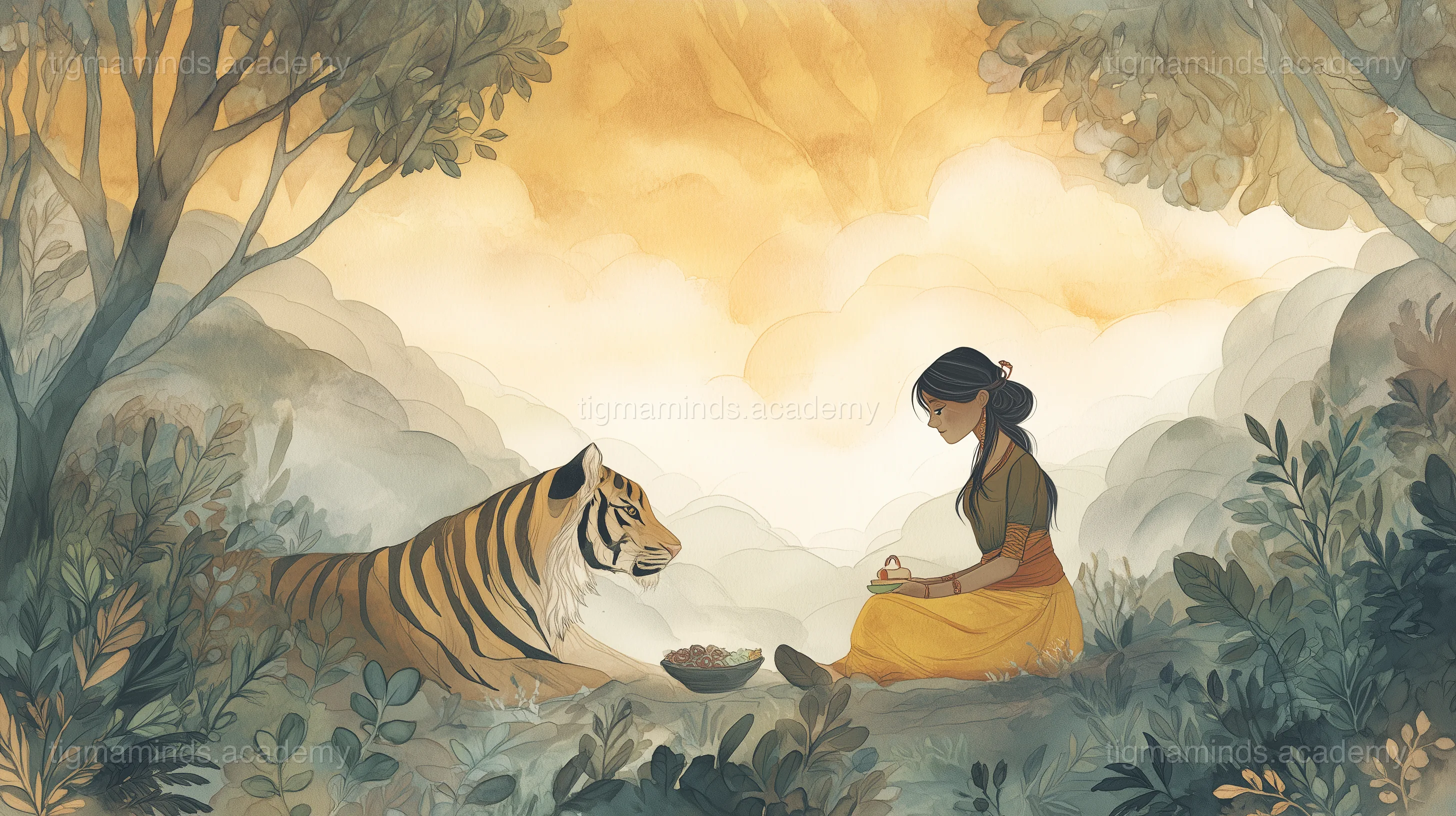
The Sick Grandfather
In a village high in the green hills of Nagaland, a girl named Licha lived with her grandfather, who was the village storyteller. He knew every tale — about the hornbill and the moon, about the rivers and the mountains, about the spirits who lived in the old stones. But now he was very sick, and his voice had become a whisper.
The village healer examined him and said, "I can make a medicine, but it needs one rare ingredient — a single whisker from a living tiger. Without it, the medicine has no power."
Licha's heart sank. Tigers lived in the deep forest below the village. They were fierce and proud, and no one went near them.
"I will get the whisker," said Licha.
The healer looked at her sadly. "Child, the tiger will not give you a whisker just because you ask. You cannot take it by force — the tiger is stronger. You cannot trick the tiger — the tiger is cleverer. There is only one way."
"What way?" asked Licha.
"Patience," said the healer. "The long, slow kind."
The First Month
Licha walked down the hill to the edge of the forest where a great Bengal tiger was known to live. She carried a bowl of warm rice. She placed it on a rock at the forest's edge, sat down twenty paces away, and waited.
The tiger did not come. She heard him growling deep in the trees, warning her away. She left the rice and went home.
The next day, she did the same. And the next. And the next. For a full month, Licha brought warm rice to the rock every morning. Sometimes the tiger ate it after she left — she could see his paw prints in the mud. Sometimes he didn't. But Licha never missed a day.
The Second Month
In the second month, the tiger began to appear. Not close — just a flash of orange between the trees, two amber eyes watching from the shadows. Licha sat very still, humming a song her grandfather used to sing. She did not look directly at the tiger, because her grandfather had taught her that staring is a challenge, and looking away is a gift.
By the end of the second month, the tiger came to the rock while Licha was still there. He ate the rice ten paces from her. She could hear him chewing. She could see his stripes ripple as he breathed. Her heart pounded, but she stayed still.
The Third Month
In the third month, the tiger sat down beside the rock after eating. He did not growl. He watched Licha with calm golden eyes, and she watched the sky. They sat in silence — the girl and the tiger — as the morning mist burned away and the birds sang.
One morning, the tiger walked over and lay down near Licha's feet. His great striped body was warm, and his breath smelled of the forest. Licha, very slowly, reached out and rested her hand on his neck. The tiger did not flinch. He closed his eyes.
"Great tiger," Licha whispered. "My grandfather is sick. The healer says a single whisker from your face can save him. I would never take it without asking. Will you give me one?"
The tiger opened his eyes and looked at her for a long moment. Then he lowered his enormous head and pressed his face against her open palm. Licha gently took hold of one long whisker and pulled. It came away with a soft tik, like a thread snapping.
"Thank you," she said. The tiger blinked, rose, and walked back into the forest without a sound.
The Medicine
Licha ran up the hill with the whisker clasped in her fist. The healer took it, held it to the light, and smiled. "This is a true whisker, freely given. The medicine will work."
She brewed the medicine that afternoon, and by evening, Licha's grandfather sat up for the first time in weeks. By the next morning, his voice was back — still rough, but strong enough to tell a story.
"Which story shall I tell?" he asked.
"Tell the one about the girl and the tiger," said Licha.
Her grandfather smiled. "I don't know that one."
"You will," said Licha. "I'll teach it to you."
The Lesson of Patience
The people of Nagaland still tell this story when someone is impatient or wants to take a shortcut. You cannot rush trust, they say. Trust is built the way Licha built it — one bowl of rice, one quiet morning, one gentle song at a time. The tiger did not give his whisker because Licha was brave. He gave it because she was patient.
And somewhere in the green hills, a tiger still comes to a certain rock at dawn, looking for a bowl of warm rice and the sound of a girl's song.
The end.
Choose your level. Everyone starts with the story — the code gets deeper as you go.
Here is a taste of what Level 1 looks like for this lesson:
import numpy as np
import matplotlib.pyplot as plt
animals = ["Tiger", "Human", "Bat", "Dolphin"]
touch = [90, 10, 5, 0]
hearing = [65, 40, 95, 98]
vision = [80, 90, 15, 30]
x = np.arange(len(animals))
w = 0.25
plt.bar(x - w, touch, w, label="Touch")
plt.bar(x, hearing, w, label="Hearing")
plt.bar(x + w, vision, w, label="Vision")
plt.xticks(x, animals)
plt.ylabel("Relative sensitivity (%)")
plt.title("Which Sense Does Each Animal Rely On?")
plt.legend()
plt.show()This is just the first of 6 coding exercises in Level 1. By Level 4, you will build: Map Animal Sensory Ranges.
By Level 4, enrolled students build: Map Animal Sensory Ranges
Free
Level 0: Listener
Stories, science concepts, diagrams, quizzes. No coding.
You are here
Level 0 is always free. Coding levels (1-4) are part of our 12-Month Curriculum.
What whiskers can feel — sensory systems and haptic technology.
The big idea: "The Tiger's Whisker" teaches us about Animal Anatomy & Sensory Systems — and you don't need to write a single line of code to understand it.
Mechanoreceptors are sensory cells that respond to mechanical stimulation — pressure, stretch, vibration, or touch. They are found throughout the animal kingdom, from the simplest invertebrates to humans. In your skin alone, there are at least four distinct types of mechanoreceptors, each tuned to different aspects of touch: Merkel cells detect sustained pressure, Meissner's corpuscles detect light fluttering touch, Ruffini endings detect skin stretch, and Pacinian corpuscles detect rapid vibration.
The mechanism is elegantly simple: mechanical force deforms the cell membrane, which opens ion channels — tiny protein gates that allow charged atoms (ions) to flow across the membrane. This ion flow generates an electrical signal called a receptor potential. If the signal is strong enough, it triggers a nerve impulse (action potential) that travels along nerve fibers to the brain. The entire process — from physical touch to electrical signal — takes less than a millisecond.
A tiger's whiskers (vibrissae) are surrounded by a dense cluster of mechanoreceptors at their base — up to 200 nerve endings per whisker, compared to about 20 for a human hair follicle. This makes each whisker an extraordinarily sensitive instrument, capable of detecting air currents, vibrations from nearby movement, and the precise dimensions of openings in the dark. The whisker itself is not alive — it is made of keratin, like your hair — but it acts as a lever that amplifies tiny forces and transmits them to the receptors at the base.
Key idea: Mechanoreceptors convert physical touch and vibration into electrical nerve signals by opening ion channels in cell membranes — a tiger's whisker base contains 10 times more of these sensors than a human hair.
Once a mechanoreceptor generates an electrical signal, that signal must travel to the brain for processing. Nerve cells (neurons) transmit information as action potentials — brief electrical pulses of about 0.1 volts that travel along the nerve fiber (axon). These pulses travel at speeds between 1 and 120 meters per second, depending on the type of nerve fiber. The fastest fibers are coated in myelin, a fatty insulating sheath that speeds up transmission — like insulation on an electrical wire.
A crucial property of nerve signals is that they are all-or-nothing: a single action potential is always the same size (about 0.1 volts), regardless of how strong the stimulus is. The brain distinguishes between a gentle touch and a hard push not by the voltage of individual signals, but by the frequency of pulses (stronger stimuli produce more pulses per second) and by how many nerve fibers are activated simultaneously. A light brush might produce 10 pulses per second in a few fibers; a hard push might produce 100 pulses per second in hundreds of fibers.
When whisker signals from a tiger reach the brain, they arrive at a specialized region of the somatosensory cortex called the barrel cortex. Remarkably, each individual whisker has its own dedicated cluster of neurons in the brain — a tiny barrel-shaped column of cells. This means the brain maintains a precise map of whisker positions, allowing the tiger to determine exactly which whisker was deflected and by how much. This spatial mapping is so precise that a tiger can navigate through dense jungle in complete darkness using whisker information alone.
Key idea: Nerve signals travel as all-or-nothing electrical pulses along neurons — the brain reads touch intensity from the frequency of pulses and the number of active fibers, not from signal voltage.
Access all 130+ lessons, quizzes, interactive tools, and offline activities
Tigers are crepuscular and nocturnal hunters — they are most active during twilight and darkness. While their eyes have excellent low-light vision (ab...
Engineers looked at the tiger's whisker system and asked: can we build this? The answer is **robotic whisker sensors** — flexible rods with strain gau...