
A paper boat travels the mighty river, meeting friends along the way.
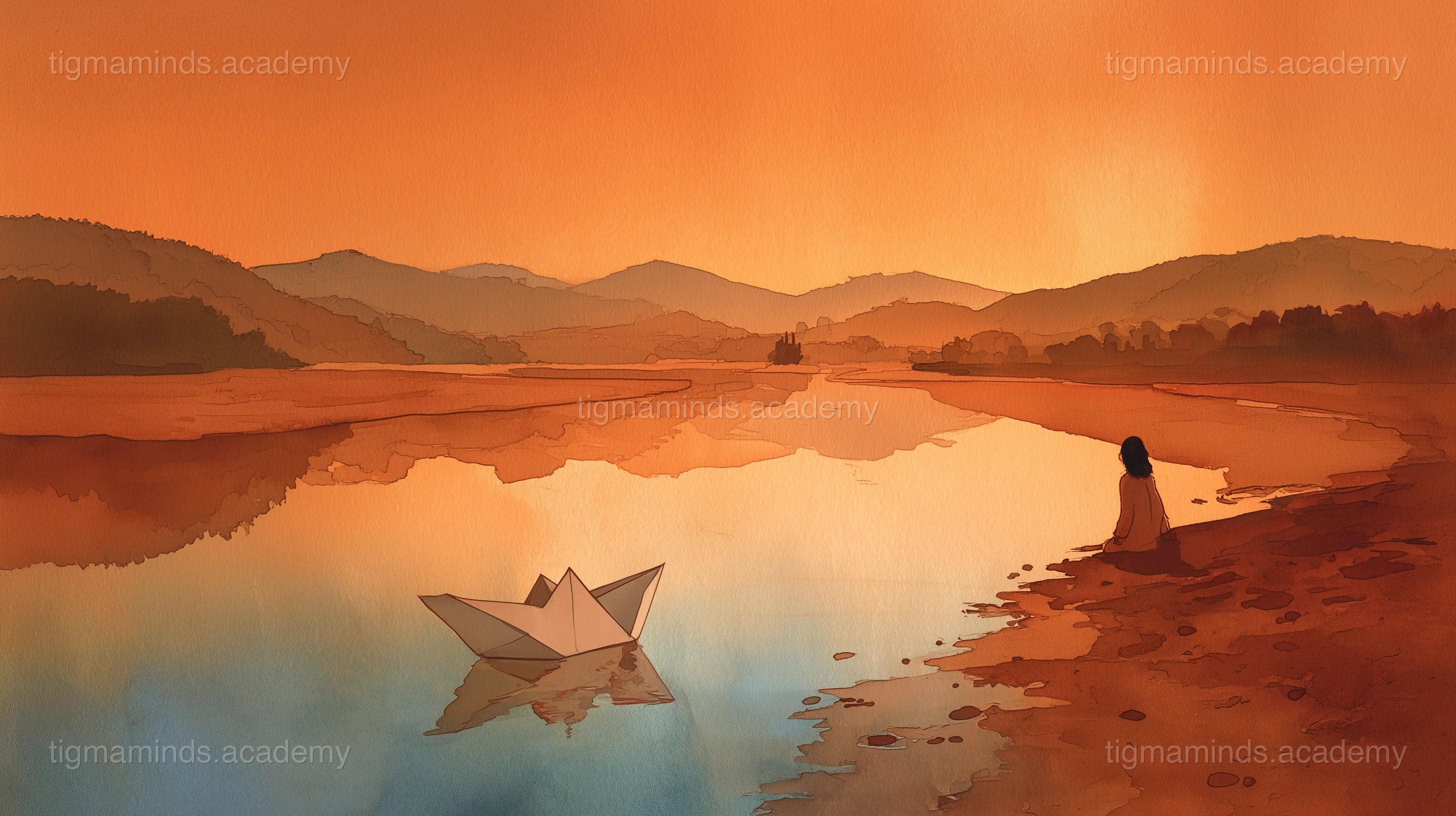
The Launch
On a rainy Tuesday afternoon in Dibrugarh, a girl named Pari folded a piece of notebook paper into a boat. She wrote her name on one side and a message on the other: "If you find this boat, please write your name too."
She walked to the ghat where the Brahmaputra stretched wider than she could see, placed her boat on the muddy water, and gave it a gentle push.
"Go," she whispered. "See the world for me."
The River's Passengers
The paper boat — let's call her Nauka — was terrified at first. The Brahmaputra was enormous. Waves taller than Nauka's mast slapped her sides. River dolphins surfaced and blew spray that nearly sank her.
But Nauka was well-folded, and the paper was thick. She floated.
Near Majuli island, a fisherman's son saw her and scooped her up. He read Pari's message, smiled, and wrote his name — Bhaskar — in wobbly letters. Then he put Nauka back in the water.
Near Tezpur, a woman washing clothes found Nauka caught in the reeds. She added her name — Rima — and set her free.
At Guwahati, a university student plucked Nauka from under the Saraighat Bridge, added Arjun, and threw her back with a laugh.
The Long Middle
By now, Nauka was getting soggy. Her folds were soft, her edges blurred, and the ink was starting to run. But she kept floating. Past Goalpara, where the river turned lazy and wide. Past Dhubri, where the sky was so big it made Nauka dizzy.
Seven more names were added along the way — by children, by fishermen, by a monk who found her near a temple ghat. Nauka carried twelve names now, from twelve different lives, all connected by a single paper boat.
The End of the River
Finally, Nauka reached the place where the Brahmaputra stops being the Brahmaputra and becomes the sea. The water turned salty. The waves grew rough. Nauka knew she couldn't survive the ocean.
But just before the last wave took her, a boy on a fishing trawler scooped her up. He was from Bangladesh, and he couldn't read the names, but he understood the message. He dried Nauka carefully, pressed her flat, and pinned her to the wall of his cabin.
"You came a long way, little boat," he said.
What Nauka Learned
Nauka never made it back to Pari. But she didn't need to. She had carried twelve names across a thousand kilometres of river, connecting strangers who would never meet but who had all, for one moment, held the same small boat in their hands.
And somewhere in Dibrugarh, Pari folded another boat. Because that's the thing about paper boats — you never send just one.
The end.
Choose your level. Everyone starts with the story — the code gets deeper as you go.
Here is a taste of what Level 1 looks like for this lesson:
import numpy as np
import matplotlib.pyplot as plt
# Will a boat float or sink?
# Archimedes: buoyant force = weight of displaced water
hull_volume = 0.5 # m³ (volume of hull below waterline)
boat_mass = 300 # kg (hull + cargo + passengers)
water_density = 1000 # kg/m³
buoyant_force = water_density * 9.8 * hull_volume # Newtons
weight = boat_mass * 9.8 # Newtons
freeboard_ratio = (buoyant_force - weight) / buoyant_force
print(f"Buoyant force: {buoyant_force:.0f} N")
print(f"Boat weight: {weight:.0f} N")
print(f"Floats? {'Yes!' if buoyant_force >= weight else 'No — sinks'}")
print(f"Safety margin: {freeboard_ratio*100:.1f}%")This is just the first of 6 coding exercises in Level 1. By Level 4, you will build: Simulate Paper Boat Buoyancy and Degradation.
By Level 4, enrolled students build: Simulate Paper Boat Buoyancy and Degradation
Free
Level 0: Listener
Stories, science concepts, diagrams, quizzes. No coding.
You are here
Level 0 is always free. Coding levels (1-4) are part of our 12-Month Curriculum.
A paper boat travels the mighty river, meeting friends along the way.
The big idea: "The Little Boat on the Brahmaputra" teaches us about Fluid Dynamics & Buoyancy — and you don't need to write a single line of code to understand it.
Drop a marble into a bucket of water. It sinks. Now drop a plastic bowl into the same bucket. It floats. Both are heavier than a feather, so weight alone does not decide what floats. The real question is: does the object push aside (displace) enough water to hold itself up?
Here is the rule, discovered by Archimedes around 250 BCE: any object in a fluid feels an upward push equal to the weight of fluid it displaces. That upward push is called the buoyant force. If the buoyant force is at least as large as the object’s weight, the object floats. If the weight wins, the object sinks.
Now think about density — how much mass is packed into a given volume. Water’s density is about 1,000 kg/m³. A solid steel bolt has a density of 7,800 kg/m³ — almost 8 times water. It sinks. But shape the same steel into a hollow hull with lots of air inside, and the average density (total mass divided by total volume, including the air) drops below 1,000 kg/m³. The hull floats.
This is exactly how traditional Brahmaputra boats work. A hollowed-out log (অসমীয়া নাও, Assamese nao) encloses a pocket of air. Wood plus air together are less dense than water. If the boat springs a leak, water replaces air, the average density rises, and the boat sinks lower. This is why bailing water out of a leaking boat is a matter of survival — you are literally fighting to keep the average density below water’s.
Check yourself: A steel ship weighing 50,000 tonnes floats, but a 1 kg steel bolt sinks. Both are steel. Why does one float and the other sink? (Answer: the ship is hollow — its hull encloses an enormous volume of air. The average density of ship + air is far below water’s density. The bolt is solid steel, density 7,800 kg/m³, much above water.)
Key idea: An object floats when the buoyant force (equal to the weight of water it displaces) matches or exceeds the object’s weight. Hollow hulls work because they trap air, lowering the average density below water’s 1,000 kg/m³.
Imagine pushing a flat dinner plate through water versus pushing a knife edge-first. The plate smacks into the water and stops almost immediately. The knife slices through. The difference is drag — the resistance force water exerts on a moving object. Hull shape controls how much drag a boat produces, and that controls how fast it can go and how much fuel (or muscle) it needs.
There are three basic hull cross-sections, each with a trade-off:
Why does shape affect drag so much? Drag has two main parts: friction drag (water rubbing along the hull surface) and form drag (energy wasted pushing water out of the way and making waves). A pointed, streamlined bow reduces form drag because it gently redirects water to the sides instead of slamming into it. Brahmaputra boatmen figured this out centuries ago — their traditional boats have long, gently tapered bows even though nobody ever wrote a fluid dynamics equation.
Prediction you can test: Make two aluminum-foil boats — one wide and flat, one narrow with a pointed front. Push both across a tub of water with equal force. The narrow one should glide farther (less drag). Now load coins into each. The flat one should hold more before sinking (more stability). You have just discovered the fundamental trade-off in boat design: stability and cargo capacity versus speed and efficiency.
Key idea: Every hull shape is a trade-off. Flat bottoms are stable but slow. V-hulls cut waves but carry less. Round bottoms have the least drag but need a keel to stop rolling. Brahmaputra boats use flat or gently curved hulls for stability in shifting currents.
Access all 130+ lessons, quizzes, interactive tools, and offline activities
Pari’s paper boat in our story drifted downstream effortlessly — the current carried it. But what if she wanted to travel *upstream*? That means fight...
Most rivers have a single channel that stays roughly in place from year to year. The Brahmaputra is different. It is a **braided river** — instead of ...