
How the great hornbill earned its golden crown by listening, not fighting.
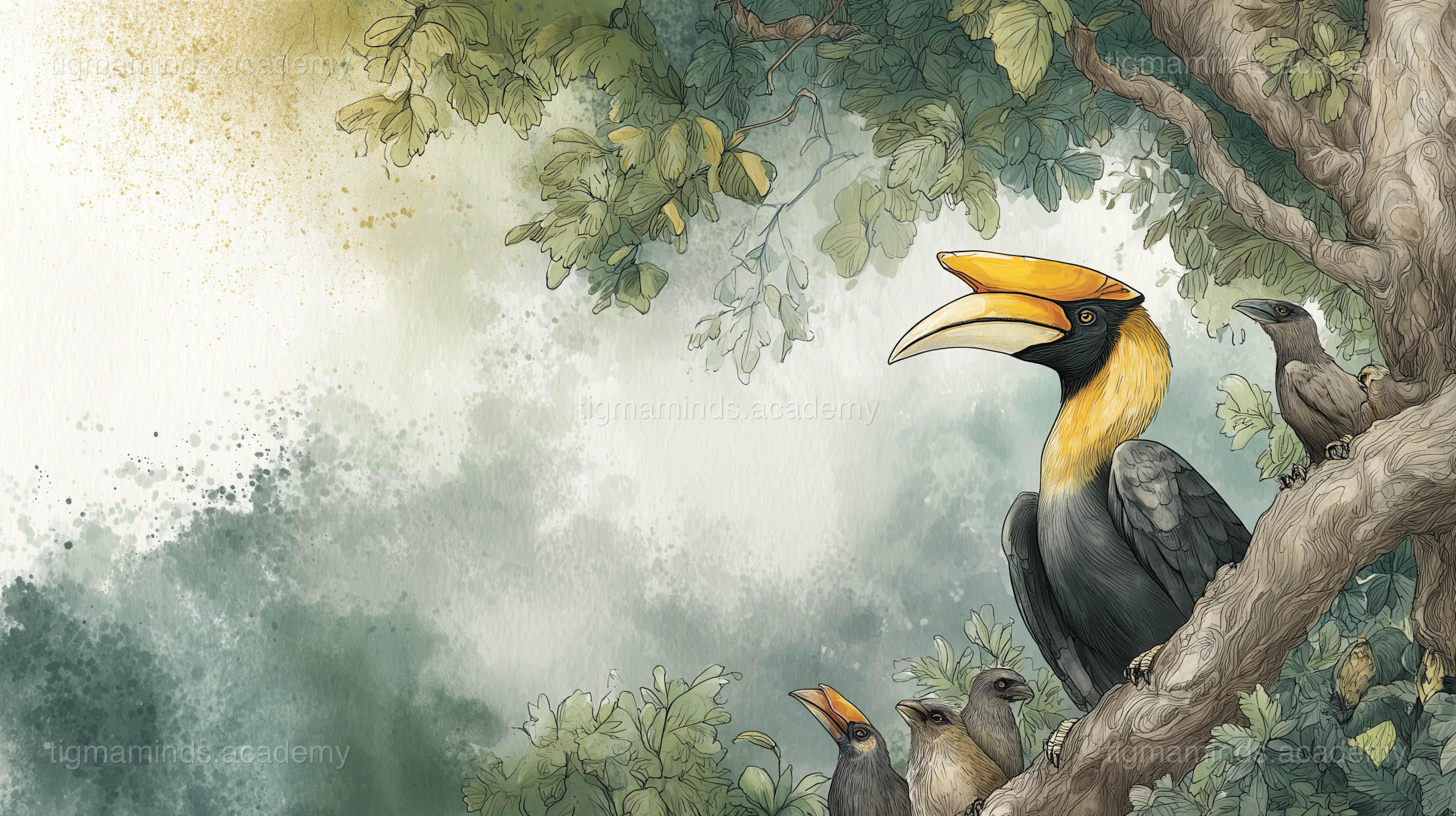
The Forest Without a King
In the forests of Nagaland, where the trees grow so tall they tickle the clouds, the animals once had no king. Every decision was an argument. The tiger wanted to hunt more. The deer wanted more meadows. The monkeys wanted more fruit trees. Nobody agreed on anything.
"We need a king," said the old elephant. "Someone wise enough to listen to everyone."
"I should be king!" roared the tiger. "I am the strongest."
"I should be king!" trumpeted the elephant. "I am the biggest."
"I should be king!" hissed the snake. "I am the oldest."
The Contest
The animals decided to hold a contest. Whoever could solve the forest's biggest problem would become king. And the biggest problem was this: the river had stopped flowing.
The tiger tried to scare the river into flowing by roaring at it. The river didn't care. The elephant tried to push the water with his trunk. The water just splashed and stayed. The snake tried to dig a new channel, but the ground was too hard.
Nobody could fix it.
The Hornbill's Way
A great hornbill named Vokho had been watching quietly from the tallest tree. While everyone else was trying to force the river, Vokho had been listening.
He flew upstream — past the arguing animals, past the dry riverbed, past the silent forest — until he found the problem. A massive landslide had blocked the river with a wall of mud and rocks.
Vokho couldn't move the rocks. He wasn't strong enough. But he remembered something his mother had taught him: "When you can't do something alone, ask for help — and ask nicely."
Vokho flew to the woodpeckers. "Friends, can you drill through the wood caught in the rocks?" The woodpeckers said yes. He flew to the otters. "Friends, can you dig channels under the mud?" The otters said yes. He flew to the rain clouds. "Friends, can you soften the earth?" The clouds said yes.
Together, the woodpeckers drilled, the otters dug, the rain softened, and slowly — then suddenly — the river broke free and flowed again.
The Crown
The animals were amazed. "The hornbill fixed the river!" they said. "But he didn't use strength or size."
"No," said the old elephant, smiling. "He used something better. He listened. He asked. He brought us together. That is what a king does."
The forest spirits heard the elephant's words and placed a golden casque on Vokho's head — a crown made of sunlight and resin that would be worn by every hornbill born after him.
To this day, the great hornbill wears its golden crown through the forests of Nagaland. And the Naga people honour it as a symbol of wisdom — not the wisdom of knowing everything, but the wisdom of knowing when to listen.
The end.
Choose your level. Everyone starts with the story — the code gets deeper as you go.
Here is a taste of what Level 1 looks like for this lesson:
# How far does a hornbill carry seeds?
import numpy as np
# A hornbill eats a fig, flies, and drops the seed
flight_speed_kmh = 50 # km/h
gut_retention_hours = 0.5 # how long seed stays inside
dispersal_km = flight_speed_kmh * gut_retention_hours
print(f"Seed dispersal distance: ${dispersal_km} km")
# What if we model many flights?
np.random.seed(42)
distances = np.random.uniform(0.5, 12, size=100) # km
print(f"Average dispersal: ${distances.mean():.1f} km")
print(f"Maximum dispersal: ${distances.max():.1f} km")
# A tree without hornbills: seeds fall 0 km from parentThis is just the first of 6 coding exercises in Level 1. By Level 4, you will build: Analyze Hornbill Nesting and Seed Dispersal Data.
By Level 4, enrolled students build: Analyze Hornbill Nesting and Seed Dispersal Data
Free
Level 0: Listener
Stories, science concepts, diagrams, quizzes. No coding.
You are here
Level 0 is always free. Coding levels (1-4) are part of our 12-Month Curriculum.
How the great hornbill earned its golden crown by listening, not fighting.
The big idea: "The Hornbill's Crown" teaches us about Ornithology & Animal Behavior — and you don't need to write a single line of code to understand it.
Look at a great hornbill and the first thing you notice is that massive yellow-and-black structure sitting on top of its bill. It looks heavy, like a helmet made of bone. But here is the surprise: pick one up (researchers have) and it weighs almost nothing. How can something that big be that light?
The answer is the same trick engineers use in bicycle helmets, airplane wings, and cardboard boxes: make it hollow with internal supports. The casque is made of keratin — the exact same protein that forms your fingernails and hair. The outer walls are thin but stiff. Inside, a network of bony struts criss-crosses the space like the framework of a building, creating air pockets. This is called a cellular structure. The material sits only where stress is highest (the surface), and is removed where it is not needed (the interior). Maximum strength, minimum weight.
Why does this matter for the bird? A hornbill weighs 2.5–4 kg and needs to fly through dense forest canopy. Every extra gram on its head shifts its centre of gravity forward, making flight harder. Evolution solved this by building a casque that looks imposing (useful for scaring rivals and attracting mates) while weighing very little (essential for flight). The Helmeted Hornbill is the one exception — its casque is solid, ivory-like material, making it the only hornbill with a truly heavy head. Males of that species crash into each other casque-first in midair battles, so the solid structure works as a battering ram.
Check yourself: A hollow tube is stronger per gram than a solid rod of the same material. Can you think of other examples where nature or engineering uses hollow structures for strength? (Hint: bamboo, bird bones, bicycle frames, the Eiffel Tower’s legs.)
Key idea: The hornbill casque is made of keratin (like your fingernails), built hollow with internal struts — the same lightweight-but-strong engineering found in bike helmets and airplane wings.
Imagine locking yourself inside a room for three months. No going out. Someone passes food to you through a tiny slit in the wall. That is exactly what a female hornbill does every breeding season — and it is one of the most extraordinary nesting strategies in the animal kingdom.
Here is how it works. The female finds a large natural cavity in a tree trunk (hornbills cannot excavate their own holes — they rely on existing ones). She climbs inside and then seals the entrance from the inside using mud, droppings, and chewed fruit pulp, leaving only a narrow vertical slit — just wide enough for the male’s bill tip to poke through. She stays sealed inside for 2–4 months, laying eggs, incubating them, and raising the chicks until they are strong enough to survive outside.
During this entire time, the male is the sole provider. He flies back and forth 50–70 times per day, carrying fruits (mostly figs) to the slit and passing them to the female inside. If the male dies or is unable to return, the female and chicks usually die too — which is why hornbills mate for life and defend their territory fiercely.
Why seal at all? The mud wall is a fortress. Snakes, monitor lizards, and climbing predators cannot get through it. The slit is too narrow for any predator to reach inside. The cavity also maintains a stable temperature and humidity — a natural incubator. When the chicks are nearly ready to fledge, the female breaks out of the seal. In some species, the chicks then reseal the entrance themselves and continue being fed until they are fully feathered.
Prediction you can test: Large old trees with natural cavities are rare. If logging removes old-growth trees, hornbills lose nesting sites. This is a major conservation problem — no old trees, no hornbills.
Key idea: The female hornbill seals herself inside a tree cavity for months, protected by a mud wall, while the male delivers food through a tiny slit — an extreme strategy to protect eggs and chicks from predators.
Access all 130+ lessons, quizzes, interactive tools, and offline activities
A **keystone** is the wedge-shaped stone at the top of a stone arch. Remove it and the entire arch collapses. A **keystone species** works the same wa...
Hornbills cannot speak. But they have a remarkably rich communication system that uses **sound**, **visual displays**, and even the **noise of their w...