
Rain is every color if you know how to look.
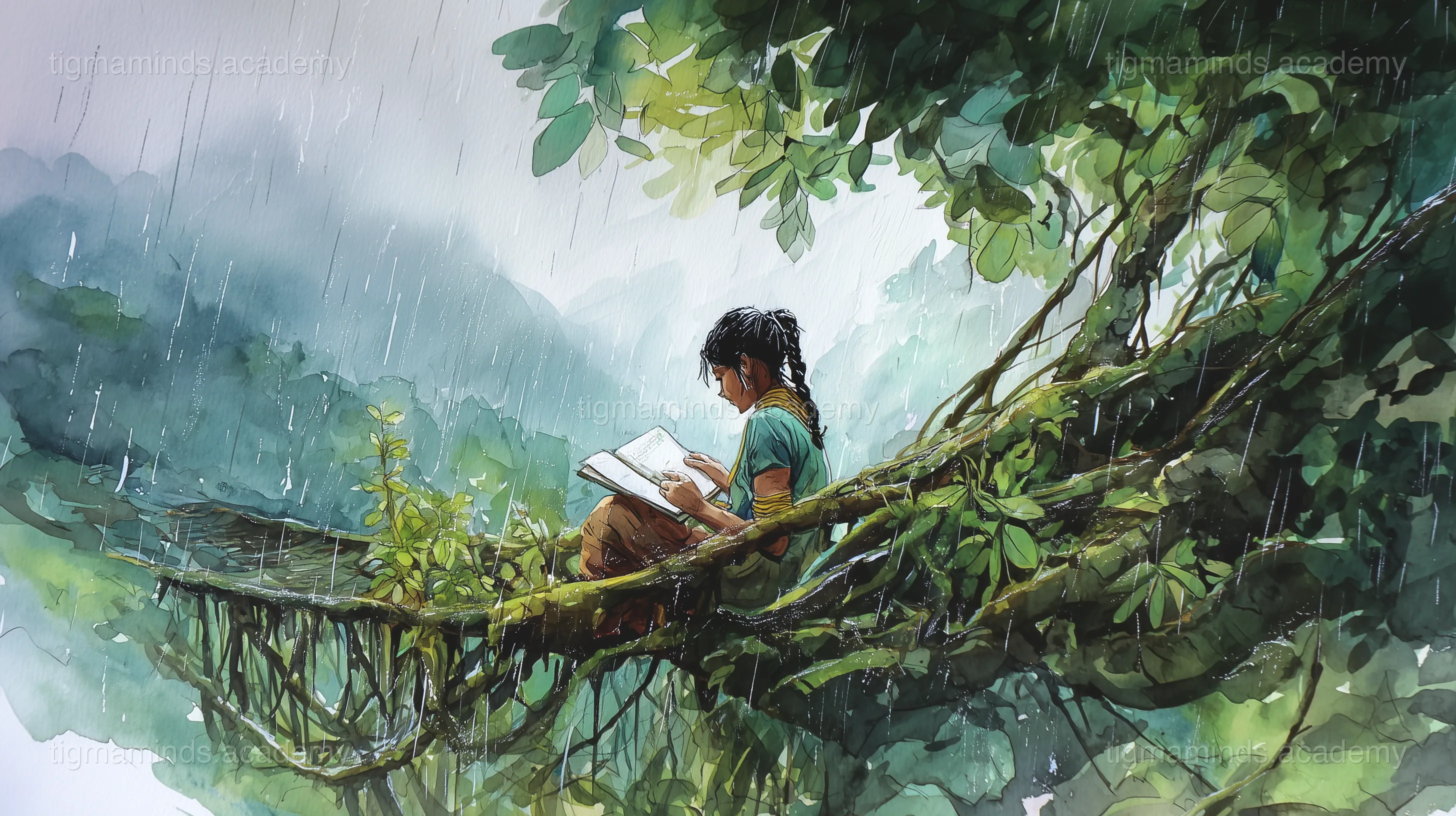
The Wettest Place
In Cherrapunji, Meghalaya — one of the wettest places on Earth — it rained so much that most people had forgotten what a dry day looked like. The roads were rivers. The gardens were ponds. And every child owned three umbrellas.
But a girl named Bansara owned none.
"Why don't you carry an umbrella?" her classmates asked.
"Because umbrellas are for people who don't want to see the rain," said Bansara. "And I want to see everything."
The Sketchbook
Bansara carried a sketchbook wrapped in a plastic bag. Every day after school, while other children ran home to stay dry, Bansara sat under the sacred grove near the living root bridge and painted the rain.
Most people thought rain was grey. Bansara knew better.
Morning rain was silver, thin and bright like needles. Afternoon rain was green, filtered through a million leaves. Evening rain was gold, lit by the last sunlight. And night rain — her favourite — was blue, so deep and quiet it felt like painting silence.
Her sketchbook filled up with rain in every colour. Sixty-four paintings. Sixty-four kinds of rain. And still she found new ones.
The Visitor
One day, a man from the city came to Cherrapunji. He was writing a book about weather and wanted to photograph the rain. He carried expensive cameras and complained constantly about getting wet.
"This is terrible," he said, wiping his lens. "How do you people live with this?"
Bansara showed him her sketchbook.
The man went quiet. He turned the pages slowly — silver rain, green rain, gold rain, blue rain. Rain on tin roofs. Rain on living bridges. Rain through spiderwebs. Rain caught in a child's cupped hands.
"I came here to photograph rain," he said, "and I've been looking at it wrong the entire time."
The Exhibition
The man helped Bansara display her paintings at the village school. People came from neighbouring villages to see them. A teacher from Shillong drove two hours in the rain to visit.
"You've done something no camera can do," the teacher told Bansara. "You've shown us what rain feels like, not just what it looks like."
Bansara smiled. "I just painted what was already there," she said. "Everyone else was too busy hiding from it to notice."
The Colours of Rain
Bansara still lives in Cherrapunji. She still doesn't own an umbrella. And her sketchbook now has over two hundred paintings of rain — each one different, each one proof that the world is never just one colour, even when the sky is grey.
If you ever visit Cherrapunji and it's raining — which it almost certainly will be — look carefully. The rain isn't grey. It's silver, green, gold, and blue. You just have to stop running from it long enough to see.
The end.
Choose your level. Everyone starts with the story — the code gets deeper as you go.
Here is a taste of what Level 1 looks like for this lesson:
import numpy as np
import matplotlib.pyplot as plt
# Your first data analysis with Python
data = [45, 52, 38, 67, 41, 55, 48] # measurements
mean = np.mean(data)
plt.bar(range(len(data)), data)
plt.axhline(mean, color='red', linestyle='--', label=f'Mean: {mean:.1f}')
plt.xlabel("Sample")
plt.ylabel("Value")
plt.title("Color Science & Pigments — Sample Data")
plt.legend()
plt.show()This is just the first of 6 coding exercises in Level 1. By Level 4, you will build: Build a Color Mixing Simulator.
By Level 4, enrolled students build: Build a Color Mixing Simulator
Free
Level 0: Listener
Stories, science concepts, diagrams, quizzes. No coding.
You are here
Level 0 is always free. Coding levels (1-4) are part of our 12-Month Curriculum.
Rain is every color if you know how to look.
The big idea: "The Girl Who Painted Rain" teaches us about Color Science & Pigments — and you don't need to write a single line of code to understand it.
A rainbow is not an object — it is an optical phenomenon created by the interaction of sunlight with millions of water droplets. When a ray of white sunlight enters a spherical raindrop, it slows down (because water has a refractive index of about 1.33, compared to 1.0 for air) and bends — a process called refraction. Different wavelengths of light bend by slightly different amounts: violet bends the most (shortest wavelength, ~380 nm) and red the least (longest wavelength, ~700 nm).
Inside the droplet, the light reflects off the back surface and exits through the front, refracting again as it leaves. The total deviation (the angle between the incoming and outgoing rays) is about 138° for red light and 140° for violet. This means each color exits at a slightly different angle, spreading white light into the familiar spectrum. The observer sees red from droplets higher in the sky (at about 42° from the anti-solar point) and violet from droplets lower in the sky (at about 40°).
Every rainbow is unique to the observer. Because each person stands at a different position relative to the sun and the rain, they receive light from a different set of droplets. Two people standing side by side see rainbows from slightly different droplets — you can never walk toward a rainbow because it moves with you. The rainbow is always centered on the anti-solar point (the point directly opposite the sun from your perspective), which is why you never see a rainbow when the sun is higher than 42° above the horizon.
Key idea: Rainbows form when sunlight refracts, reflects, and disperses inside spherical raindrops — each observer sees their own unique rainbow from a different set of drops.
Watercolor painting is applied physics. When a loaded brush touches paper, three forces compete: gravity (pulling the water downward), surface tension (holding the water together as a droplet), and capillary action (pulling the water into the paper fibers). The balance between these forces determines whether the paint pools, spreads, or gets absorbed — and skilled watercolorists manipulate these forces with every brushstroke.
Capillary action is particularly important. Paper is made of cellulose fibers with microscopic gaps between them. Water molecules are attracted to cellulose (adhesion) and to each other (cohesion). The adhesive force pulls water into the gaps between fibers, and cohesion drags more water along behind it. The narrower the gap, the stronger the capillary pull — this is why watercolor paper with finer fibers absorbs paint more slowly and evenly, giving the artist more control.
The "bloom" effect — where wet paint spreads unpredictably into adjacent wet areas — is caused by osmotic flow. When two pools of different concentration meet on wet paper, water flows from the dilute area toward the concentrated area (trying to equalize concentration). This carries pigment particles along with it, creating the soft, feathered edges that give watercolor its distinctive character. Professional watercolorists exploit this physics deliberately: they control exactly how wet the paper is, how concentrated the paint is, and where wet and dry areas meet to produce effects that look spontaneous but are actually carefully engineered.
Key idea: Watercolor behavior is governed by capillary action, surface tension, and osmotic flow — artists control paint by manipulating these physical forces.
Access all 130+ lessons, quizzes, interactive tools, and offline activities
There are two fundamentally different ways to mix colors, and confusing them is the most common mistake in understanding color. Additive mixing applie...