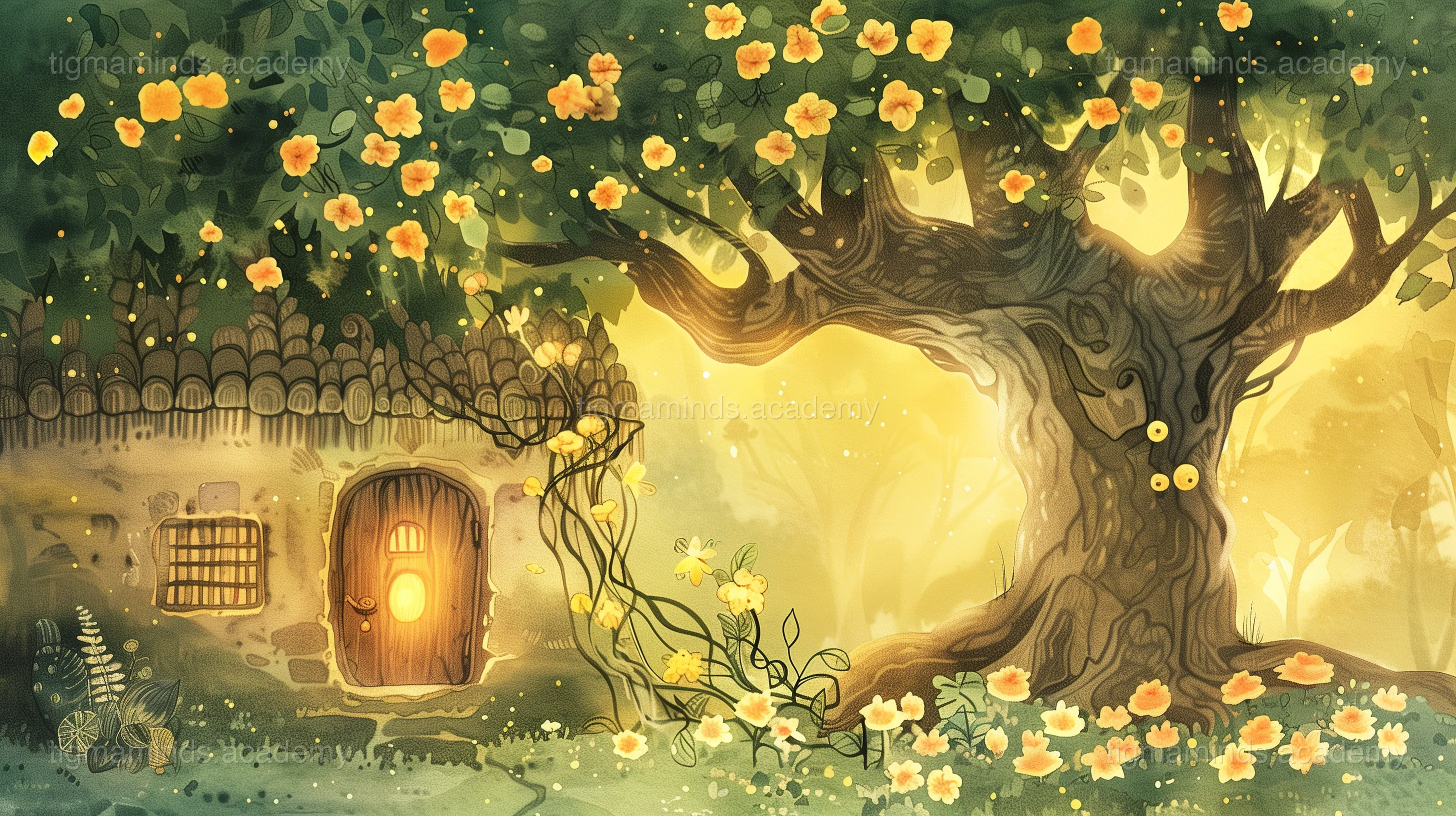
Tejimola — The Girl Who Became a Plant
Plant Biology & Genetics

Tejimola — The Girl Who Became a Plant

A kind girl whose spirit refused to be silenced, growing back as tulsi, gourd, lotus, and champa tree.

Plant Biology & Genetics12-Month Curriculum 12h

The Story

The Girl by the River

In a village where the Brahmaputra bent gently around a grove of banana trees, there lived a girl named Tejimola. She was perhaps eleven years old, with dark eyes that noticed everything and hands that were never still — always planting something, always tending something, always coaxing green things out of brown earth.

Tejimola was the kind of child that the whole village loved. She fed the sparrows that gathered on the bamboo fence outside her house, scattering leftover rice for them each morning until they knew the sound of her footsteps and came before she called. She sang to the fish in the river — nonsense songs, made-up songs, songs with no words at all — and the fishermen swore the catch was always better near the spot where Tejimola sat on the bank. She never passed a person on the path without smiling, and her smile was the kind that made people stand a little straighter and feel that the day might turn out well after all.

Her mother had died when Tejimola was very young — so young that she remembered only a warmth, a scent of mustard oil and jasmine, and a voice singing the same lullaby that Tejimola now sang to the sparrows. Her father, a merchant who traded in cotton and spices, loved Tejimola more than anything in the world. He braided her hair before school. He brought her seeds from every town he visited — sunflower seeds from the plains, marigold seeds from the hill markets, a small packet of tulsi seeds wrapped in a banana leaf from a temple in the south.

But the merchant was often away. The river trade took him downstream for weeks at a time, and during those absences, Tejimola was left in the care of her stepmother.

The Stepmother

The stepmother was not wicked in the way of fairy tales — not at first. She was a woman who had married a man she did not love for the security of his house, and she resented the child who reminded her every day that she was not the first wife, not the first love, not the one who mattered most. Tejimola's kindness, her effortless goodness, her way of making the whole village smile — these things felt to the stepmother like accusations. Like mirrors held up to show her own smallness.

When the merchant was home, the stepmother was polite. She cooked well. She kept the house clean. She spoke to Tejimola in a voice that was not warm but was not cold either — a voice like standing water, neither flowing nor frozen.

But when the merchant left on his longest journey — three months down the Brahmaputra to the markets of the south — something in the stepmother shifted. The pretence of courtesy fell away like a leaf in autumn.

She gave Tejimola the heaviest chores. She fed her last and least. She forbade her from singing, from sitting by the river, from feeding the sparrows. "You waste rice on birds," she said, "while I stretch every grain to keep this house fed."

Tejimola bore it quietly. She did the chores without complaint. She ate what she was given. She stopped singing — but the sparrows still came, and the stepmother hated them for it.

One evening, the stepmother found Tejimola in the garden, kneeling in the dirt, planting tulsi seeds by moonlight. The girl's hands were covered in soil, and she was whispering to the seeds the way she whispered to everything — gently, encouragingly, as if the seeds were alive and frightened and needed to be told that the world was safe.

Something broke in the stepmother. She seized Tejimola by the arm, dragged her to the far corner of the garden where the soil was dark and loose, and buried her there — in the earth that Tejimola had loved so well.

The First Growing

The village searched for Tejimola. The stepmother told them the girl had run away — perhaps followed her father downstream, perhaps wandered into the forest. The neighbours searched the river, the forest paths, the market towns. They found nothing.

But three days after Tejimola disappeared, a tulsi plant pushed through the soil in the far corner of the garden. It grew with impossible speed — ankle-high by morning, knee-high by noon, waist-high by evening. Its leaves were dark green and glossy, larger than any tulsi the village had ever seen, and they gave off a fragrance so strong and sweet that people passing on the road would stop and breathe deeply and feel, for a moment, an inexplicable sadness.

The stepmother knew. She knew the way you know a dream is about to become a nightmare. She pulled the tulsi out by its roots — every stem, every leaf, every thread of root she could find. She burned the remains and scattered the ashes in the river.

The Second Growing

A week later, on the muddy riverbank where the fishermen moored their boats, a gourd vine appeared. It grew along the ground with a purpose that seemed almost deliberate, its tendrils reaching toward the village, its leaves broad and shaped like open hands. Within days, it had covered the bank in green, and gourds hung from its stems — pale green, smooth, each one slightly warm to the touch, as if a small sun lived inside.

The fishermen were delighted. The village children picked the gourds and carried them home. But the stepmother saw the vine and went cold. She tore it down in the night — every stem, every root, every gourd. She hacked the earth with a hoe until nothing remained.

The Third Growing

In the pond behind the temple, where the water was still and dark and reflected the sky like a mirror, a lotus bloomed. It was white — not the pink of ordinary lotus but a pure, luminous white that seemed to glow in the early morning mist. Its petals were perfect. Its fragrance drifted across the village like a whispered name.

The temple priest said he had never seen a lotus bloom out of season. The old women of the village touched their foreheads and murmured prayers. The children gathered at the pond's edge and stared.

The stepmother came at midnight with a bamboo pole and pulled the lotus from the water. She crushed it underfoot. She threw the remains into the forest.

The Fourth Growing

And then the champa tree grew.

It appeared not in the garden, not on the riverbank, not in the pond — but in the centre of the village courtyard, where the path forked and the banyan tree cast its ancient shade. It grew from bare, packed earth where nothing had grown for as long as anyone remembered. It grew fast — a sapling at dawn, a young tree by evening, a full-grown champa by the end of the week.

Its trunk was straight and strong. Its leaves were dark, glossy, pointed like spearheads. And its flowers — the champa flowers — were the colour of old gold, waxy and perfect, with a fragrance that filled the entire village. Not just the courtyard, not just the lane, but every house, every room, every corner. The scent of champa — warm, sweet, heavy with memory — drifted through open windows and settled on sleeping faces and made people dream of a girl who used to sing to sparrows.

The stepmother came with an axe. She stood before the tree and raised the blade. But the tree was thick now, its bark hard, its roots deep. She struck once and the axe bounced back. She struck again and the handle cracked. She struck a third time and the blade broke clean off and fell at her feet.

The champa tree stood. The flowers bloomed. The fragrance poured out over the village like a benediction.

The Father Returns

Three months after he left, Tejimola's father came home. He walked up the path from the river ghat, tired and dusty, carrying gifts — a silk scarf, a brass lamp, a small wooden box of spices. He saw the champa tree and stopped.

It was beautiful. It was the most beautiful tree he had ever seen. But there was something else — something in the way its branches reached toward him, the way its lowest bough extended like an arm, the way its golden flowers turned their faces in his direction.

He walked to the tree and stood beneath it. A branch — the lowest branch — dipped slowly, gently, impossibly, and its tip brushed his face. The leaves were cool against his cheek. The flowers breathed their scent into his hair.

And he heard — not with his ears but with something deeper, something in the marrow — a voice he knew. A voice that had sung to sparrows and whispered to seeds and laughed at the fishermen's jokes and said goodnight to every star.

"Father, I am here. I never left."

The merchant fell to his knees beneath the champa tree and wept. The whole village gathered around him. The stepmother was found and sent away — not with violence, but with the quiet, implacable verdict of a community that understood, at last, what had happened.

The Growing That Never Stops

The champa tree still stands in the stories told by grandmothers in Assam. Its roots are deep. Its flowers are golden. Its fragrance reaches every room in the village.

Tejimola's story has been told for centuries — passed from mother to daughter, grandmother to grandchild, teacher to student. It changes slightly with each telling, as all living stories do. But the core remains: a girl who was kind, who was buried, and who refused to stop growing.

Tulsi, gourd, lotus, champa — each form more beautiful than the last. Each time she was torn down, she came back stronger, more radiant, more impossible to ignore. The stepmother could destroy every individual plant, but she could not destroy the force that made them grow. That force was not magic. It was something older and simpler. It was the stubborn, patient, inexhaustible will of a kind heart to exist in the world.

Tejimola's story tells us that kindness cannot be killed. You can bury it. You can uproot it. You can cut it down and burn the remains and scatter the ashes in the river. It will grow back — as tulsi, as gourd, as lotus, as champa — every time, in a new form, more beautiful than before.

The end.

Try It Yourself

Choose your level. Everyone starts with the story — the code gets deeper as you go.

Story Progress

0%

Ready to Start Coding?

Here is a taste of what Level 1 looks like for this lesson:

Level 1: Explorer — Python
# How fast do cells multiply?
import numpy as np
import matplotlib.pyplot as plt

hours = np.arange(0, 168)   # one week
cells = 2 ** (hours / 24)   # doubling daily

plt.figure(figsize=(8, 4))
plt.plot(hours, cells, color='#22c55e')
plt.xlabel('Time (hours)')
plt.ylabel('Number of cells')
plt.title('One cell becomes 128 in a week')
plt.show()
# What if cells divided every 12 hours instead?

This is just the first of 6 coding exercises in Level 1. By Level 4, you will build: Plant Growth Experiment.

By Level 4, enrolled students build: Plant Growth Experiment

Free

Level 0: Listener

Stories, science concepts, diagrams, quizzes. No coding.

You are here

Enrolled

Levels 1-4

Python, NumPy, Matplotlib, real projects, mentorship.

Sign Up Free

Stay Updated

Join Waitlist

Get notified when enrollment opens for your area.

Notify Me

Level 0 is always free. Coding levels (1-4) are part of our 12-Month Curriculum.