The Talking Parrot of Hajo
Language & Communication

The Talking Parrot of Hajo

A parrot that speaks every language.
Language & Communication12-Month Curriculum 12h

The Story

The Hill of Many Prayers

Hajo is a small town in Assam where something remarkable happens every day. On one hill stands Hayagriva Madhava Temple, sacred to Hindus. Nearby rises the Poa Mecca mosque, revered by Muslims. And not far away are ancient sites that Buddhists consider holy. Three faiths, side by side, in a town so small you can walk across it in twenty minutes.

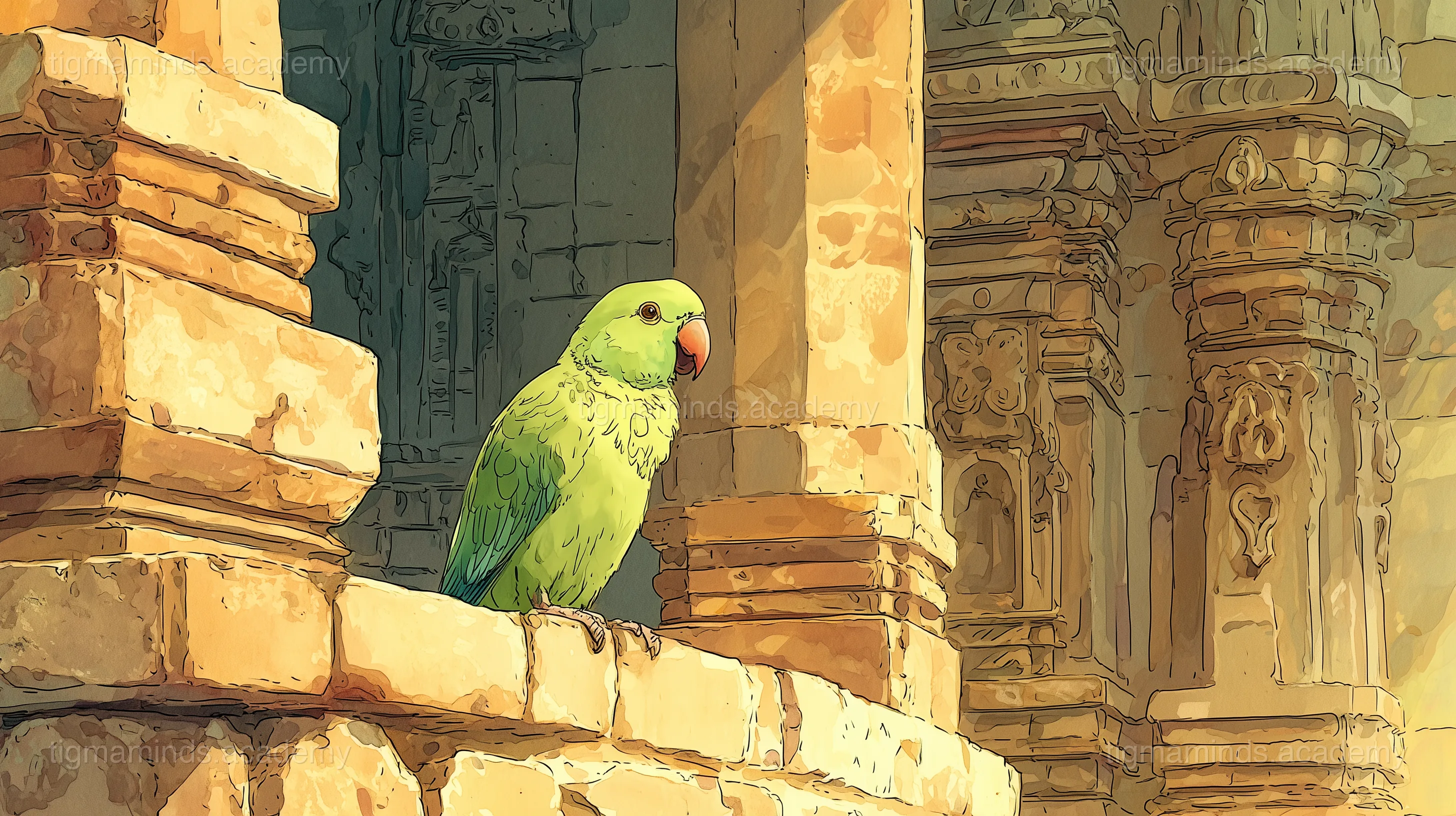
In the old banyan tree between the temple and the mosque, there lived a bright green rose-ringed parakeet named Hira.

Hira was not an ordinary parrot. Most parrots repeat what they hear — a word here, a phrase there. But Hira had an extraordinary memory. She remembered everything.

The Morning Prayers

Every dawn, Hira woke to the azaan — the Muslim call to prayer — floating across the misty air from the mosque. The words were beautiful and rhythmic, and Hira, perched in her banyan tree, listened carefully. Within a week, she could repeat the call perfectly, her parrot voice high and clear in the morning silence.

An hour later, the temple bells rang and the Hindu priest began his morning aarti, chanting verses in Sanskrit. Hira cocked her green head and listened. Within two weeks, she could recite parts of the aarti as well.

And on quiet afternoons, when a group of Buddhist monks visiting from Tawang sat beneath her tree to meditate, Hira heard them chant "Om mani padme hum" in low, steady voices. She learned that too.

Soon Hira had a morning routine: she sang the azaan at dawn, chanted Hindu verses at sunrise, and murmured Buddhist mantras at noon. She was a one-parrot interfaith choir.

The Argument

One day, two boys got into an argument at the base of Hira's tree. Rahim said the azaan was the most beautiful sound in Hajo. Gopal said the temple bells were more beautiful. They argued louder and louder until they were red in the face.

Hira flew down from her branch and landed on the low wall between them. She looked at Rahim and recited a line from the azaan in her clear, bright voice. Then she turned to Gopal and chanted a Sanskrit verse. Then, for good measure, she murmured "Om mani padme hum" and tilted her head as if to say, See? They all sound beautiful.

The boys went quiet. Then Rahim laughed. "The parrot sings everyone's prayers."

"Maybe she knows something we don't," said Gopal.

The Festival of the Parrot

Word spread through Hajo about the talking parrot who knew prayers from every faith. People came to hear her — first from curiosity, then from something deeper. A Muslim grandmother brought her Hindu neighbour to listen together. A Buddhist visitor recorded Hira on his phone and played it for his monastery.

The town began to hold an annual Festival of Harmony near Hira's banyan tree. Families from every faith gathered to share food, tell stories, and listen to the small green parrot who couldn't tell the difference between one prayer and another — because to her, they were all just beautiful sounds made by people she loved.

What Hira Understood

Hira lived in that banyan tree for many years. She never understood the meaning of the words she spoke — she was, after all, a parrot. But perhaps that was the point. She didn't know which prayer belonged to which faith. She didn't know that humans had drawn lines between their ways of reaching the sky. She just heard beautiful sounds and repeated them all, because all of them were worth repeating.

The people of Assam still tell Hira's story when someone asks how Hajo stays peaceful. "We learned from a parrot," they say, smiling. "She taught us that if you listen to everyone's prayers, you realize they're all asking for the same thing — kindness, peace, and a little bit of grace."

The end.

Try It Yourself

Choose your level. Everyone starts with the story — the code gets deeper as you go.

Story Progress

0%

Ready to Start Coding?

Here is a taste of what Level 1 looks like for this lesson:

Level 1: Explorer — Python
import numpy as np
import matplotlib.pyplot as plt

# Your first data analysis with Python
data = [45, 52, 38, 67, 41, 55, 48]  # measurements
mean = np.mean(data)

plt.bar(range(len(data)), data)
plt.axhline(mean, color='red', linestyle='--', label=f'Mean: {mean:.1f}')
plt.xlabel("Sample")
plt.ylabel("Value")
plt.title("Language & Communication — Sample Data")
plt.legend()
plt.show()

This is just the first of 6 coding exercises in Level 1. By Level 4, you will build: Build a Simple Word Recognition Program.

Free

Level 0: Listener

Stories, science concepts, diagrams, quizzes. No coding.

You are here

Enrolled

Levels 1-4

Python, NumPy, Matplotlib, real projects, mentorship.

Sign Up Free

Stay Updated

Join Waitlist

Get notified when enrollment opens for your area.

Notify Me

Level 0 is always free. Coding levels (1-4) are part of our 12-Month Curriculum.