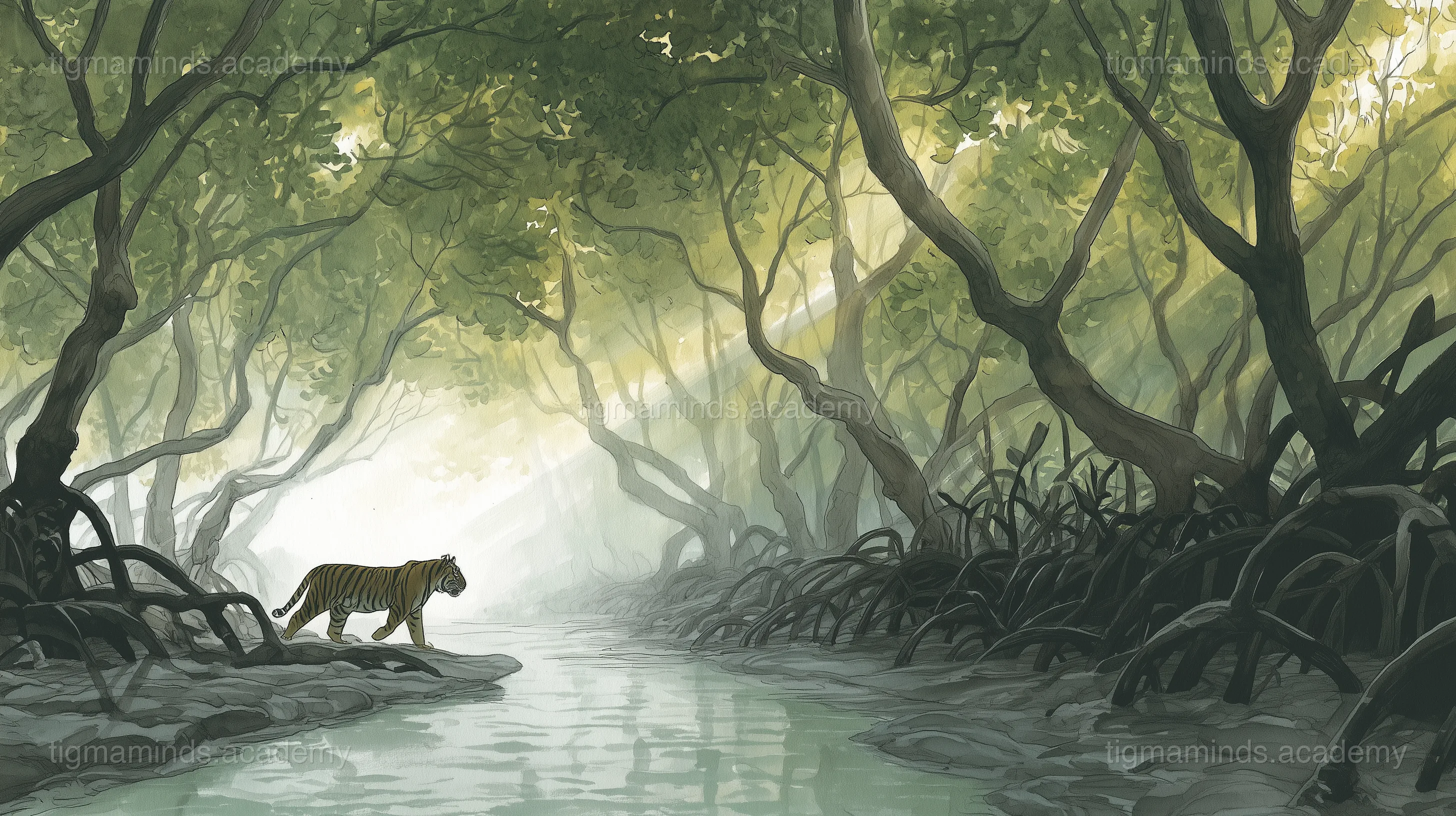
How mangrove trees drink from salt water — osmosis, filtration, and survival at the edge of the sea.
The Forest That Drinks the Sea
Mohona had lived her entire fourteen years at the edge of the world — or at least that is what it felt like. Her father, Debashish Mondal, was a forest ranger stationed at the Sajnekhali watch post in the Sundarbans, the vast mangrove delta where the Ganges, Brahmaputra, and Meghna rivers pour into the Bay of Bengal. Behind their quarters lay a thin strip of packed earth, and beyond that, in every direction, there was nothing but water and trees and silence.
Not the silence of an empty place. The Sundarbans were never empty. At dawn, the brahminy kites circled above the mudflats, their rust-orange wings catching the first light. Mud skippers — small goggle-eyed fish that could walk on their fins — popped in and out of burrows like anxious neighbours. Somewhere in the deeper channels, the Irrawaddy dolphins surfaced with a soft huff of exhaled air, and somewhere deeper still, in the shadows of the dense canopy, a Royal Bengal tiger moved through knee-deep water without making a sound.
But the thing Mohona noticed most was the trees. The mangroves of the Sundarbans were not like the trees she had seen in her grandmother's village near Kolkata. Those trees stood on dry ground with their roots decently buried, the way trees were supposed to behave. The Sundarbans mangroves had no such manners. Their roots rose out of the mud in bizarre, tangled arches — some reaching a metre above the waterline — as if the trees were standing on tiptoe, trying to keep their feet out of the water. Other roots, thin and pale, poked straight up out of the mud like snorkels.
"Why do they grow like that?" Mohona had asked her father when she was small.
"Because they're breathing," he said.
She had thought he was joking. Trees don't breathe — not the way people do. But Debashish was not the joking type. He was a man of careful observations and slow explanations, and when Mohona was old enough, he taught her the truth: the mangrove's world was one of the most hostile environments a tree could face, and every strange feature she saw was an answer to a problem.
The Problem of Salt
The first problem was salt. The Sundarbans sit at the confluence of freshwater rivers and the salty Bay of Bengal. Twice a day, the tides push seawater deep into the delta, flooding the forest floor with water that contains roughly 35 grams of salt per litre — the same salinity as the open ocean. Then the tide recedes, the freshwater flows back, and the salinity drops. Then it rises again. The mangroves live in a world of constant chemical uncertainty.
For most plants, this would be fatal. Salt is a poison. When a normal plant's roots are surrounded by salty water, something terrible happens at the cellular level. The concentration of dissolved salt outside the root is higher than the concentration inside the root cells. Water, obeying the laws of osmosis, flows from the area of lower solute concentration (inside the root) to the area of higher concentration (outside). The plant doesn't absorb water — it loses it. The cells shrivel. The plant wilts and dies, even though it is surrounded by water. It is the botanical equivalent of dying of thirst in the middle of the ocean.
Mohona's father showed her this with a simple experiment. He cut a fresh carrot in half and placed one piece in a cup of tap water and the other in a cup of water saturated with salt. The next morning, the freshwater carrot was firm and plump. The saltwater carrot had gone limp and rubbery — its cells had lost water through osmosis.
"So how do the mangroves survive?" Mohona asked.
Debashish smiled. "They cheat."
Three Strategies for Drinking Salt Water
Over millions of years of evolution, the mangroves of the Sundarbans have developed not one but three strategies for dealing with salt. Different species use different methods, and some use all three at once.
The first strategy is ultrafiltration at the root. The roots of species like Rhizophora (the stilt-root mangrove) have cell membranes that act as a physical filter. As water is drawn into the root by osmotic pressure, the membranes exclude up to 90-97% of the salt. The mechanism is not fully understood, but it appears to involve a combination of very small pores in the membrane and active chemical processes that reject sodium and chloride ions while allowing water molecules to pass. It is, in essence, the same principle behind the reverse-osmosis filters used in modern desalination plants — except the mangrove invented it tens of millions of years before humans did.
The second strategy is salt excretion. Some species, like Avicennia (the grey mangrove), absorb the salty water and then pump the salt back out through special glands on their leaves. If you pick a mangrove leaf of the right species on a hot day and lick it, you can taste the salt crystals on its surface. The tree is literally sweating salt.
The third strategy is sacrifice. Some mangroves concentrate their accumulated salt into a few older, expendable leaves. These leaves turn yellow, fill with salt, and eventually drop off — carrying the salt away with them. The tree sacrifices a few leaves to protect the rest.
"It's like bailing water from a leaky boat," Debashish told Mohona. "You can plug the leaks, you can pump the water out, or you can throw the wet cargo overboard. The mangroves do all three."
Breathing Through Mud
Salt was only the first problem. The second was oxygen. The mud of the Sundarbans is waterlogged and anaerobic — meaning it contains almost no dissolved oxygen. Normal tree roots absorb oxygen from tiny air pockets in the soil. Mangrove mud has no air pockets. It is dense, black, and smells of hydrogen sulphide — the rotten-egg gas produced by bacteria that thrive in oxygen-free environments.
The mangroves' solution was the feature that had puzzled Mohona as a child: the strange roots that poked straight up out of the mud. These are called pneumatophores — literally "air carriers." They are covered in tiny pores called lenticels that open at low tide, allowing air to flow into the root system through a network of spongy tissue called aerenchyma. When the tide rises and submerges the pneumatophores, the lenticels close to prevent water from entering. The tree stores the absorbed air in its aerenchyma tissue and uses it during high tide, like a diver breathing from a tank.
The arching stilt roots of Rhizophora serve a similar purpose. Their surfaces above the waterline are covered with lenticels. The arch shape keeps a portion of the root above water even at high tide, ensuring a continuous supply of air.
One monsoon afternoon, Mohona was walking with her father along the elevated boardwalk near Sajnekhali when the rain stopped and the tide went out, exposing a vast flat of grey mud. Hundreds of pneumatophores stood in neat rows, glistening. A lesser adjutant stork picked its way between them, hunting crabs.
"Imagine this whole forest is an animal," Debashish said. "The canopy is its body. The stilt roots are its legs. And those" — he pointed at the pneumatophores — "are its nostrils."
The Living Coastline
But the Sundarbans mangroves do something even more remarkable than surviving. They build land. The dense tangle of roots — stilt roots, pneumatophores, cable roots, buttress roots — acts as a physical trap for sediment. Every tide brings suspended particles of mud and silt from the rivers. The roots slow the water, the particles settle, and over years, decades, centuries, new land accumulates. The Sundarbans delta is not shrinking — it is growing, centimetre by centimetre, built by the trees themselves.
This sediment-trapping also protects the coast. When Cyclone Amphan struck the Sundarbans in May 2020 with sustained winds of 240 kilometres per hour, the mangrove belt absorbed a significant portion of the storm surge. Villages behind intact mangrove forest suffered less flooding than villages where the mangroves had been cleared for shrimp farms. Studies have estimated that mangroves can reduce storm surge height by 50-99 centimetres per kilometre of forest width.
Mohona saw the aftermath of Amphan. The watch post at Sajnekhali was damaged but standing. The boardwalks were twisted. Several large mangroves had been uprooted, their root systems — massive tangles of wood the size of a small room — lying on their sides, still clutching fistfuls of mud. But the forest was already recovering. Within weeks, new shoots were emerging from fallen trunks. The pneumatophores that had been buried by storm-driven mud were pushing back up through the surface.
"This is the toughest forest on Earth," her father said, surveying the damage with his hands on his hips. "Salt water, no oxygen, cyclones, tigers — and it just keeps growing."
Mohona picked up a fallen mangrove leaf. Its surface was rough with salt crystals, deposited by the glands underneath. She held it to the light and saw the fine network of veins that carried water, nutrients, and salt through the leaf's body — a circulatory system as complex as her own.
She was beginning to understand what her father had been teaching her all along. The Sundarbans were not just a forest. They were a living laboratory — a place where every root, every leaf, every grain of mud told a story about osmosis, filtration, gas exchange, and the extraordinary ingenuity of evolution.
The end.
Choose your level. Everyone starts with the story — the code gets deeper as you go.
Here is a taste of what Level 1 looks like for this lesson:
import numpy as np
import matplotlib.pyplot as plt
# Your first data analysis with Python
data = [45, 52, 38, 67, 41, 55, 48] # measurements
mean = np.mean(data)
plt.bar(range(len(data)), data)
plt.axhline(mean, color='red', linestyle='--', label=f'Mean: {mean:.1f}')
plt.xlabel("Sample")
plt.ylabel("Value")
plt.title("Osmosis, Salt Tolerance & Root Filtration — Sample Data")
plt.legend()
plt.show()This is just the first of 6 coding exercises in Level 1. By Level 4, you will build: Build an Osmosis & Filtration Simulator.
Free
Level 0: Listener
Stories, science concepts, diagrams, quizzes. No coding.
You are here
Level 0 is always free. Coding levels (1-4) are part of our 12-Month Curriculum.
How mangrove trees solve the lethal problem of salt water using ultrafiltration, excretion glands, and pneumatophores — the same principles behind modern desalination.
The big idea: "The Sundarbans Mangrove" teaches us about Osmosis, Salt Tolerance & Root Filtration — and you don't need to write a single line of code to understand it.
Fill two cups with water. Dissolve six teaspoons of salt into one and leave the other plain. Now cut a carrot in half and place one piece in each cup. Come back in twelve hours. The freshwater carrot will be firm, maybe even slightly swollen. The saltwater carrot will be limp and rubbery, as if all the life has been squeezed out of it. No one touched the carrots. No one squeezed them. So what happened?
The answer is osmosis — the movement of water through a semi-permeable membrane from a region of lower solute concentration to a region of higher solute concentration. A semi-permeable membrane is any barrier that lets small molecules (like water) pass through but blocks larger molecules or ions (like dissolved salt). Cell membranes in both plants and animals are semi-permeable.
In the saltwater cup, the water outside the carrot has a higher concentration of dissolved salt than the water inside the carrot's cells. Water molecules move from inside the cells (where there's more water and less salt) to outside the cells (where there's less water and more salt). The cells lose water, shrink, and the carrot goes limp. This process is called plasmolysis.
In the freshwater cup, the opposite happens. There's more dissolved material inside the carrot cells than in the pure water outside, so water flows into the cells, making them swell and keeping the carrot firm. This is called turgor pressure, and it's what keeps all plant stems and leaves rigid. When a houseplant wilts, it's because the cells have lost turgor pressure — usually from not enough watering.
Key idea: Osmosis is the movement of water across a semi-permeable membrane from lower solute concentration to higher solute concentration. Plant cells in salty environments lose water and collapse (plasmolysis), while cells in fresh water absorb water and become firm (turgor).
Here is a paradox: mangrove trees grow in water that would kill any garden plant within days. The Sundarbans tidal water contains about 35 grams of salt per litre — the same as the open ocean. If a tomato plant's roots were immersed in this water, osmosis would pull water out of the roots, and the plant would wilt and die even while surrounded by water. It is the botanical equivalent of a sailor dying of thirst at sea.
Mangroves solve this with an engineering trick that humans didn't replicate until the 20th century: reverse-osmosis ultrafiltration. The root cell membranes of species like Rhizophora (the stilt-root mangrove) are structured so that they exclude 90 to 97 percent of the salt from incoming water. The exact mechanism involves both physical pore size — the membrane openings are small enough to block hydrated sodium and chloride ions — and active biochemical processes that use cellular energy to reject salt ions.
Modern desalination plants use the same principle. They force seawater through synthetic membranes at high pressure, and the membranes let water through while blocking salt. A typical industrial reverse-osmosis membrane rejects about 99% of dissolved salt. The mangrove root, operating with no external energy source except sunlight, achieves 90-97% rejection — a remarkable feat of biological engineering.
But 90-97% rejection still means 3-10% of the salt gets through. Over time, this would accumulate and poison the tree. Which is why filtration is only the first line of defence — mangroves need additional strategies to survive.
Key idea: Mangrove roots use ultrafiltration membranes to reject 90-97% of salt from seawater — the same reverse-osmosis principle used in modern desalination plants. The membranes block salt ions by pore size and active biochemical processes, allowing water through while excluding most dissolved salt.
Access all 130+ lessons, quizzes, interactive tools, and offline activities
Dig a hole on a beach, just below the tide line, and push your hand into the dark mud at the bottom. It will feel dense, sticky, and it may smell like...
Drop a handful of sand into a glass of still water. It settles quickly to the bottom. Now drop the same sand into a glass of water that you are stirri...