
Storytelling and narrative structure — how stories teach.
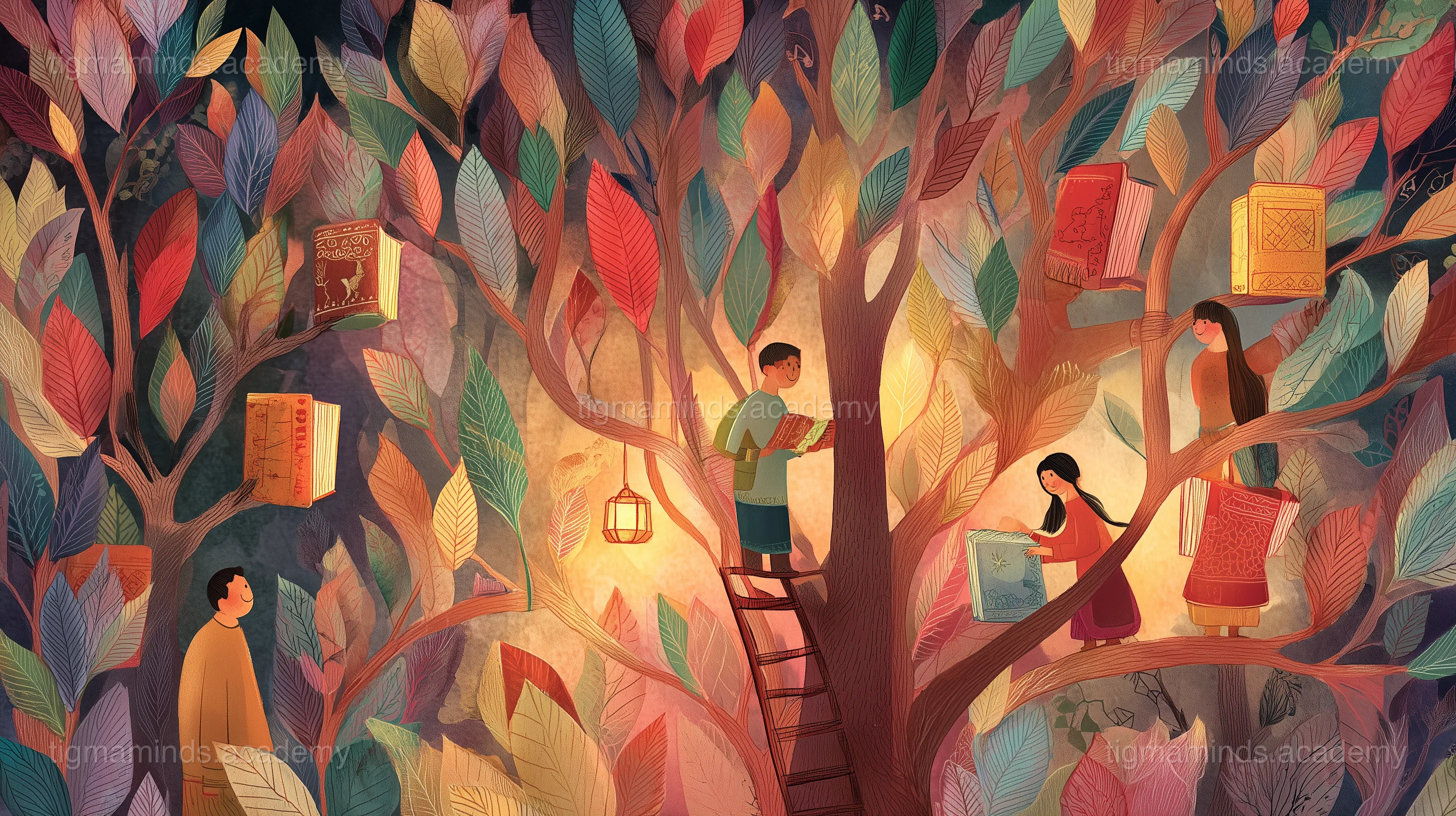
The Hidden Garden
Somewhere in Northeast India — nobody knows exactly where, though some say it's in the misty hills of Meghalaya, and others swear it's on a hidden island in the Brahmaputra — there is a garden where stories grow.
Not flowers. Not vegetables. Stories.
They sprout from the earth like seedlings — thin green shoots at first, each one carrying a tiny folded tale inside. As they grow, the tales unfold: characters appear on the leaves, plots twist through the stems, and endings bloom at the very top like bright, surprising flowers.
A girl named Aheli found this garden by accident. She was chasing a blue butterfly through the forest near her village in Haflong, the hill town in Dima Hasao, when the trees parted and she stumbled into a clearing she had never seen before.
The Story Seedlings
The garden was unlike anything Aheli had ever imagined. Rows and rows of plants grew in neat beds, each one different. Some were tall and dramatic, with thick stems and dark leaves — these, Aheli would learn, were adventure stories. Some were small and delicate, with silver leaves that trembled in the breeze — quiet, gentle tales about kindness and patience. Some had thorns — stories with difficult lessons. And some were just beginning to push through the earth — stories not yet ready to be told.
At the centre of the garden stood an old woman with earth-stained hands and a face full of laugh lines. She wore a rikutu gamosa over her shoulders and a smile that seemed to know every secret the garden held.
"Welcome," she said. "I've been waiting for you."
"Who are you?" asked Aheli.
"I'm the gardener," said the old woman. "I plant the seeds. The stories grow themselves."
How Stories Grow
The old woman showed Aheli around. Each bed was labelled with a small wooden sign.
Bed One: Stories of Rivers. Here grew tales of the Brahmaputra, the Barak, and a hundred smaller rivers — stories about boats, dolphins, floods, and the children who played on the banks.
Bed Two: Stories of Creatures. Python tales, hornbill tales, firefly tales, elephant tales — each plant bearing a different animal on its leaves, each animal carrying a different lesson in its heart.
Bed Three: Stories of People. Weavers, ferryman, farmers, teachers — the people of Assam, of Nagaland, of Meghalaya, of Arunachal Pradesh, of Manipur, of Tripura, of Mizoram — each one with a story that deserved to be told.
Bed Four: Stories That Haven't Been Born Yet. This bed was mostly bare earth with a few tiny green shoots just breaking the surface. "These are next year's stories," said the gardener. "They need time."
"What makes them grow?" asked Aheli.
"Listening," said the gardener. "Every time a child sits quietly and listens to a story, a new seed appears in the garden. Every time someone says tell me more, a seedling grows an inch. And every time someone passes a story on — tells it to a friend, reads it to a younger child — a story plant blooms."
The Hundredth Story
Aheli walked slowly through the garden, touching the leaves, reading the stories written on them. She recognized some — a tale about a firefly festival on Majuli, a story about golden muga silk, a legend about how the hornbill got its crown. She had heard these stories before. She had lived with them.
"This is the hundredth story," said the gardener, gesturing to the plant nearest the garden gate. It was tall and full, with broad leaves and a single white flower at the top — a sewali phool, a night jasmine, glowing softly even in daylight.
"What's the hundredth story about?" asked Aheli.
"It's about you," said the gardener. "It's about a girl who found the story garden and realized that stories don't end. They just become seeds for more stories. Every ending is a beginning. Every the end is really a what happens next."
The Seed in Her Pocket
The gardener pressed a small seed into Aheli's palm — dark and round, like a betel nut, warm as if it had been sitting in sunlight.
"Plant this wherever you live," said the gardener. "Water it with listening. Feed it with curiosity. And when it grows, share its stories with everyone you meet."
Aheli closed her hand around the seed. When she looked up, the garden was gone — the clearing was just a clearing, the old woman was just a memory, and the forest was quiet except for birdsong and the distant sound of a river.
But the seed was real. She could feel its warmth in her palm.
Aheli walked home and planted the seed in her grandmother's garden in Haflong. She watered it every day. She sat beside it every evening and told it stories she had heard — stories of rivers and silkworms and paper boats and cloud weavers and rice fields and eagles and night jasmine and woodpeckers and ferryman's riddles and brave boys on bicycles.
And the seed grew.
It is still growing. Because the story garden never closes, and the stories of Northeast India never end. They just become seeds — carried by children, planted in new soil, watered by wonder — waiting to bloom again in someone else's heart.
The end.
---
— End of 100 Stories —
Choose your level. Everyone starts with the story — the code gets deeper as you go.
Here is a taste of what Level 1 looks like for this lesson:
import numpy as np
import matplotlib.pyplot as plt
# Your first data analysis with Python
data = [45, 52, 38, 67, 41, 55, 48] # measurements
mean = np.mean(data)
plt.bar(range(len(data)), data)
plt.axhline(mean, color='red', linestyle='--', label=f'Mean: {mean:.1f}')
plt.xlabel("Sample")
plt.ylabel("Value")
plt.title("Storytelling & Narrative — Sample Data")
plt.legend()
plt.show()This is just the first of 6 coding exercises in Level 1. By Level 4, you will build: Build an Interactive Story Engine.
Free
Level 0: Listener
Stories, science concepts, diagrams, quizzes. No coding.
You are here
Level 0 is always free. Coding levels (1-4) are part of our 12-Month Curriculum.
Storytelling and narrative structure — how stories teach.
The big idea: "The Story Garden" teaches us about Storytelling & Narrative — and you don't need to write a single line of code to understand it.
Stories across cultures follow surprisingly consistent structural patterns. The simplest is the three-act structure: Setup (introduce characters and situation), Confrontation (present a problem or conflict), and Resolution (solve it). This maps onto what narratologist Tzvetan Todorov called equilibrium → disruption → new equilibrium. Whether it is a Hollywood film, an Assamese folk tale, or a bedtime story, this arc is nearly universal.
Joseph Campbell identified a more elaborate pattern, the Hero's Journey (monomyth): a hero leaves the ordinary world, faces trials in a special world, achieves a transformation or boon, and returns changed. Campbell found this structure in myths from ancient Greece, Hindu epics, Indigenous Australian dreamtime stories, and Norse sagas. The universality suggests it reflects something fundamental about human psychology — perhaps the structure of learning itself (comfort zone → challenge → growth).
Why do these patterns recur? Cognitive scientists suggest that the human brain is wired to process information in causal sequences — event A causes event B, which leads to event C. Stories that follow this pattern are easier to understand, remember, and retell. Random sequences of events do not "stick" in memory; causally linked sequences do. Narrative structure is not arbitrary — it is optimized for the architecture of human cognition.
Key idea: Stories across all cultures follow consistent structural patterns (three-act structure, hero's journey) because the human brain processes and remembers information most efficiently in causal sequences.
Cognitive load theory, developed by John Sweller in the 1980s, explains why some information is easy to learn and some is overwhelming. Working memory (the brain's "RAM") can hold only about 4 chunks of new information simultaneously. If a lesson presents too many unfamiliar elements at once, working memory overflows and learning fails.
Stories reduce cognitive load through several mechanisms. They provide a familiar structure (beginning, middle, end) that serves as a scaffold, so the listener does not have to figure out the organizational framework. They embed new information in concrete, emotional contexts (characters, settings, conflicts) rather than presenting it as abstract facts. And they create temporal links — each event connects to the next in time — which reduces the effort needed to organize information in memory.
Research shows that people remember information presented in story form roughly 6–7 times better than the same information presented as a list of facts. This is the story superiority effect. It is why every culture on Earth uses stories to transmit important knowledge — from survival skills to moral principles to scientific understanding. TigmaMinds uses stories not as decoration but as a cognitive delivery system that genuinely makes learning more efficient.
Key idea: Stories reduce cognitive load by providing familiar structure, concrete context, and temporal links — people remember story-embedded information 6–7 times better than bare facts.
Access all 130+ lessons, quizzes, interactive tools, and offline activities
For over 95% of human history, all knowledge was stored in **human memory** and transmitted through **oral tradition** — stories, songs, chants, and r...
freq = 45, pulse_rate = 2 → DANGER
A Thought, in Motion