Light pollution and astronomy.
The Boy Who Counted Stars
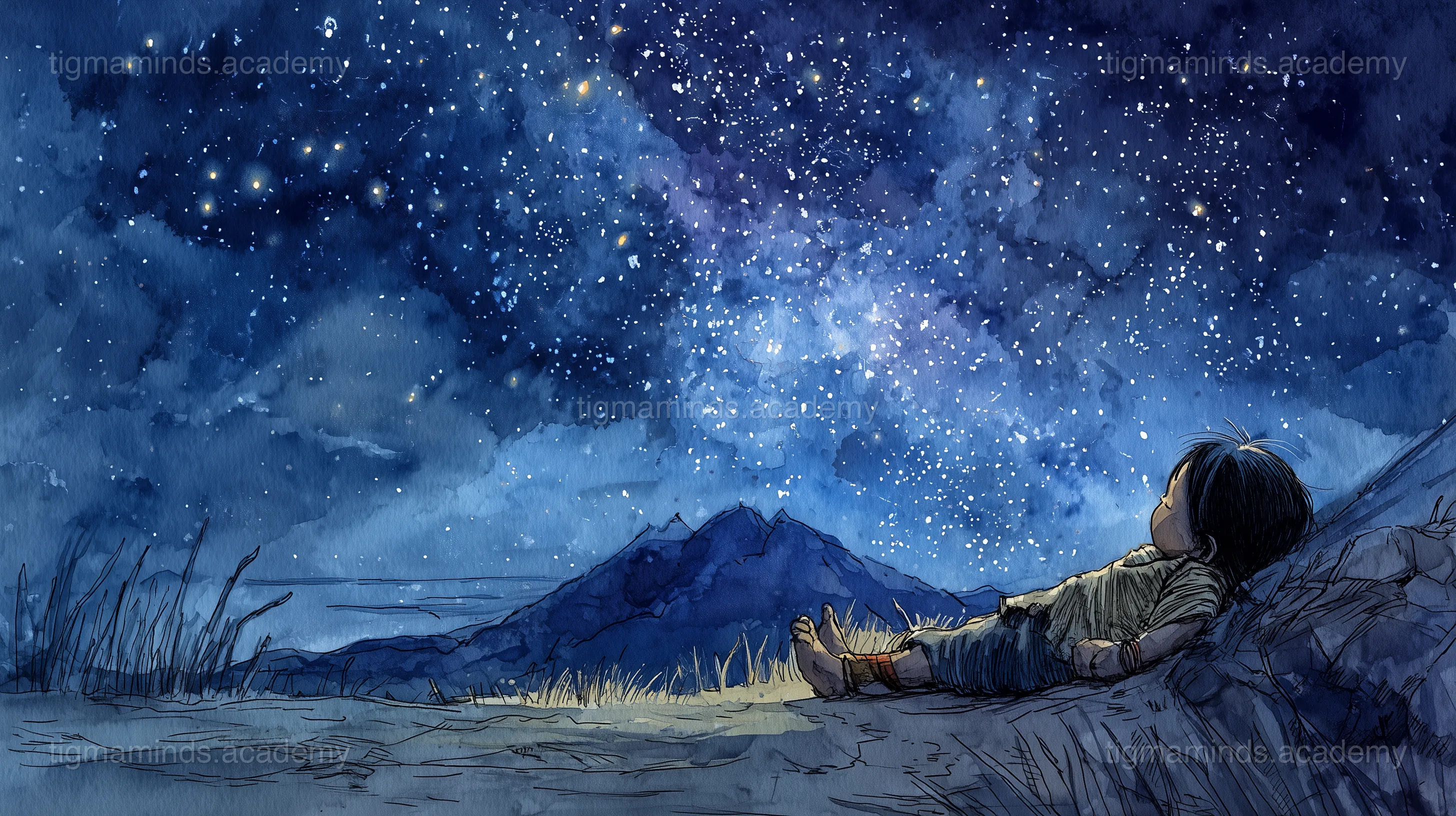
In Ziro Valley, in the heart of Arunachal Pradesh, where the Apatani people have grown rice in flooded terraces for longer than anyone can count, there lived a boy named Tamo. Tamo was ten years old and he had a hobby that no one else in his family understood: he counted stars.
Every clear night, Tamo would climb onto the flat roof of his family's bamboo house, lie on his back on a woven mat, and count. He never got past a few hundred before his eyes grew heavy, but every night he tried.
"There are more stars here than anywhere in the world," Tamo told his older sister Yari. "I'm sure of it."
Yari, who was sixteen and had been to Itanagar once, rolled her eyes. "Stars are the same everywhere, Tamo. You're being silly."
"Then why could I only see twenty stars when I visited cousin Michi in the city? Here I can see thousands."
Yari didn't have an answer for that.
The Visit to the City
That winter, Tamo travelled with his father to Guwahati for a family wedding. It was the farthest Tamo had ever been from Ziro. The city was enormous — bright and loud and exciting in ways the valley never was. There were cars and streetlights and glowing signs and buildings that hummed with electricity all night long.
On the first night, Tamo climbed to the rooftop of his uncle's house and looked up. He could see perhaps thirty stars — pale, faint things, barely visible through the orange haze that hung over the city.
"Where are they all?" Tamo whispered. He felt cheated, as if someone had stolen most of the sky.
The Grandmother's Explanation
When Tamo returned to Ziro, he went straight to his grandmother, Anya Hage, who sat weaving a shawl by the fire. Anya Hage was the oldest person Tamo knew, and she had an answer for everything.
"Anya, why are the stars brighter here than in the city?"
His grandmother put down her shuttle and looked at him with her calm, dark eyes. "Come outside," she said.
They stood in the yard. Above them, the Milky Way stretched across the sky like a river of spilled rice — millions of stars, so dense and bright they cast faint shadows on the ground.
"Light a candle," said Anya Hage.
Tamo lit a small beeswax candle and held it up.
"Can you see the flame?"
"Yes, clearly."
"Good. Now take it inside, next to the cooking fire."
Tamo carried the candle inside and held it near the blazing wood fire. The candle's flame was still there — still burning — but next to the roaring fire, it was nearly invisible. Just a tiny flicker lost in the bigger blaze.
"The candle didn't change," said Anya Hage from the doorway. "You changed what was around it. Stars are like candles, child. They shine the same everywhere. But in the city, there are so many other lights — streetlights, car lights, building lights — that the stars get drowned out. Here in Ziro, the valley is dark and quiet. We have no big lights to compete. So the stars show themselves."
The Gift of Darkness
Tamo sat on the steps and thought about this for a long time. "So darkness is a good thing?"
"Darkness is the reason you can see the stars. Without it, the sky is just a blank orange ceiling. The people in the city have forgotten what the sky looks like because they have filled their nights with so much light that the stars cannot compete."
"That's sad," said Tamo.
"It is. But you live in Ziro Valley, where the nights are still dark and the stars still rule. That is not backwardness, child. That is a gift."
The Star Map
That spring, Tamo began drawing star maps on sheets of handmade Apatani paper. He drew the constellations as he saw them from his rooftop — not with their foreign names, but with Apatani names he and his grandmother invented together. The cluster near the eastern ridge became The Rice Basket. The bright pair above the pine forest became The Two Brothers. The faint smudge of a distant galaxy became The Smoke From Anya's Fire.
He hung the maps on his bedroom wall, and visiting children would come to stare at them. "You can see all that from your roof?" they asked.
"You can see all that from your roof," Tamo said. "You just have to look."
And that is why, the people of Ziro Valley say, their stars are the brightest in the world. Not because the stars are different — but because the valley is wise enough to stay dark.
The end.
Choose your level. Everyone starts with the story — the code gets deeper as you go.
Here is a taste of what Level 1 looks like for this lesson:
# How many stars can you see?
# The Bortle scale meets the magnitude limit
bortle_class = 4 # your sky darkness (1-9)
mag_limit = 7.0 - (bortle_class * 0.5)
print(f"From a Class {bortle_class} sky:")
print(f"You can see stars down to magnitude {mag_limit:.1f}")
# Each magnitude step = 2.5× more stars
total_stars = int(50 * (2.512 ** mag_limit))
print(f"That's roughly {total_stars:,} visible stars!")
# Try changing bortle_class to 1 (Ziro Valley)
# or 9 (inner city) — watch the count changeThis is just the first of 6 coding exercises in Level 1. By Level 4, you will build: Measure Light Pollution in Your Area.
By Level 4, enrolled students build: Measure Light Pollution in Your Area
Free
Level 0: Listener
Stories, science concepts, diagrams, quizzes. No coding.
You are here
Level 0 is always free. Coding levels (1-4) are part of our 12-Month Curriculum.
Where darkness reveals the universe.
The big idea: "Why Stars Are Brighter in Ziro Valley" teaches us about Light Pollution & Astronomy — and you don't need to write a single line of code to understand it.
Look at the night sky. Some stars are bright. Some are faint. Some are barely there. You can see the difference — but how would you measure it? How would you tell someone exactly how bright a star is?
Why do some stars look brighter than others? Two reasons: some stars genuinely produce more light (they are bigger or hotter), and some stars are simply closer to Earth. A giant star far away can look faint, while a modest star nearby can look brilliant. What you see in the sky is a mix of both — the star’s true power and its distance from you.
About 2,100 years ago, a Greek astronomer named Hipparchus wanted to record how bright each star appeared from Earth — regardless of why. His solution was simple: he called the brightest-looking stars 'first magnitude' (first-class, the best) and the faintest ones he could see 'sixth magnitude' (barely there). Stars in between got numbers 2 through 5. This measures apparent brightness — what your eyes see — not the star’s true power.
Notice something odd: brighter stars get smaller numbers. This is the opposite of what you might expect. It is like a ranking — 1st place is better than 6th place. This backwards numbering confused people for 2,000 years, but it stuck, and astronomers still use it today.
Try this in your head: If Sirius is magnitude -1.4 and Polaris (the North Star) is magnitude 2.0, which one is brighter? (Answer: Sirius — the lower number wins.)
Key idea: The magnitude scale ranks star brightness with smaller numbers for brighter stars — like a ranking where 1st place is the brightest.
Here is where it gets interesting. The gap between magnitude 6 and magnitude 5 is not '1 unit brighter' the way 2 kg is 1 kg more than 1 kg. Instead, a magnitude-5 star is 2.5 times brighter than a magnitude-6 star. Not 1 unit more — 2.5 times more.
Why? Because our eyes do not work in equal steps. If a candle lights your room and you add a second candle, you notice the difference. But if 100 candles are already burning, adding one more candle is barely noticeable. Your eyes respond to ratios, not differences. The magnitude scale is built to match how your eyes actually work.
Let us climb the staircase step by step:
Five steps. Each one multiplied by 2.5. Total: 100 times brighter. A scale where equal steps mean equal multiplications (not equal additions) is called a logarithmic scale. You have now learned what that means — it is not complicated, it is just a staircase where each step multiplies instead of adds.
Check yourself: If someone says 'magnitude 3 is two steps above magnitude 5,' how many times brighter is it? (Answer: 2.5 × 2.5 = about 6.3 times brighter.)
Key idea: Each magnitude step multiplies brightness by 2.5 (not adds). Five steps = 100×. This is a logarithmic scale — it matches how our eyes actually perceive brightness.
Access all 130+ lessons, quizzes, interactive tools, and offline activities
Stars do not actually twinkle. They send out perfectly steady light. So what is happening?...
In 2001, astronomer John Bortle created a simple 1-to-9 scale to rate how dark your sky is: • **Class 1–2:** The Milky Way is so bright it casts shad...
The Magnitude Staircase — Each Step Multiplies by 2.5×