
Astronomy and celestial navigation hidden in the story of wise men following a star.
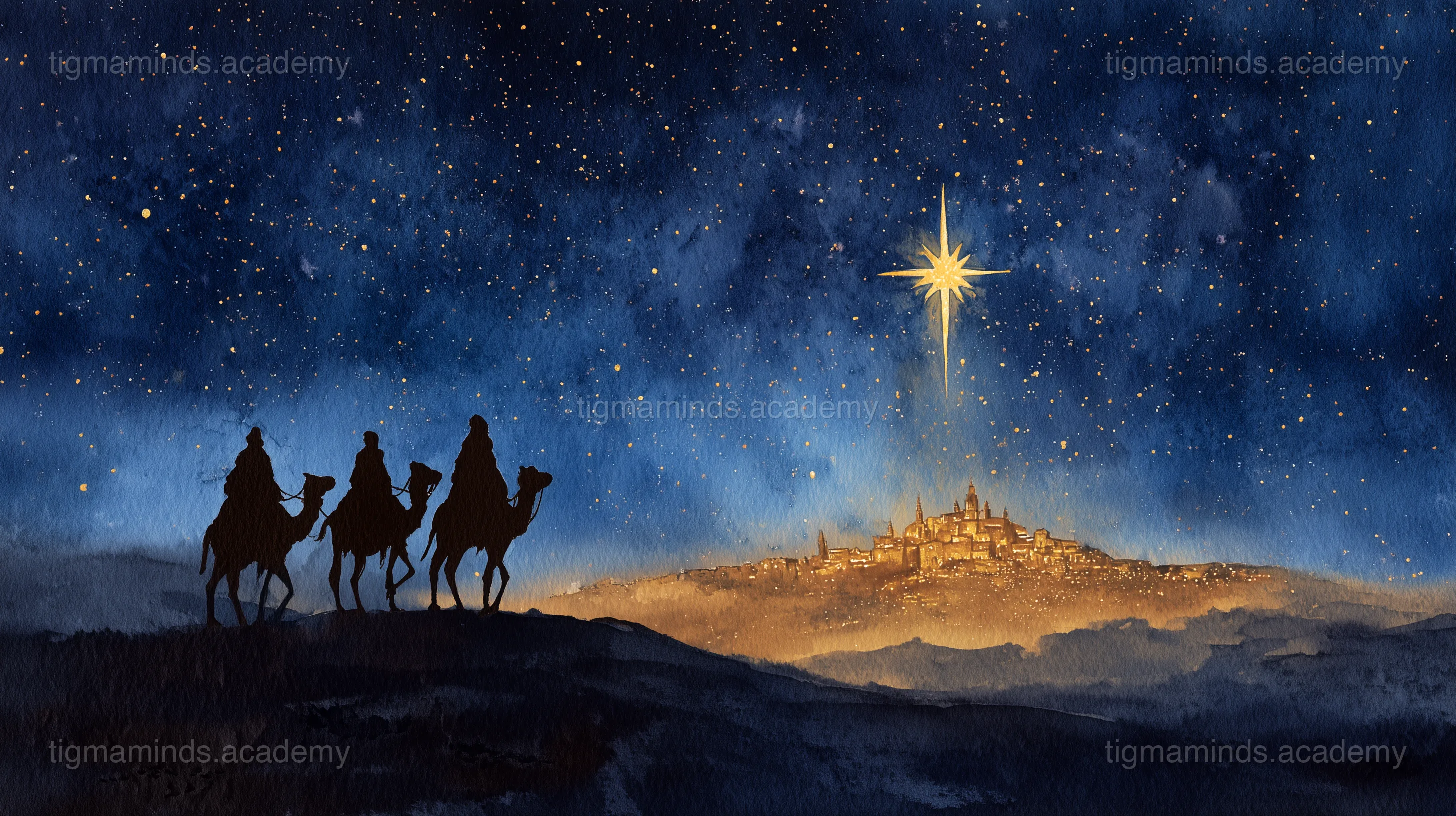
The Journey Begins
Two thousand years ago, in the ancient land of Persia — a vast empire stretching from modern Iran to the borders of India — there lived a group of scholars known as the Magi. They were not magicians in the fairy-tale sense. They were astronomers, mathematicians, and interpreters of the sky. They studied the movements of planets with the same rigour that modern scientists study data. They kept records of celestial events spanning centuries, passed down on clay tablets and parchment scrolls.
The Magi knew the sky the way a sailor knows the sea. They could name every bright star, track the wandering planets night after night, and predict eclipses months in advance. Their observatory towers rose above the flat Mesopotamian plains, and from these towers they watched the heavens with patient, meticulous attention.
One evening, something extraordinary appeared.
The Star
In the western sky, low above the horizon after sunset, two brilliant points of light drew closer together over a span of weeks. Jupiter, the king of the planets — the brightest wanderer in the sky — was approaching Saturn, the slow-moving guardian of time. Night after night, the gap between them narrowed, until they appeared to almost touch: a single, blazing point of light, brighter than any star in that region of the sky.
This was a planetary conjunction, and it occurred in the constellation Pisces — a grouping of stars that the Babylonian astronomical tradition associated with profound change and new beginnings.
But this was not an ordinary conjunction. Over the following months, Jupiter appeared to stop, reverse direction, and approach Saturn again. Then it reversed once more and approached a third time. A triple conjunction — three meetings in a single year. The Magi had never seen such a thing in their lifetimes, and their records showed it happened only once every nine hundred years.
They consulted their ancient tables. They calculated the positions. They discussed the meaning among themselves. And then they made a decision that would echo through history: they would follow the star.
The Road to Bethlehem
The Magi packed supplies for a journey of many months. They loaded camels with provisions, astronomical instruments, and gifts — gold, frankincense, and myrrh. They set out westward from Babylon or perhaps from further east, navigating by the same stars they had studied all their lives.
Each clear night, they measured the altitude of Polaris — the North Star — above the horizon. This single measurement told them their latitude, their north-south position on the Earth. As they traveled westward and slightly south, Polaris sank lower in the sky, confirming their progress.
They crossed the Euphrates River, traversed the Syrian desert, passed through the ancient trading city of Palmyra, and arrived in Damascus. From there, they turned south along the Jordan Valley toward Jerusalem, where they sought audience with King Herod to ask: "Where is the one who has been born king?"
Herod, alarmed, consulted his own scholars, who pointed to the prophecy naming Bethlehem as the birthplace. The Magi continued south — just a few more miles — and the Gospel of Matthew records that "the star they had seen when it rose went ahead of them until it stopped over the place where the child was."
The Science Behind the Star
What was the Star of Bethlehem? For two millennia, astronomers have investigated this question with the tools of science. The leading candidate is the triple conjunction of Jupiter and Saturn in 7 BCE — calculated independently by Johannes Kepler in 1614 using his own laws of planetary motion.
The conjunction matches the timeline (King Herod died in 4 BCE, so Jesus was born before that), the location (visible from both Persia and Judea), and the duration (eight months of repeated close approaches, long enough for a caravan journey). The constellation Pisces carried astrological significance for the Magi. And the phenomenon — two planets appearing to merge into one brilliant light — would have been unmistakable to trained observers.
Other hypotheses include a nova (new star) recorded by Chinese astronomers in 5 BCE, Halley’s Comet in 12 BCE, and a Jupiter-Venus conjunction in 3–2 BCE. Each has strengths and weaknesses. The beauty of the question is that it can be investigated scientifically: we can compute the exact positions of every planet for any date in history using Kepler’s laws and Newton’s gravity.
The Lesson of the Star
The Star of Bethlehem is a story about observation, knowledge, and the courage to act on evidence. The Magi did not follow a miracle — they followed their understanding of the sky, accumulated over generations of careful study. They combined astronomy (measuring positions), mathematics (predicting conjunctions), navigation (tracking latitude by Polaris), and geography (planning a route across 1,500 kilometres of terrain).
For a science student, this story opens a universe of questions. How do we measure star brightness? How do planets move and why? How did ancient navigators find their way without instruments we would recognise? And how can we use modern computation to reconstruct the sky of two thousand years ago?
The end.
Choose your level. Everyone starts with the story — the code gets deeper as you go.
Here is a taste of what Level 1 looks like for this lesson:
# Kepler's Third Law verifier
import math
# Planet data: (name, distance_AU, period_years)
planets = [
("Mercury", 0.387, 0.241),
("Venus", 0.723, 0.615),
("Earth", 1.000, 1.000),
("Mars", 1.524, 1.881),
("Jupiter", 5.203, 11.86),
("Saturn", 9.537, 29.46),
]
print("Kepler's Third Law: T² = a³")
print(f"{'Planet':10s} {'a (AU)':>8s} {'T (yr)':>8s} {'a³':>10s} {'T²':>10s} {'Ratio':>8s}")
for name, a, T in planets:
ratio = T**2 / a**3
print(f"{name:10s} {a:8.3f} {T:8.3f} {a**3:10.3f} {T**2:10.3f} {ratio:8.4f}")
# Every ratio should be ~1.000This is just the first of 6 coding exercises in Level 1. By Level 4, you will build: Build a Planetarium Engine.
By Level 4, enrolled students build: Build a Planetarium Engine
Free
Level 0: Listener
Stories, science concepts, diagrams, quizzes. No coding.
You are here
Level 0 is always free. Coding levels (1-4) are part of our 12-Month Curriculum.
The real-world science behind the Star of Bethlehem — stellar magnitude, planetary conjunctions, Kepler’s laws, and finding your way by the stars.
The big idea: "The Star of Bethlehem" teaches us about Astronomy & Celestial Navigation — and you don't need to write a single line of code to understand it.
Look up at the night sky on a clear evening. Some stars blaze brightly; others are faint pinpoints you can barely see. Astronomers measure this brightness using a system called the magnitude scale, invented by the Greek astronomer Hipparchus around 130 BCE. He divided visible stars into six groups: the brightest were "first magnitude" and the faintest were "sixth magnitude."
Here is the surprising part: lower numbers mean brighter objects. The scale runs backward from what you might expect. The Sun is magnitude −26.7 (extremely bright, extremely negative). The full Moon is −12.7. Venus at its brightest is −4.6. The faintest star you can see with your naked eye is about magnitude 6. Each step of 1 magnitude corresponds to a brightness change of exactly 2.512 times — a number chosen so that 5 magnitude steps equal exactly 100 times the brightness difference.
Why does this matter for the Star of Bethlehem? Because the Magi were trained to notice brightness differences. A Jupiter-Saturn conjunction would have produced a combined brightness of about magnitude −2.9 — brighter than any single star in that part of the sky. To astronomers who catalogued thousands of stars by magnitude, this new "star" would have been impossible to miss.
Check yourself: Vega has magnitude 0.0 and Polaris has magnitude 2.0. How many times brighter is Vega? (Hint: each magnitude step is 2.512×.)
Key idea: The magnitude scale measures star brightness logarithmically: lower numbers = brighter. Each magnitude step is a 2.512× brightness change. Five steps = 100× difference. The Magi’s expertise in this system let them recognise the unusual conjunction instantly.
Planets orbit the Sun at different speeds. Mercury zips around in 88 days. Earth takes 365 days. Jupiter takes nearly 12 years. Saturn takes over 29 years. Because they all orbit the same Sun but at different distances and speeds, their positions in our sky are constantly changing. Sometimes two planets appear close together — this is called a conjunction.
A conjunction does not mean the planets are actually close in space. Jupiter might be 600 million kilometres from Saturn. But from our viewpoint on Earth, they appear in nearly the same direction, like two cars on different lanes of a highway appearing to overlap when seen from far away. The angular separation — how far apart they look in the sky, measured in degrees — can shrink to less than 1 degree during a conjunction (for reference, the full Moon is about 0.5 degrees across).
In 7 BCE, something rare happened: a triple conjunction of Jupiter and Saturn in the constellation Pisces. Earth’s motion caused Jupiter to appear to overtake Saturn, then loop back (due to retrograde motion), then overtake it again — three close approaches in a single year. Triple conjunctions of Jupiter and Saturn occur roughly every 900 years. For the Magi, this was a once-in-many-lifetimes event.
Think about it: If Jupiter takes 11.86 years and Saturn takes 29.46 years to orbit the Sun, how often do they appear to meet in the sky? The answer involves their orbital periods — roughly every 20 years for a single conjunction, but 900 years for a triple.
Key idea: Planetary conjunctions occur when two planets appear close together in our sky due to their different orbital speeds. A triple conjunction — three meetings in one year — is extremely rare and would have been unmistakable to the Magi.
Access all 130+ lessons, quizzes, interactive tools, and offline activities
The Magi traveled roughly 1,500 kilometres from Persia to Bethlehem, across desert and mountains, without maps, roads, or GPS. How? They used the star...
Johannes Kepler (1571–1630) discovered three laws governing planetary motion. He also investigated the Star of Bethlehem — using his own laws to calcu...