
A star becomes something beautiful in a wetland.
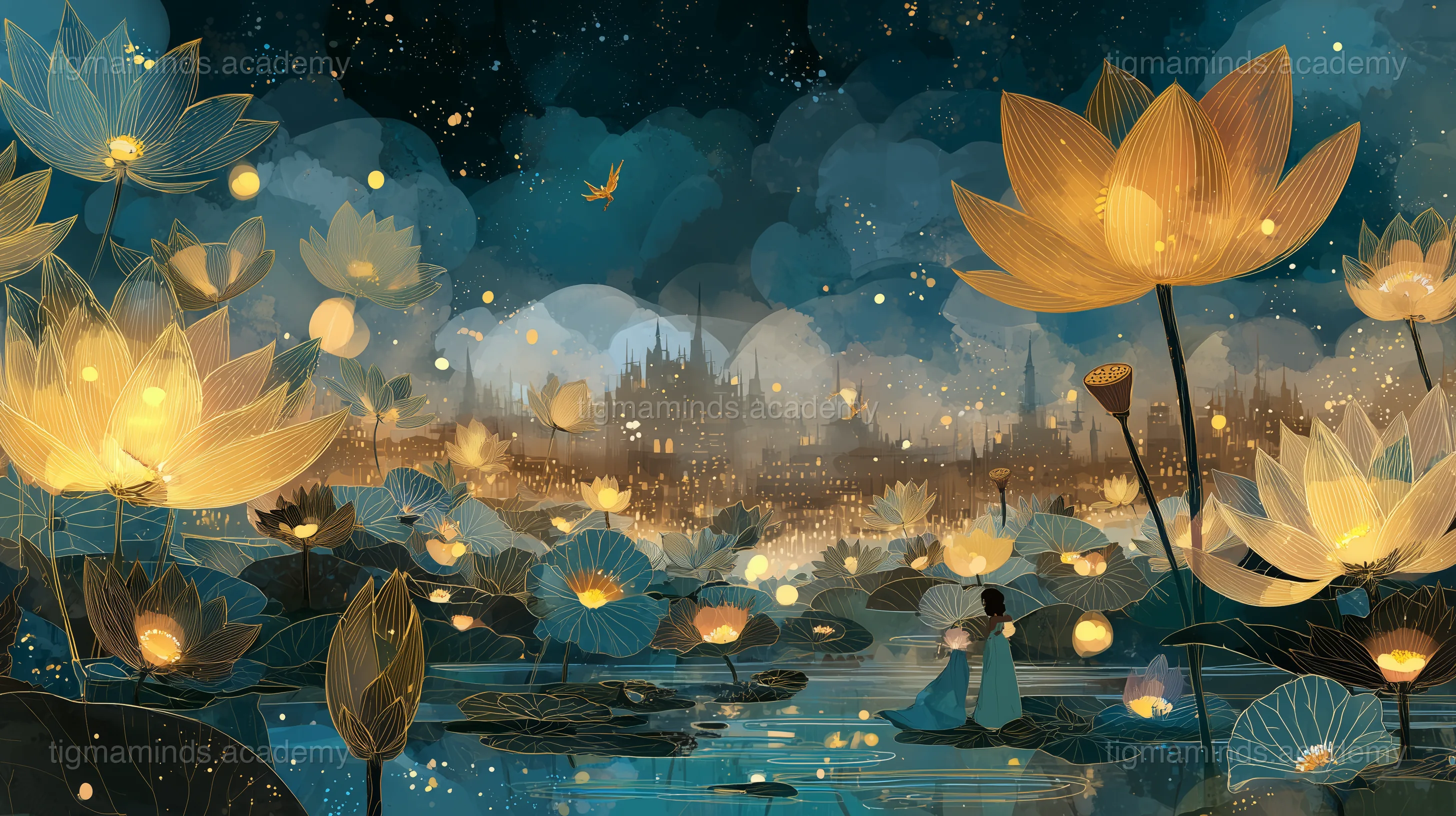
The Falling Star
On the darkest night of winter, when the sky above Guwahati was thick with stars, one small star at the edge of the Milky Way lost its grip.
Stars don't have hands, of course. But they have gravity, and this little star's gravity wasn't strong enough to hold its place. It slipped — slowly at first, then faster — tumbling through the cold black sky, trailing light like a golden ribbon.
"Hold on!" called the other stars.
But the little star couldn't. It fell and fell, shrinking as it fell, until it was no bigger than a raindrop. It landed with a soft plip in the middle of Deepor Beel — the great wetland on the edge of Guwahati.
The Sinking
The star sank through the dark water, still glowing faintly. The fish scattered. A turtle blinked. A water snake investigated, then decided the glowing thing was too strange to eat.
The star settled into the mud at the bottom of the beel and lay there, pulsing with a dim golden light. It was sad. Stars belong in the sky, not in the mud. What good is light at the bottom of a lake?
"I'm useless here," the star whispered. "Nobody can see me."
The Transformation
But the star's light didn't fade. Instead, it did something unexpected. It seeped into the mud, into the roots of the water plants, into the seeds lying dormant at the bottom of the beel. The light fed them the way sunlight feeds a garden — gently, steadily, from below instead of above.
One morning, a lotus bud rose from the water. Then another. Then twenty. Then a hundred. They bloomed all at once — enormous golden lotuses the likes of which no one in Guwahati had ever seen. They glowed faintly, even at night, as if lit from within.
The fishermen rubbed their eyes. The morning walkers stopped and stared. The migratory birds — bar-headed geese, ferruginous ducks, spot-billed pelicans — changed their flight paths to land at Deepor Beel, drawn by the golden glow.
The Bird Girl
A girl named Chayanika, who came to the beel every morning to watch birds, noticed the lotuses first.
"These aren't normal," she told her father, a botanist. "Lotuses don't glow."
Her father examined them and found nothing scientifically unusual. "They're just lotuses," he said. "Very healthy ones."
But Chayanika knew better. She had been watching the sky the night the star fell. She had seen the golden streak arc across Guwahati and disappear over the wetland. She put two and two together.
"You're the star," she whispered to the largest lotus. "You fell, and you became this."
The lotus swayed, though there was no wind.
A Better Place
The star — now a field of golden lotuses — discovered something surprising. More people saw it here than had ever seen it in the sky. In the sky, it had been one of a billion stars, barely noticeable. In Deepor Beel, it was extraordinary. Families came to photograph the golden lotuses. Scientists came to study them. Birds came from as far as Siberia to rest among them.
The star had fallen from the sky and found a place where it mattered more.
Sometimes, the place you land isn't the place you planned. But that doesn't mean it's the wrong place. Sometimes falling is just the universe's way of putting you where you're needed most.
The end.
Choose your level. Everyone starts with the story — the code gets deeper as you go.
Here is a taste of what Level 1 looks like for this lesson:
import numpy as np
import matplotlib.pyplot as plt
# Meteorite impact energy calculator
# KE = 0.5 * mass * velocity^2
masses = np.array([0.001, 0.1, 1, 10, 100, 1000]) # kg
velocity = 20_000 # m/s (20 km/s typical entry speed)
energies_joules = 0.5 * masses * velocity**2
energies_tnt_kg = energies_joules / 4.184e6 # convert to kg TNT equivalent
for m, e_j, e_t in zip(masses, energies_joules, energies_tnt_kg):
print(f"Mass {m:>7.3f} kg -> {e_j:.2e} J ({e_t:.1f} kg TNT)")
# The v-squared makes all the difference!
print(f"\nDouble speed (40 km/s) for 1 kg rock:")
print(f" {0.5 * 1 * 40000**2:.2e} J — that is 4x more energy!")This is just the first of 6 coding exercises in Level 1. By Level 4, you will build: Simulate Meteorite Entry and Impact.
By Level 4, enrolled students build: Simulate Meteorite Entry and Impact
Free
Level 0: Listener
Stories, science concepts, diagrams, quizzes. No coding.
You are here
Level 0 is always free. Coding levels (1-4) are part of our 12-Month Curriculum.
A star becomes something beautiful in a wetland.
The big idea: "The Star That Fell Into Deepor Beel" teaches us about Astronomy & Meteorites — and you don't need to write a single line of code to understand it.
In the story, a star fell from the sky into Deepor Beel. It is a beautiful image — but real stars are enormous balls of gas, millions of kilometres away. The Sun, our nearest star, is 1.3 million times the volume of Earth. No star could ever "fall" to the ground. So what are those bright streaks that flash across the night sky? They are meteors — and they have nothing to do with stars at all.
A meteoroid is a small piece of rock or metal drifting through space — most are no bigger than a grain of sand, though some are the size of a pebble or a football. They come from asteroids, comets, and even the Moon or Mars (blasted off by ancient impacts). These tiny wanderers orbit the Sun just like planets do, and sometimes Earth’s path crosses theirs. When that happens, the meteoroid slams into our atmosphere at astonishing speed: between 11 and 72 km per second. That is 40,000 to 260,000 km/h — fast enough to cross Assam end to end in under a second.
Here is the part most people get wrong: meteors do not glow because of friction. Think about what happens when you push a bicycle pump and the barrel gets warm — you are compressing air, and compressed air heats up. A meteoroid does the same thing, but millions of times more violently. It rams into the air so fast that the air ahead of it cannot get out of the way. This air gets compressed into a tiny space and heated to 20,000–40,000 °C — hotter than the surface of the Sun. It is this superheated compressed air that glows, not the rock itself. The rock does eventually melt and vaporise (a process called ablation), but the light you see is mostly from the shocked air.
Here is a prediction to test your understanding: if a meteoroid entered the Moon’s sky at the same speed, would it glow? Think carefully before reading on. The answer is no — the Moon has no atmosphere, so there is no air to compress. The meteoroid would simply slam into the surface silently, creating a crater. This confirms that the glow comes from the atmosphere, not from the rock itself.
Key idea: Meteors glow because they compress the air ahead of them to extreme temperatures — it is compression heating, not friction, that creates the streak of light.
Most meteoroids burn up completely in the atmosphere — the streak you see lasts a fraction of a second and the rock is gone. But sometimes a meteoroid is big enough or tough enough to survive the fiery descent and land on Earth’s surface. When it does, we call it a meteorite. About 48.5 tonnes of space material reach Earth every day, though most of it is microscopic dust. An estimated 6,100 meteorites larger than 1 kg land each year, but most fall into oceans or uninhabited areas and are never found.
Scientists classify meteorites into three main types, and each type tells a different story about the solar system’s past. Iron meteorites (~5% of finds) are made of 90–95% iron and 5–10% nickel. Slice one open, polish and etch it with acid, and you see a stunning criss-cross crystal pattern called Widmanstätten patterns — a lattice of interlocking iron-nickel crystals that could only have formed by cooling at a rate of about 1 °C per million years. This tells us they came from the metal core of a small planet-like body (a protoplanet) that formed early in the solar system’s history and was later destroyed by collisions.
Stony meteorites (~94% of finds) are made of silicate minerals like olivine and pyroxene. The most primitive type, chondrites, contain tiny round grains called chondrules — millimetre-sized beads of rock that formed in the swirling cloud of gas and dust (the solar nebula) 4.56 billion years ago, before any planet existed. Chondrites are the oldest solid material you can hold in your hand. They are literally older than Earth. The third type, stony-iron meteorites (~1% of finds), contain roughly equal parts metal and silicate — they come from the boundary layer between a protoplanet’s core and mantle. The most beautiful variety, pallasites, contain translucent green olivine crystals suspended in a matrix of iron-nickel metal, like jewels set in steel.
Here is what makes meteorites extraordinary: they are time capsules. The iron in an iron meteorite crystallised inside a protoplanet’s core. The chondrules in a chondrite formed in the solar nebula before any planet existed. And the olivine crystals in a pallasite sat at the core–mantle boundary of a world that no longer exists. By studying meteorites, we can reconstruct the history of the solar system’s first few million years — a period we cannot observe any other way.
Key idea: Meteorites come in three types — iron (from planetary cores), stony (from the original solar nebula), and stony-iron (from core–mantle boundaries) — each a time capsule from 4.56 billion years ago.
Access all 130+ lessons, quizzes, interactive tools, and offline activities
When a meteorite is large enough and fast enough, it does not just land — it **explodes**. The energy comes from a simple formula: KE = ½ × m × v². No...
The story’s star fell into Deepor Beel — one of Assam’s most important wetlands and a **Ramsar site** (a wetland of international importance, recognis...