
Survival in the high mountains of Sikkim — altitude science.
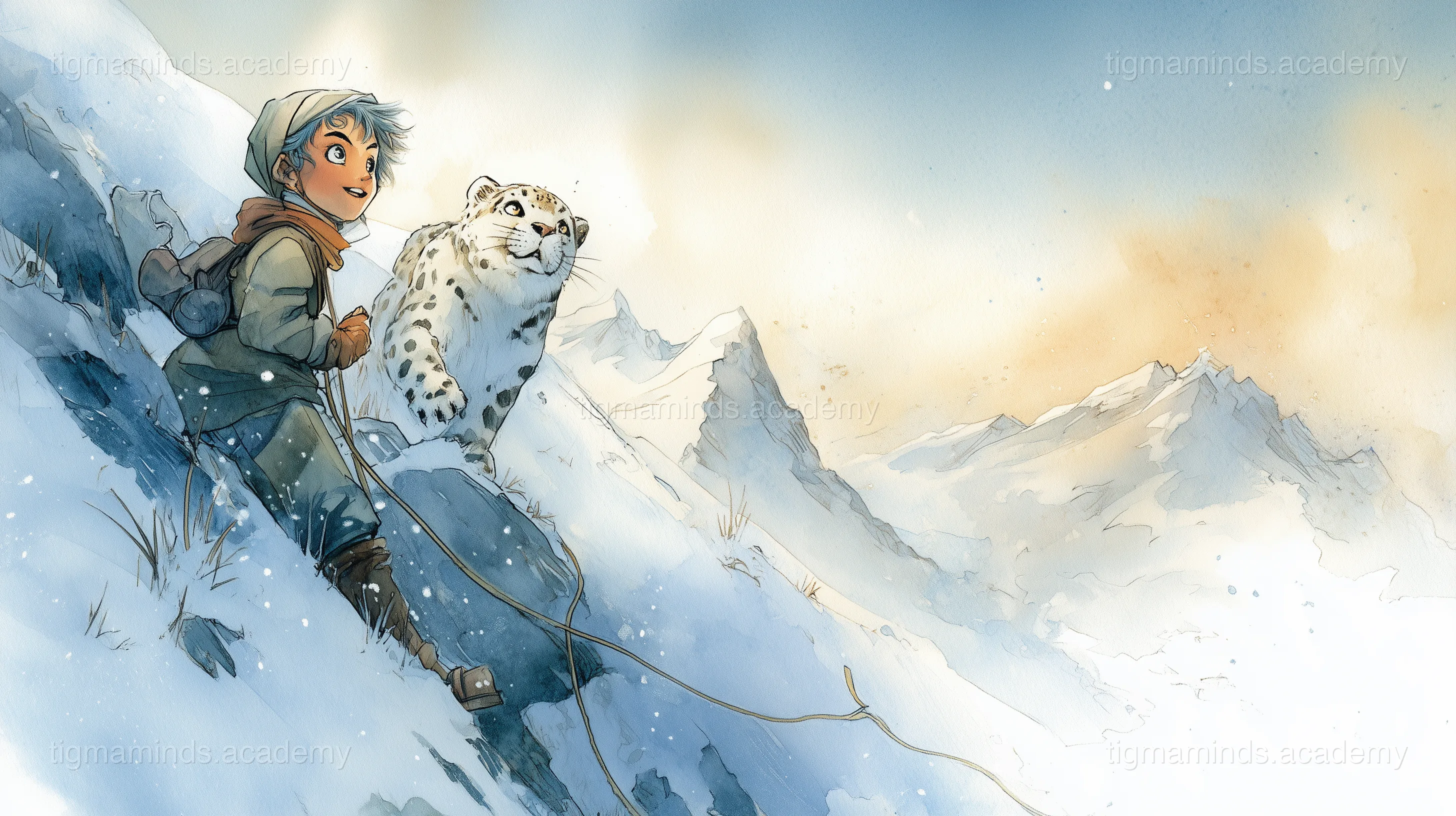
The Mountain Above the Clouds
In Sikkim, where the mountains rise so high they wear caps of snow even in summer, there lived a girl named Diki. She was eleven years old, small for her age, and she knew every trail on Khangchendzonga's lower slopes the way a fish knows its river.
Diki's family were yak herders. Every morning, she climbed with the yaks to the high meadows where the grass was sweet and the air was so thin it made newcomers dizzy. She was used to seeing blue sheep on the ridges, monal pheasants in the rhododendron bushes, and the occasional Himalayan black bear raiding a berry bush.
But she had never seen a snow leopard. Nobody in her village had. Snow leopards were ghosts — grey shadows that lived above the tree line, seen only in footprints and the stories of old hunters.
"They exist," her grandfather said. "But they don't want to be seen. A snow leopard's greatest power is invisibility."
The Snare
One autumn morning, while the yaks grazed, Diki wandered farther than usual, following a trail of blue sheep tracks up a rocky gully. Near the top, behind a boulder, she heard a sound that froze her mid-step — a low, ragged growl, half anger, half pain.
She crept around the boulder and stopped breathing.
A snow leopard lay on its side, its thick grey tail twitching, its pale green eyes wide with fury. Its left hind leg was caught in a wire snare — a poacher's trap, illegal and cruel, biting into the fur and skin. The leopard had been struggling. The wire was wet with blood.
Diki's first instinct was to run. Snow leopards can kill a yak. A child would be nothing. But the leopard looked at her — and something in those green eyes was not threatening. It was asking.
"You're stuck," Diki whispered.
The leopard blinked. Slowly. Deliberately. As if it understood.
The Freeing
Diki's hands shook as she knelt beside the snare. The wire was twisted tight, looped around a stake driven into the rocky ground. She didn't have tools — just her fingers, her small knife for cutting rope, and her stubbornness.
She talked to the leopard as she worked. "I'm going to help you. Please don't bite me. My grandfather would be very cross if I got bitten by a snow leopard."
The leopard didn't move. It watched her with those pale green eyes, its breathing slow and deliberate, as if it had decided to trust this small human with the thin fingers and the shaking voice.
It took twenty minutes. Diki unwound the wire loop by loop, cutting where she could, bending where she couldn't. When the last strand came free, the leopard pulled its leg back and stood — shakily, favouring the injured leg, but standing.
For a long moment, girl and leopard looked at each other. Diki could see every detail — the rosette spots on the grey fur, the massive paws, the tail as thick and long as a scarf. The leopard was the most beautiful thing she had ever seen.
The Promise
The snow leopard dipped its great head — not a bow, exactly, but a gesture that felt ancient and deliberate, like a promise being made without words. Then it turned and limped up the gully, its grey body blending with the rocks until Diki couldn't tell where the leopard ended and the mountain began.
That night, Diki told her grandfather what had happened. He was quiet for a long time.
"You freed a snow leopard," he said. "Do you know what that means?"
"That I was lucky it didn't eat me?"
Her grandfather smiled. "In the old stories, when a snow leopard is freed by a human, it makes a promise — to guard that human's mountain. Not just for the human, but for everything on it. The sheep, the yaks, the birds, the flowers. A snow leopard's promise lasts for a hundred years."
The Guardian
That winter was the hardest anyone could remember. The snow came early and deep. Wolves came down from the higher peaks, hungry and bold. In other valleys, yaks were killed and herds scattered.
But in Diki's valley, nothing happened. The wolves came to the ridge and stopped, as if an invisible fence blocked their path. Herders in neighbouring villages were puzzled. "Something is guarding your valley," they said. "Something the wolves are afraid of."
Diki knew what it was. Some mornings, climbing to the high meadow, she found tracks in the snow — large, round paw prints with no claw marks, circling the valley's edge like a patrol. Snow leopard tracks. And once, just once, on a ledge above the trail, she saw a grey shape watching her with pale green eyes.
The leopard dipped its head. Diki dipped hers back.
The people of Sikkim say that every mountain has a guardian. Sometimes it's a spirit. Sometimes it's a prayer flag. And sometimes it's a snow leopard who made a promise to a girl brave enough to kneel beside a wild thing and set it free.
Diki still herds yaks on Khangchendzonga's slopes. She has never seen the snow leopard up close again. But she sees the tracks every winter, circling, circling, keeping the promise.
The end.
Choose your level. Everyone starts with the story — the code gets deeper as you go.
Here is a taste of what Level 1 looks like for this lesson:
import numpy as np
# How does air pressure change with altitude?
altitude = 5500 # metres (Everest Base Camp)
sea_level_pressure = 101325 # Pascals
# Barometric formula
pressure = sea_level_pressure * (1 - 2.25577e-5 * altitude)**5.256
oxygen_percent = 20.9 # always the same!
oxygen_available = pressure * oxygen_percent / 100
print(f"Altitude: {altitude} m")
print(f"Pressure: {pressure:.0f} Pa ({pressure/sea_level_pressure*100:.0f}% of sea level)")
print(f"Oxygen per breath: {oxygen_available/sea_level_pressure/oxygen_percent*100*100:.0f}% of sea level")
print(f"A snow leopard thrives here. You would gasp.")This is just the first of 6 coding exercises in Level 1. By Level 4, you will build: Build an Altitude Effects Calculator.
By Level 4, enrolled students build: Build an Altitude Effects Calculator
Free
Level 0: Listener
Stories, science concepts, diagrams, quizzes. No coding.
You are here
Level 0 is always free. Coding levels (1-4) are part of our 12-Month Curriculum.
Survival in the high mountains of Sikkim — altitude science.
The big idea: "The Snow Leopard's Promise" teaches us about Altitude & Mountain Physics — and you don't need to write a single line of code to understand it.
Imagine a stack of blankets on top of you. The bottom blanket feels the weight of all the blankets above it — it is squashed flat. The top blanket has nothing pressing on it — it is fluffy. Air works the same way. At sea level, you are at the bottom of the atmosphere, with hundreds of kilometres of air pressing down on you. That pressure squeezes air molecules close together, so each breath is packed with oxygen.
Now climb a mountain. With every kilometre you go up, there is less air above you, so less weight pressing down, so the air is less squeezed. The molecules spread out. Each breath still fills your lungs with the same volume of air, but that air contains fewer molecules. At 5,500 metres (Everest Base Camp), the pressure is roughly half of sea level. Your lungs fill up, but each breath gives you only half as many oxygen molecules.
This is why Diki in the story does not get dizzy on the high meadows but visitors do. She grew up there — her body is adapted. A visitor from Guwahati (near sea level) would be gasping after a short walk at the same altitude.
Try this in your head: If each breath at sea level gives you 100 "units" of oxygen, how many do you get at Everest Base Camp (5,500 m, half the pressure)? How about at Everest summit (8,849 m, one-third the pressure)? (Answers: about 50 units and about 33 units.)
Key idea: Air pressure drops with altitude because there is less atmosphere pressing down. Less pressure means fewer oxygen molecules per breath — at 5,500 m, you get about half the oxygen of sea level.
You might think mountains should be warmer because they are closer to the sun. They are not — the summit of Khangchendzonga is 8,586 m closer to the sun than Guwahati, but the sun is 150 million km away. That extra 8 km makes no difference at all. So why are mountains freezing?
The answer: the sun does not heat the air directly. Sunlight passes through the atmosphere without warming it much. Instead, sunlight heats the ground, and the ground heats the air touching it, like a stove heating a pot. The higher you go, the farther you are from this "stove." Less heating means colder air.
There is a second reason. Air that rises (pushed up by wind hitting a mountain, for example) expands because there is less pressure higher up. And expanding air cools — you can feel this if you let air out of a bicycle tyre: the escaping air feels cool because it is expanding rapidly.
The result is a simple rule: temperature drops about 6.5°C for every 1,000 metres you climb. If it is 25°C in Gangtok (1,650 m), what is the temperature at 5,000 m?
Snow leopards live at 3,000–5,500 m, where temperatures can drop to -40°C in winter. They survive with a thick double-layered fur coat, wide furry paws (natural snowshoes), and a long thick tail they wrap around their body like a scarf while sleeping.
Key idea: Mountains are cold because the ground heats the air from below (not the sun directly), and rising air expands and cools. Temperature drops about 6.5°C per 1,000 m of altitude.
Access all 130+ lessons, quizzes, interactive tools, and offline activities
Here is a common mistake: people think the *percentage* of oxygen decreases at altitude. It does not. Oxygen is 20.9% of the air at sea level, at 5,00...