The Singing Bamboo of Mizoram
Resonance & Harmonics

The Singing Bamboo of Mizoram

Bamboo groves that sing — resonance in nature.
Resonance & Harmonics12-Month Curriculum 12h

The Story

The Lonely Hill

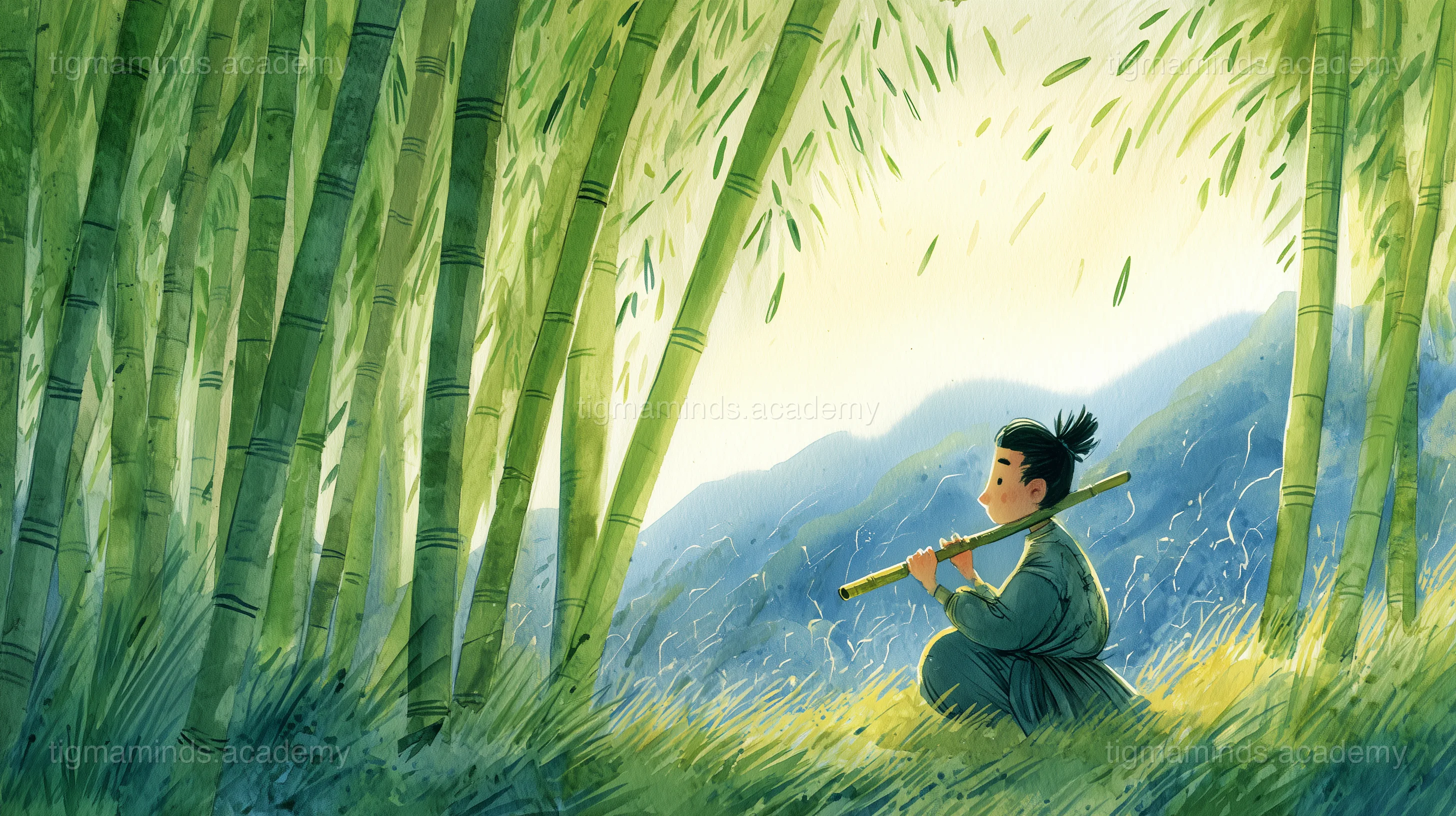
Vala lived on a hilltop in Mizoram, where the bamboo grew so thick that the forest looked like a green ocean frozen in mid-wave. His family's house was the only one on the hill — the nearest neighbour was a forty-minute walk down a mud path.

Vala had no brothers or sisters. No children lived nearby. His best friends were a rooster who followed him everywhere and a dog who was too old to follow anyone.

"I wish I had someone to talk to," Vala told his mother.

"Talk to the bamboo," she said, not looking up from her loom. "It has plenty to say."

The First Song

Vala thought his mother was joking. But that afternoon, when the wind picked up from the valley, he sat at the edge of the bamboo grove and listened.

At first, he heard only wind — the usual rushing and rustling. But as he sat still and his ears adjusted, he began to hear something else. The bamboo stalks were rubbing against each other, and each pair made a different sound. Thick stalks hummed low, like a sarinda. Thin stalks sang high, like a flute. Hollow stalks whistled. Cracked stalks clicked a rhythm.

Together, they made music.

Not random noise — music. A melody that rose and fell with the wind, that changed tempo when the gusts changed, that had verses and choruses and bridges, just like the songs his mother sang at the loom.

"You are singing," Vala whispered.

Learning the Language

Every day after school, Vala sat in the bamboo grove. He learned that morning wind made gentle songs — lullabies, almost. Afternoon wind made playful, dancing tunes. Storm wind made fierce, dramatic music that shook the ground.

He learned that different groves had different voices. The grove near the stream sang in a lower key because the stalks were thicker with water. The grove on the ridge sang higher because the bamboo was thinner and older. The grove behind his house — his favourite — sang in a voice that was warm and round, like his mother's.

Vala started bringing a bamboo flute and playing along. He would listen to the grove's melody, find the key, and join in. The bamboo didn't mind. If anything, it seemed to sway a little more when he played — leaning toward him, as if to hear better.

The Concert

One Sunday, Vala's mother invited relatives from the valley for a meal. His cousins were loud and boisterous, and Vala felt shy.

"Show them the bamboo," his mother said.

Reluctantly, Vala led his cousins to the grove. "Sit down and listen," he said.

They sat. They fidgeted. They were about to complain — and then the wind came. The grove began to sing its afternoon song, and Vala lifted his flute and joined in.

His cousins went quiet. For five minutes, they sat in the green light of the bamboo grove and listened to a duet between a boy and a forest. When it ended, the youngest cousin said, "Can the bamboo teach me a song too?"

"It already did," said Vala. "You just have to come back and listen."

The Singing Hills

In Mizoram, the people say that every bamboo grove has its own song. Some groves are cheerful. Some are mournful. Some sing only at night. The trick is not to make the bamboo sing — it already does. The trick is to be quiet enough to hear it.

Vala never felt lonely on his hilltop again. He had a whole orchestra growing in his backyard. And on windy days, if you climbed the path to his house, you could hear two voices on the hill — one made of wood and wind, and one made of breath and bamboo. Playing together. Perfectly in tune.

The end.

Try It Yourself

Choose your level. Everyone starts with the story — the code gets deeper as you go.

Story Progress

0%

Ready to Start Coding?

Here is a taste of what Level 1 looks like for this lesson:

Level 1: Explorer — Python
import numpy as np
import matplotlib.pyplot as plt

# Your first data analysis with Python
data = [45, 52, 38, 67, 41, 55, 48]  # measurements
mean = np.mean(data)

plt.bar(range(len(data)), data)
plt.axhline(mean, color='red', linestyle='--', label=f'Mean: {mean:.1f}')
plt.xlabel("Sample")
plt.ylabel("Value")
plt.title("Resonance & Harmonics — Sample Data")
plt.legend()
plt.show()

This is just the first of 6 coding exercises in Level 1. By Level 4, you will build: Build and Tune a Set of Bamboo Wind Chimes.

Free

Level 0: Listener

Stories, science concepts, diagrams, quizzes. No coding.

You are here

Enrolled

Levels 1-4

Python, NumPy, Matplotlib, real projects, mentorship.

Sign Up Free

Stay Updated

Join Waitlist

Get notified when enrollment opens for your area.

Notify Me

Level 0 is always free. Coding levels (1-4) are part of our 12-Month Curriculum.