
Ancient trade networks — economic geography.
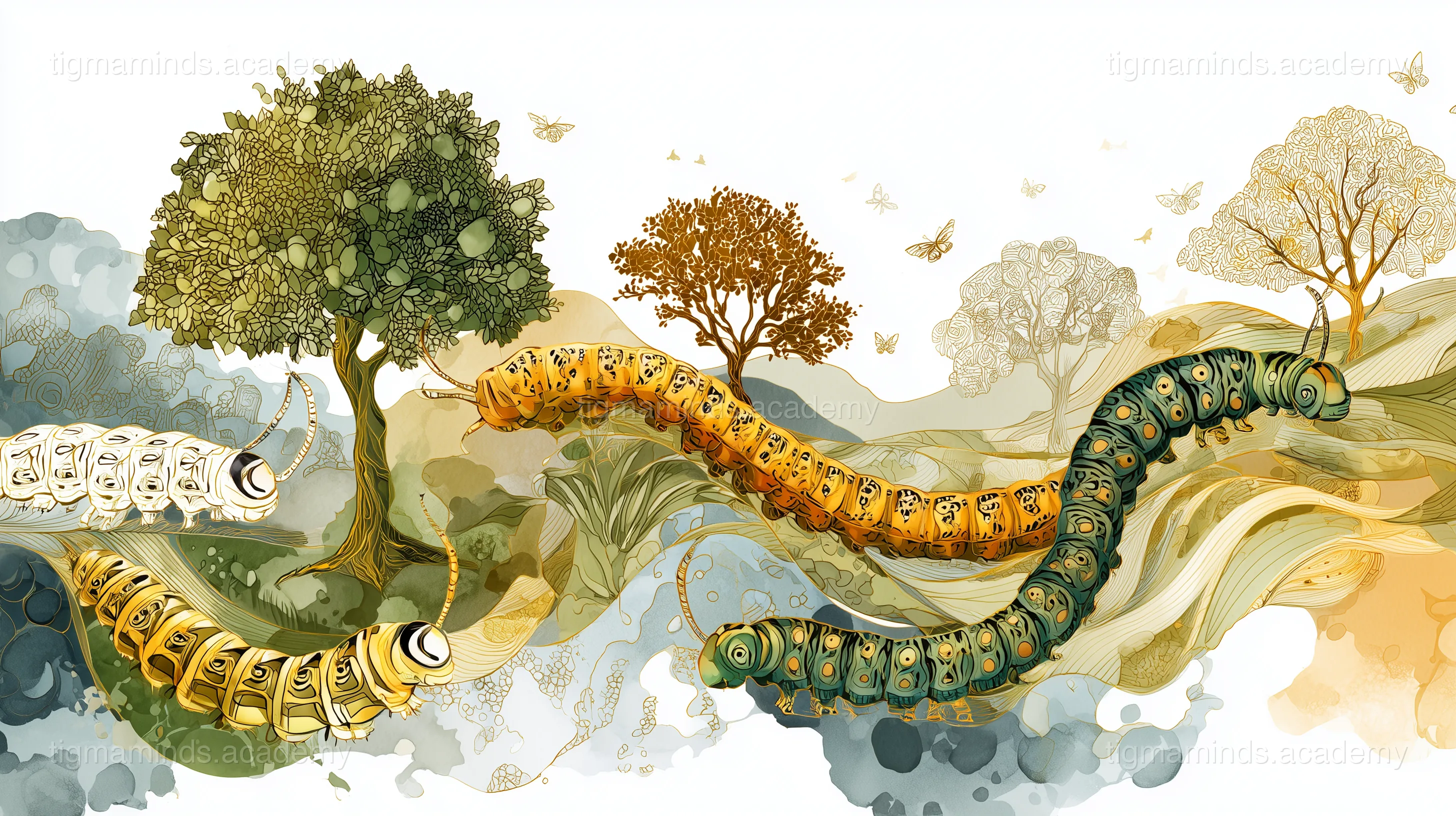
Three Friends
In the silk country of Assam, where mulberry trees and som trees grow side by side and the air hums with the quiet industry of spinning worms, there lived three caterpillars who were the best of friends.
Muga was a golden caterpillar who lived on the som tree. He was proud and a little vain, because the silk he spun was the colour of sunlight — golden muga silk, the most famous silk in all of Assam, so precious that it was once reserved for royalty.
Eri was a plump, cream-coloured caterpillar who lived on the castor plant. She was gentle and warm-hearted, and the silk she spun was soft and cosy — eri silk, sometimes called the peace silk, because it could be harvested without harming the caterpillar.
Pat was a small, energetic caterpillar who lived on the mulberry tree. He was quick and clever, and his silk was fine and white — pat silk, smooth and lustrous, perfect for the beautiful mekhela chadors that the women of Assam wore.
The three friends had never left their trees. But one morning, Muga said something that changed everything.
"I wonder," said Muga, "what the rest of Assam looks like."
The Journey Begins
They set off at dawn, three caterpillars inching along a country road, heading east toward the rising sun. It was slow going — caterpillars are not built for speed — but the world was full of wonders.
They crossed a tea garden, where the bushes grew in neat green rows and women with baskets plucked the tender top leaves. "This is where tea comes from!" said Pat, amazed. "I thought it grew in cups."
They passed a potter's village, where red clay pots dried in the sun. They crawled past a bamboo grove where basket weavers worked in the shade. They watched a fisherman cast his net in a beel — one of Assam's many wetland lakes — and pull up silver fish that flashed in the light.
"Assam makes so many things," said Eri, wonderingly.
"And we make silk," said Muga. "But which silk is the best?"
The Argument
It started as a friendly question and became a full argument — as things sometimes do among close friends.
"Golden muga is the best," said Muga. "It's the rarest silk on earth. It shines like gold. Kings wore it."
"Eri silk is the best," said Eri. "It's the warmest silk. Old people wrap themselves in it when winter comes. And nobody has to die to make it."
"Pat silk is the best," said Pat. "It's the most useful silk. Every bride in Assam wants a pat mekhela chador. Without pat silk, there would be no weddings."
They argued through a whole village, past a temple, across a bridge, and into a weaving hamlet near Sualkuchi — the silk village, where the looms clicked and clacked from every doorway.
The Weaver's Answer
An old weaver named Maina Baideo was sitting at her loom when three arguing caterpillars crawled up to her feet. She was not surprised — weavers in Sualkuchi have been talking to silkworms for generations.
"What's the matter?" she asked.
"Which silk is the best?" the caterpillars asked together.
Maina Baideo laughed — a warm, deep laugh that shook her silver hair. She reached behind her loom and pulled out three pieces of cloth.
The first was muga — it caught the light and glowed like a small sun. "This is for celebrations," she said. "For Bihu, for weddings, for the days when life shines brightest."
The second was eri — thick and soft, with a gentle sheen. "This is for comfort. For cold nights. For wrapping a baby or warming an elder. This silk is a hug."
The third was pat — smooth and white and lustrous, with delicate patterns woven into its surface. "This is for beauty. For the everyday art of getting dressed. This silk makes ordinary days feel special."
She looked at the three caterpillars. "Asking which silk is best is like asking which meal is best — breakfast, lunch, or dinner. You need all three. Each one does something the others can't."
The Return
The three caterpillars crawled home in companionable silence, each one thinking about what the weaver had said. They climbed back onto their own trees — som, castor, and mulberry — and began to spin.
Muga spun gold. Eri spun warmth. Pat spun beauty. And together, the three silks of Assam clothed the people of the land in every season, for every occasion, in every shade of wonderful.
They never argued about which silk was best again. Because the answer, they now understood, was all of them — woven together, like the best friendships, each thread making the others stronger.
The end.
Choose your level. Everyone starts with the story — the code gets deeper as you go.
Here is a taste of what Level 1 looks like for this lesson:
import numpy as np
import matplotlib.pyplot as plt
# Your first data analysis with Python
data = [45, 52, 38, 67, 41, 55, 48] # measurements
mean = np.mean(data)
plt.bar(range(len(data)), data)
plt.axhline(mean, color='red', linestyle='--', label=f'Mean: {mean:.1f}')
plt.xlabel("Sample")
plt.ylabel("Value")
plt.title("Trade Routes & Economic Geography — Sample Data")
plt.legend()
plt.show()This is just the first of 6 coding exercises in Level 1. By Level 4, you will build: Map and Analyze a Historical Trade Network.
Free
Level 0: Listener
Stories, science concepts, diagrams, quizzes. No coding.
You are here
Level 0 is always free. Coding levels (1-4) are part of our 12-Month Curriculum.
Ancient trade networks — economic geography.
The big idea: "The Silk Route of the Caterpillars" teaches us about Trade Routes & Economic Geography — and you don't need to write a single line of code to understand it.
Trade routes do not follow straight lines — they follow paths of least resistance determined by geography. Mountains, deserts, rivers, and oceans constrain movement. The ancient Silk Road zigzagged through Central Asia not because travelers wanted a longer journey, but because mountain passes, oasis cities, and river valleys created a network of feasible paths through otherwise impassable terrain.
Northeast India's ancient trade routes similarly followed geographic logic. The Brahmaputra Valley served as a natural corridor connecting India with Myanmar, Yunnan (China), and Southeast Asia. Passes through the Patkai Hills (like the Stillwell Road route) connected the Brahmaputra plains with the Chindwin and Irrawaddy valleys. Each route segment connected water sources, grazing land, and settlements — the "rest stops" that made long-distance travel survivable.
Modern network analysis can model these ancient decisions. Given a digital elevation model, water source locations, and settlement positions, algorithms can compute optimal routes that closely match historically known trade paths. The analysis reveals that ancient traders independently discovered near-optimal solutions to the same graph-theory problems that modern computer scientists study — they just used experience and intuition instead of algorithms.
Key idea: Trade routes follow paths of least resistance dictated by terrain, water sources, and settlements. Ancient traders independently found near-optimal network solutions that modern algorithms confirm.
Trade routes carry more than goods — they carry ideas, technologies, languages, religions, and diseases. The Silk Road introduced paper, gunpowder, the compass, and printing from China to Europe — four inventions that transformed Western civilization. It also spread Buddhism from India to China, Islam from Arabia to Central Asia, and plague from the Mongolian steppe to Europe (the Black Death of 1347).
Northeast India's position at the intersection of South, Southeast, and East Asian cultural zones made it a crucible of exchange. Silk weaving technology arrived from China via the Shan states; rice cultivation techniques spread from the Brahmaputra valley to Southeast Asia; Buddhist monasteries served as schools that transmitted knowledge alongside religion. The genetic and linguistic diversity of Northeast India reflects millennia of trade-driven mixing.
Economists model cultural exchange using diffusion theory — the same mathematics that describes how heat spreads through a material or how ink disperses in water. Cultural innovations spread from their point of origin outward, faster along trade routes (high-conductivity paths) and slower across barriers like mountains and deserts (low-conductivity zones). The resulting patterns of cultural similarity and difference map closely onto historical trade networks.
Key idea: Trade routes transmit ideas, technologies, and cultural practices alongside goods. Cultural diffusion follows the same mathematical patterns as heat diffusion — faster along connected corridors, slower across barriers.
Access all 130+ lessons, quizzes, interactive tools, and offline activities
**Economic geography** studies why economic activity concentrates in certain places and not others. The answer, proposed by Nobel laureate Paul Krugma...