The Seed That Traveled a Thousand Miles
Seed Dispersal Mechanisms

The Seed That Traveled a Thousand Miles

How seeds move — dispersal mechanisms.
Seed Dispersal Mechanisms12-Month Curriculum 12h

The Story

The Seed Falls

In the Hollongapar Gibbon Sanctuary near Jorhat, Assam, a great hollong tree — the tallest in the forest — dropped a single seed one autumn morning. The seed was small, no bigger than a child's fingernail, wrapped in a papery wing that caught the light.

"Where will I grow?" wondered the seed, whom we shall call Beej.

Beej looked down at the forest floor. It was dark and crowded. Giant roots tangled everywhere. Ferns and mosses covered every patch of soil. There was no room — not even for something as small as a seed.

"I need to find my own place," said Beej. "Somewhere with light and space and good earth."

And so began the longest journey a seed from Assam had ever taken.

The Bird

A hornbill landed on a branch above and spotted Beej's papery wing glinting in the sunlight. Thinking it was an insect, the hornbill scooped Beej up in her enormous beak — and then spat her out.

"Pah! Not food!" said the hornbill.

But the hornbill was already in flight, soaring east over the treetops. Beej tumbled from her beak and fell — not back to the dark forest floor, but onto a tea garden in Tinsukia, miles from home.

The tea garden was trimmed and tidy. No room for a wild tree here. A gust of wind lifted Beej's papery wing and carried her farther east, over the border into Arunachal Pradesh.

The River

Beej landed on the bank of the Lohit River, which flows fast and cold from the mountains. Before she could settle, a sudden rain washed her into the current. The water was terrifying — roaring, tumbling, crashing over rocks. Beej spun and bobbed and was pulled under twice.

But her papery wing worked like a tiny boat. She floated. The river carried her south, past villages and gorges, past fishermen who didn't notice a speck of brown in the brown water. Days passed. Beej was cold and waterlogged, but alive.

The Lohit joined the Brahmaputra, and the Brahmaputra's slow current carried Beej westward for a while, then nudged her into a smaller tributary flowing south toward Nagaland.

The Wind

The tributary dried to a trickle near a mountain pass. Beej lay on cracked mud, her papery wing tattered and thin. She thought her journey was over.

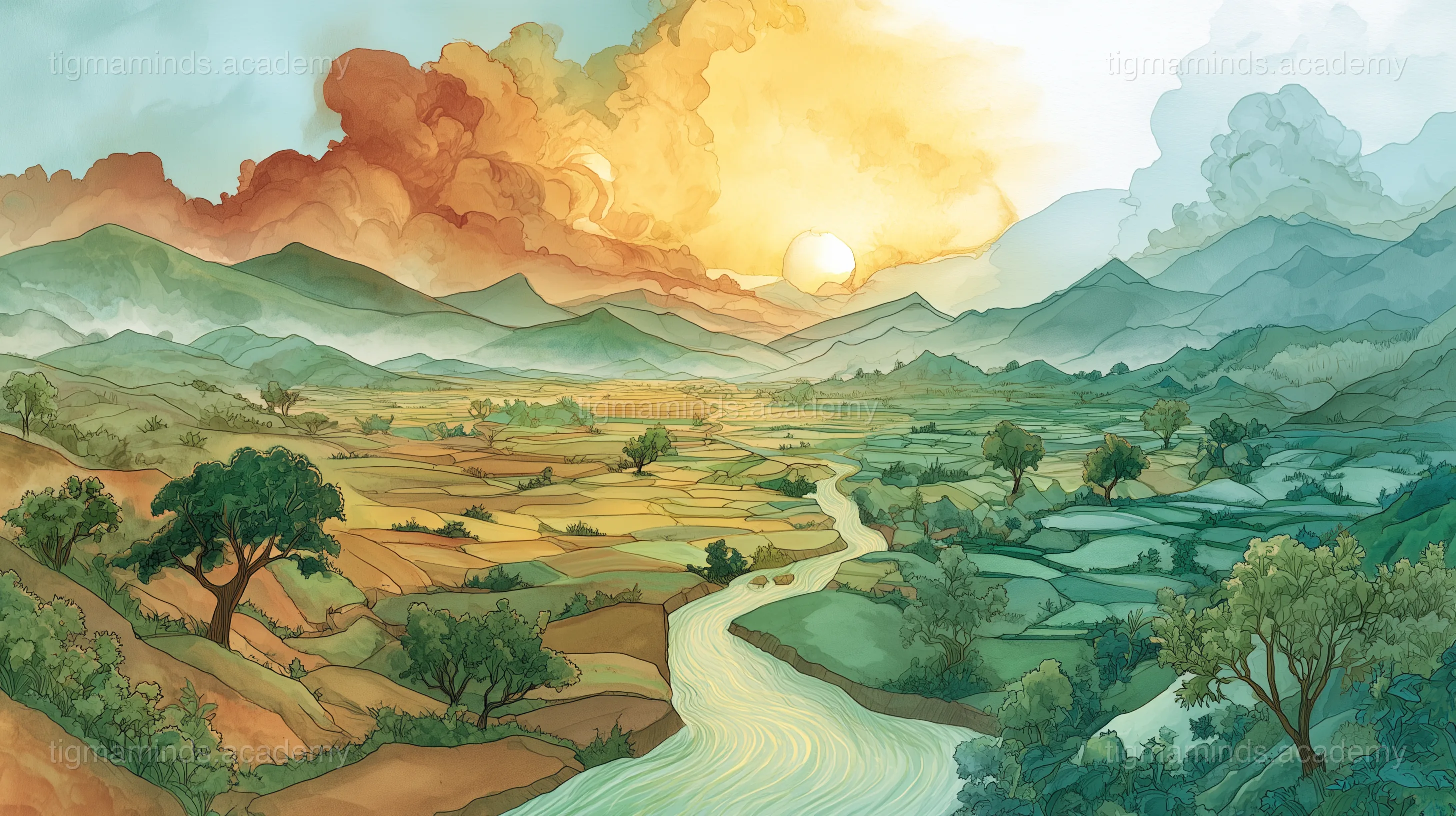
Then the autumn wind came — the strong, dry wind that blows through the passes between Nagaland and Manipur every October. It lifted Beej one last time, spinning her high above the hills. She could see everything — the green valleys, the terraced fields, the silver rivers like ribbons on a gift.

The wind set her down gently in a valley in Manipur, in a clearing where sunlight poured through a gap in the canopy. The soil was dark and rich. A stream ran nearby. There was space — beautiful, open, sunlit space.

"Here," said Beej. "This is my place."

The Tree

Beej buried herself in the soil. The monsoon rains came and soaked her. She cracked open — a tiny white root reaching down, a tiny green shoot reaching up. By the end of the first year, she was a seedling the height of a child's hand. By the fifth year, she was a sapling. By the twentieth year, she was a tree — not as tall as her mother in Hollongapar, but growing, always growing.

Birds nested in her branches. Insects lived in her bark. A family of hoolock gibbons — cousins of the ones in the Assam sanctuary — swung from her limbs. Beej had become a home, a thousand miles from where she started.

The Connection

A botanist studying the forests of Manipur found Beej's tree one day and was puzzled. "A hollong tree? Here? This species is native to Assam."

She took a sample and traced the tree's genetics back to Hollongapar — to the very grove where Beej's mother still stood. A seed had crossed three states, traveled by bird, river, and wind, and planted itself a thousand miles from home.

The people of the valley called the tree Meihou-thing — the "traveler tree." And they said that if a single seed can cross a thousand miles and grow into something tall and strong, then no journey is too long and no dreamer is too small.

The end.

Try It Yourself

Choose your level. Everyone starts with the story — the code gets deeper as you go.

Story Progress

0%

Ready to Start Coding?

Here is a taste of what Level 1 looks like for this lesson:

Level 1: Explorer — Python
import numpy as np
import matplotlib.pyplot as plt

# Simulate seed dispersal distances
# Wind-dispersed seeds follow an exponential decay
np.random.seed(42)
distances = np.random.exponential(scale=50, size=500)

plt.figure(figsize=(10, 5))
plt.hist(distances, bins=40, color='#22c55e', alpha=0.7,
         edgecolor='#166534')
plt.xlabel('Distance from parent tree (m)')
plt.ylabel('Number of seeds')
plt.title('Dispersal Kernel: Most seeds land close')
plt.axvline(x=np.median(distances), color='red',
            linestyle='--', label=f'Median: {np.median(distances):.0f}m')
plt.legend()
plt.show()  # What shape is this curve?

This is just the first of 6 coding exercises in Level 1. By Level 4, you will build: Test Seed Dispersal Distances by Mechanism.

By Level 4, enrolled students build: Test Seed Dispersal Distances by Mechanism

Free

Level 0: Listener

Stories, science concepts, diagrams, quizzes. No coding.

You are here

Enrolled

Levels 1-4

Python, NumPy, Matplotlib, real projects, mentorship.

Sign Up Free

Stay Updated

Join Waitlist

Get notified when enrollment opens for your area.

Notify Me

Level 0 is always free. Coding levels (1-4) are part of our 12-Month Curriculum.