
Genetic diversity — why traditional varieties matter.
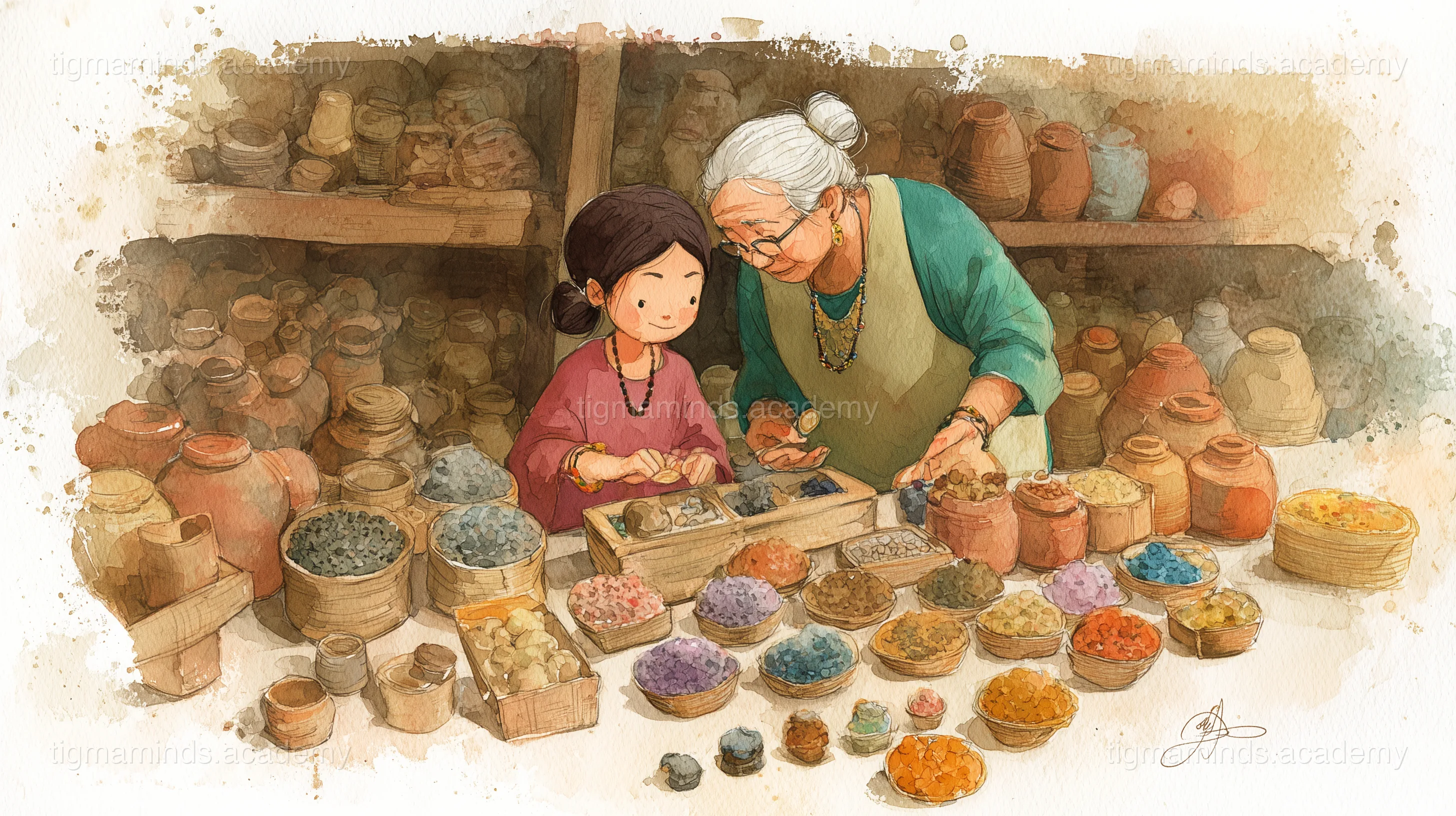
The Grandmother's Room
In a village in Nagaland, where the terraced fields climbed the hillsides like green staircases and the morning mist tasted of woodsmoke, there was a house with a special room. It was small — barely bigger than a closet — and its shelves were lined with hundreds of bamboo tubes, clay jars, and woven baskets, each one labelled in neat handwriting with names like black rice, king chilli, sticky corn, and grandmother's bean.
This was the seed room, and it belonged to Apfu Azuo, who was seventy-three years old and had been keeping seeds since she was a girl of twelve.
"Every seed in this room," Apfu Azuo told her grandchildren, "is a story."
The Granddaughter's Question
Apfu Azuo's granddaughter Vini was ten and impatient in the way that ten-year-olds are. She didn't understand why her grandmother spent hours every week sorting, drying, labelling, and storing seeds when you could buy seeds in packets from the market in town.
"Those are factory seeds," said Apfu Azuo, her voice carrying the gentle weight of certainty. "They grow one season and then you need to buy more. My seeds have been growing in these hills for longer than anyone can remember. They know this soil. They know this rain. They are our seeds."
"But they're just seeds," said Vini.
Apfu Azuo picked up a bamboo tube and poured a handful of dark, almost black rice grains into her palm. "This is black rice," she said. "My grandmother's grandmother brought this variety from a village three mountains away, walking for two days with the seeds tied in her shawl. That village no longer exists — it was swallowed by a landslide fifty years ago. This rice is the only thing left of that place. Is it just a seed?"
Vini looked at the black grains differently.
The Stories in the Seeds
Over the following weeks, Apfu Azuo showed Vini the stories hidden in every jar.
There was a king chilli — the bhut jolokia, one of the hottest chillies on earth — that had been in the family for five generations. "Your great-great-grandfather used to dare visitors to eat one," said Apfu Azuo. "Nobody ever finished."
There was a sticky corn that only grew in one particular terrace, on one particular hillside, facing one particular direction. "Move it anywhere else and it sulks," said the grandmother. "Plants have preferences, just like people."
There was a bean with no name except grandmother's bean, because nobody remembered what it was actually called. "It's been in this room since before I was born," said Apfu Azuo. "It grows beautifully, tastes wonderful, and has no name. Proof that you don't need a name to be important."
And there was a tiny envelope of wild orchid seeds — so fine they looked like dust — collected from a forest that had since been cleared for a road. "These seeds are the forest's memory," said the grandmother. "One day, when someone plants them, the forest will remember how to grow."
The Planting Lesson
In spring, Apfu Azuo took Vini to the terraced fields. Together, they planted — not with machines or chemicals, but with hands and hoes and the knowledge that had been passed down through the women of the family like the seeds themselves.
"Push the seed in with your thumb," said Apfu Azuo. "Not too deep. It needs to feel the sun calling."
Vini pressed a black rice seed into the wet earth and covered it gently. It was such a small act — one seed, one thumb, one square inch of soil — but it felt enormous. She was continuing something that had started generations before her and would continue generations after.
"When you plant a seed," said Apfu Azuo, "you are having a conversation with the future. You are saying: I trust you will be here to harvest this."
The New Seed Keeper
That summer, the black rice grew tall and dark and beautiful. The king chillies burned bright red on their bushes. The grandmother's bean climbed its bamboo stakes and produced pods so plump they seemed about to burst with stories.
When harvest came, Vini helped her grandmother select the best seeds from the best plants — not to eat, but to save. They dried them in the sun, sorted them by size, and placed them in fresh bamboo tubes with new labels written in Vini's careful handwriting.
"You're a seed keeper now," said Apfu Azuo.
Vini held a bamboo tube of black rice to her ear, as if listening for the story inside. "Seeds are stories that grow," she said, repeating what her grandmother had taught her.
"Yes," said Apfu Azuo. "And as long as someone keeps the seeds, the stories never end."
The end.
Choose your level. Everyone starts with the story — the code gets deeper as you go.
Here is a taste of what Level 1 looks like for this lesson:
import numpy as np
import matplotlib.pyplot as plt
# How many crop varieties have we lost?
years = np.array([1900, 1930, 1960, 1980, 2000, 2020])
varieties_pct = np.array([100, 85, 50, 25, 10, 6])
plt.figure(figsize=(10, 5))
plt.fill_between(years, varieties_pct, alpha=0.3, color='red')
plt.plot(years, varieties_pct, 'o-', color='red', linewidth=2)
plt.ylabel("% of varieties still grown")
plt.xlabel("Year")
plt.title("The Vanishing Harvest: Crop Diversity Loss")
plt.show() # What happened around 1960?This is just the first of 6 coding exercises in Level 1. By Level 4, you will build: Test Seed Germination Under Different Conditions.
By Level 4, enrolled students build: Test Seed Germination Under Different Conditions
Free
Level 0: Listener
Stories, science concepts, diagrams, quizzes. No coding.
You are here
Level 0 is always free. Coding levels (1-4) are part of our 12-Month Curriculum.
Genetic diversity — why traditional varieties matter.
The big idea: "The Seed Keeper of Nagaland" teaches us about Seed Banks & Genetic Preservation — and you don't need to write a single line of code to understand it.
Pick up a single seed — a grain of rice, a mustard seed, a bean. It looks like a small, dead thing. But inside that seed is a complete set of DNA instructions for building an entire plant: roots, stem, leaves, flowers, fruit. A seed is not dead; it is dormant — alive but waiting for the right conditions to wake up. Some seeds can wait for decades. One date palm seed waited 2,000 years before germinating in a laboratory in 2005.
Now think bigger. In a single village in Nagaland, Apfu Azuo’s seed room contains hundreds of varieties — black rice, sticky corn, king chilli, grandmother’s bean. Each variety carries a different combination of genes. The black rice has genes for growing in wet, terraced hillsides. The king chilli has genes for extreme capsaicin production. The wild bean has genes nobody has studied yet, but which might contain resistance to a disease that doesn’t even exist yet.
This is genetic diversity — the total variety of genes within a species. Think of it as a toolkit. A carpenter with 200 different tools can handle almost any job. A carpenter with only a hammer and a screwdriver is stuck when they need a saw. The more genetic variety a crop has, the more “tools” it has to deal with drought, new diseases, changing temperatures, or soil problems.
The danger of losing diversity was demonstrated in the Irish Potato Famine (1845–1852). Ireland grew essentially one potato variety — the “Lumper.” When a fungal blight called Phytophthora infestans arrived, every single potato plant was equally vulnerable because they were genetically identical. The blight destroyed nearly the entire crop for several years. Over one million people died of starvation. If Ireland had grown 20 different potato varieties, some would have had natural resistance to the blight, and the famine would have been far less severe.
Check yourself: If a new wheat disease appeared tomorrow, would it be better for humanity if farmers worldwide grew 5 wheat varieties or 5,000? Why?
Key idea: Seeds are living time capsules carrying unique DNA. Genetic diversity — many varieties, each with different genes — is a species’ insurance policy. When diversity is lost (monoculture), one disease can destroy everything, as the Irish Potato Famine proved.
If genetic diversity is so important, how do we protect it? One answer is a seed bank — a facility that collects, dries, and freezes seeds so they can be stored for decades or centuries. The most famous is the Svalbard Global Seed Vault, buried inside a mountain on a remote Arctic island in Norway. It holds over 1.1 million seed samples from around the world — a backup copy of Earth’s agricultural heritage.
But why does freezing work? Seeds are alive, and like all living things, their cells slowly deteriorate. DNA accumulates errors. Stored starch breaks down. Cell membranes leak. The speed of this decay depends on two things: temperature and moisture. A rule of thumb called Harrington’s Rule says that for every 5°C drop in temperature, seed lifespan roughly doubles. And for every 1% drop in moisture content, lifespan also roughly doubles. At room temperature and normal humidity, a rice seed might last 5 years. At −18°C and 5% moisture (Svalbard conditions), the same seed could last centuries.
The process: scientists collect seeds from at least 50 individual plants of each variety (to capture genetic range). They clean the seeds, test germination rate (must be ≥85%), dry them to 3–7% moisture, seal them in airtight foil packets, and store them at −18°C. Every 10–25 years, they test a sample to make sure the seeds are still viable, and if germination drops too low, they grow new plants and collect fresh seeds.
Not all seeds survive this process. “Orthodox” seeds (cereals, most vegetables) tolerate drying and freezing. But “recalcitrant” seeds (mango, cocoa, jackfruit, many tropical trees) die if dried or chilled below 15°C. These species cannot be stored in seed banks and must be preserved as living plants — which is far more expensive and vulnerable.
Check yourself: The Svalbard vault is built on an island at 78°N, inside a mountain, 130 metres above sea level. What are the advantages of this location? (Think about temperature, politics, and climate change.)
Key idea: Seed banks preserve crop diversity by drying seeds to low moisture and freezing them at −18°C. Harrington’s Rule: every 5°C cooler or 1% drier roughly doubles seed lifespan. Not all seeds can be banked — tropical “recalcitrant” seeds die when dried.
Access all 130+ lessons, quizzes, interactive tools, and offline activities
A seed sitting in a bamboo tube in Apfu Azuo’s room is alive but dormant. Its metabolism is almost stopped — barely ticking over. For it to wake up an...
The Svalbard vault is impressive, but the world’s oldest seed banks are not buildings — they are **farming communities**. In Nagaland, the Naga people...