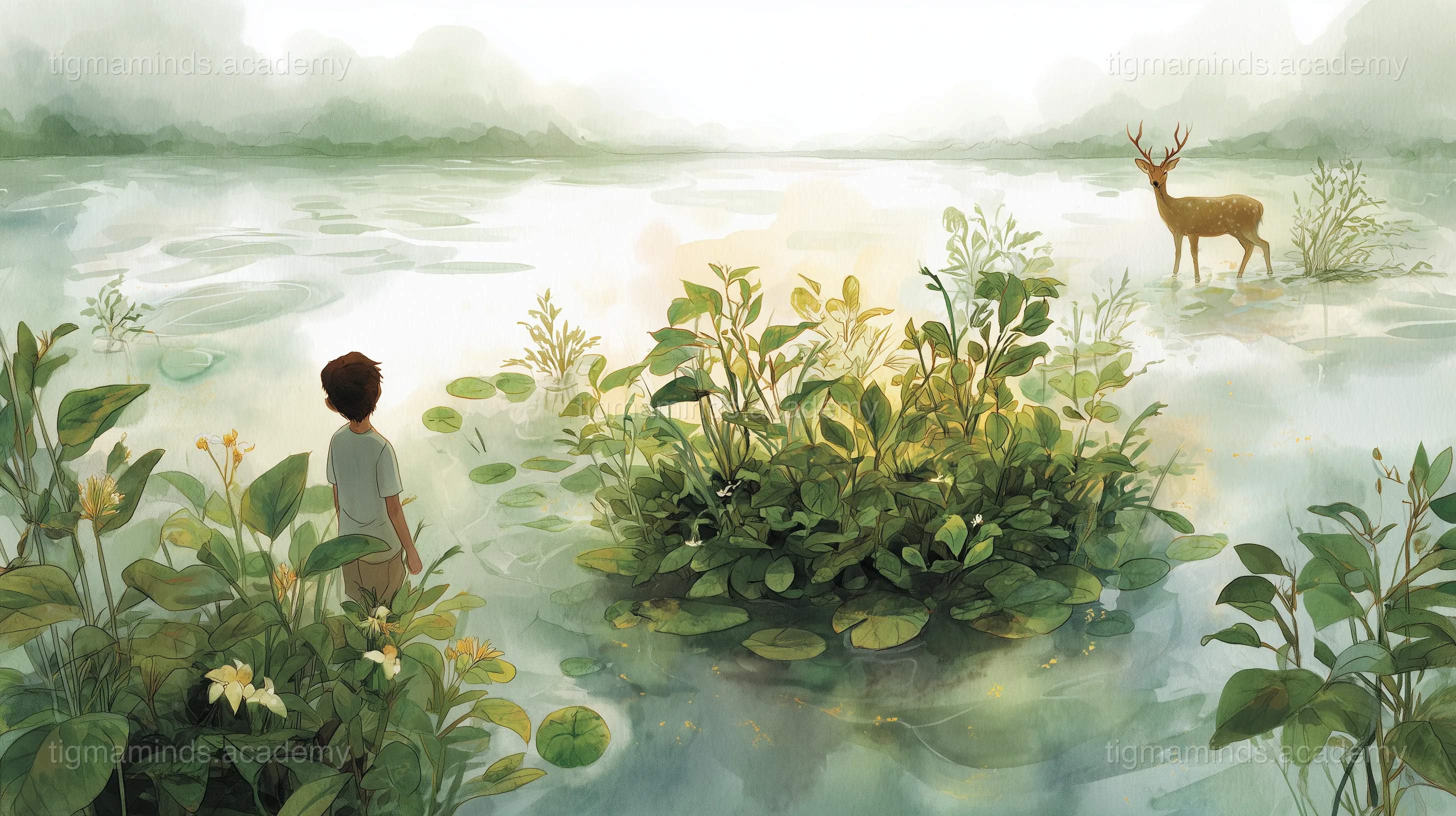
Floating islands that grow gardens.
The Floating World
Loktak Lake in Manipur is unlike any lake in the world. Its islands float. They are made of tangled vegetation and organic matter called phumdi — thick enough to walk on, light enough to drift with the wind. Some are as small as a dining table. Others are large enough to hold houses, gardens, and entire families.
A boy named Tomba lived on one of these floating islands with his grandmother, Ima Leima. Their island was medium-sized — big enough for a small bamboo house, a vegetable patch, and a circle of banana trees that acted as a windbreak. Every morning, Tomba woke to a different view, because the wind had turned their island overnight.
"Ima," Tomba asked one morning, "are there islands on this lake that nobody has ever seen?"
His grandmother looked up from the herbs she was grinding. "There is one," she said. "But it hides."
The Island That Hides
Ima Leima told Tomba the story as she stirred a pot of eromba over the fire.
"Long ago, before the roads came and the buses and the tourists, there was an island on Loktak that moved by itself — not with the wind, but against it. If you paddled toward it, it drifted away. If you waited for it, it came to you. The old healers called it Leipung Thambal — the secret garden."
"What was on it?" asked Tomba.
"Every medicinal plant that has ever grown in Manipur. Plants that cure fevers. Plants that heal broken bones. Plants that ease a sad heart. The island was a living pharmacy, planted by the lake spirit herself. But she hid it from people who wanted to take without giving back."
"How do you find it?" asked Tomba.
"You don't find it," said Ima Leima. "It finds you — when you're ready."
The Day the Island Came
A week later, Ima Leima fell ill. She developed a cough that wouldn't stop — deep and rattling, the kind that made Tomba press his hands over his ears. The village healer came and tried his usual remedies, but nothing worked.
"She needs nongmangkha," said the healer — a rare herb that grew only in the deepest parts of the lake's ecosystem. "I haven't seen it in twenty years."
Tomba didn't sleep that night. He sat in his small boat, tied to their floating island, watching the moonlight turn the lake to silver. He thought about Ima Leima's story. An island that comes to you when you're ready.
"I'm ready," he whispered to the lake. "Please."
At first, nothing happened. Then, slowly, the mist on the lake began to move — not scattering, but gathering, forming a path of silver fog across the water. And at the end of the path, half-hidden in the reeds, was a dark shape. An island. Small, round, and covered in plants so green they glowed in the moonlight.
Tomba untied his boat and paddled toward it. This time, the island didn't drift away. It waited.
The Secret Garden
Tomba stepped onto the phumdi and felt it give softly under his feet, like a living mattress. The island was no bigger than a classroom, but it was packed with more plants than he had ever seen in one place. Ferns with silver undersides. Creepers with flowers that smelled like rain. Bushes with berries that pulsed with a faint light.
And there, in the very centre, growing beside a cluster of water lilies, was a small plant with dark green leaves and tiny white flowers. Tomba didn't know its name, but something told him — a feeling, a warmth in his chest — that this was the one.
He knelt down and whispered, "May I take some? My grandmother is sick."
The plant's leaves rustled, though there was no wind. Tomba took this as a yes. He carefully picked three stems, leaving the roots intact so the plant could grow back.
As he stepped back into his boat, the island began to drift away, dissolving slowly into the mist until it was gone — as if it had never been there at all.
The Healing
Tomba raced home and brewed the leaves into a tea, the way he had watched Ima Leima prepare medicines a hundred times. The tea was bitter and green and smelled like the forest after rain.
Ima Leima drank it slowly, coughing between sips. By morning, the cough had eased. By the next day, it was gone. Within a week, she was back at her herb-grinding stone, humming a Manipuri folk song as if she had never been ill.
"Ima," said Tomba. "I found the secret garden."
Ima Leima looked at him for a long time. Then she smiled. "I know," she said. "The lake told me. It said you asked permission before you picked. That's why the island let you on."
"Will I find it again?" asked Tomba.
"Only if you need to," said his grandmother. "And only if you remember to ask, not take. The secret garden gives to those who give respect. That is the oldest rule of the lake."
Tomba grew up to become a healer himself — one who always asked before he picked, who always left roots in the ground, and who knew that the best medicine comes not from grabbing, but from listening.
The end.
Choose your level. Everyone starts with the story — the code gets deeper as you go.
Here is a taste of what Level 1 looks like for this lesson:
import numpy as np
import matplotlib.pyplot as plt
# Your first data analysis with Python
data = [45, 52, 38, 67, 41, 55, 48] # measurements
mean = np.mean(data)
plt.bar(range(len(data)), data)
plt.axhline(mean, color='red', linestyle='--', label=f'Mean: {mean:.1f}')
plt.xlabel("Sample")
plt.ylabel("Value")
plt.title("Aquatic Botany — Sample Data")
plt.legend()
plt.show()This is just the first of 6 coding exercises in Level 1. By Level 4, you will build: Build a Mini Floating Garden.
Free
Level 0: Listener
Stories, science concepts, diagrams, quizzes. No coding.
You are here
Level 0 is always free. Coding levels (1-4) are part of our 12-Month Curriculum.
Floating island ecology.
The big idea: "The Secret Garden of Loktak Lake" teaches us about Aquatic Botany — and you don't need to write a single line of code to understand it.
Loktak Lake in Manipur is famous for its phumdis — floating mats of vegetation that are among the largest natural floating islands on Earth. A phumdi is a heterogeneous mass of decomposing plant material, soil, and organic debris that has accumulated over decades or centuries. The mats are thick enough (up to 2 metres) to support human habitation; entire communities live on them.
A phumdi floats because its bulk density is lower than water. The decomposing organic matter traps gas bubbles (methane and CO2 from anaerobic decomposition) within the mat, increasing buoyancy. The root systems of living plants — grasses, sedges, and floating-leaved species — bind the mat together structurally. If the decomposition rate exceeds the rate of new plant growth, the phumdi thins and can break apart or sink.
The water level of Loktak Lake is now controlled by the Ithai Barrage dam, built in 1983. This has disrupted the natural water level fluctuations that phumdis depend on: during low water, phumdis touch the lake bottom and absorb nutrients; during high water, they float and photosynthesize freely. The dam keeps water unnaturally high, preventing this cycle and causing phumdis to thin and degrade — a case study in how hydrology engineering can have unintended ecological consequences.
Key idea: Phumdis float because trapped decomposition gases reduce their bulk density below water — they depend on natural water-level cycles that dam construction has disrupted.
Wetland water chemistry is far more complex than a swimming pool. Dissolved oxygen (DO) levels vary dramatically: surface waters exposed to air and photosynthetic plants may be oxygen-rich, while deeper waters and areas beneath thick phumdis can be nearly anoxic (oxygen-free). This vertical oxygen gradient creates distinct ecological niches — aerobic organisms above, anaerobic microbes below.
The pH of Loktak Lake varies between roughly 6.5 and 8.5, influenced by photosynthesis (which removes CO2 and raises pH during the day), respiration (which adds CO2 and lowers pH at night), and the decomposition of organic matter (which produces organic acids). This daily pH cycling means that organisms living in the lake must tolerate a range of conditions — a different kind of survival challenge than temperature.
Eutrophication — the over-enrichment of water with nutrients, especially nitrogen and phosphorus — is a growing threat to Loktak. Agricultural runoff, untreated sewage, and fertilizer from surrounding areas feed algal blooms. When the algae die and decompose, bacteria consume dissolved oxygen, creating dead zones where fish and other aerobic life cannot survive. Monitoring nutrient levels and dissolved oxygen is essential for managing the lake's health.
Key idea: Wetland water chemistry — dissolved oxygen, pH, and nutrient levels — varies continuously in space and time, creating a mosaic of microhabitats that supports high biodiversity but is vulnerable to pollution.
Access all 130+ lessons, quizzes, interactive tools, and offline activities
Wetlands cover only about 6% of the Earth's land surface but support a disproportionate share of global biodiversity. Loktak Lake alone hosts over 230...