The Sand Mandala
Geometry, Symmetry & Fractals

The Sand Mandala

A sacred pattern made to be destroyed — the geometry of impermanence.
Geometry, Symmetry & Fractals12-Month Curriculum 10h

The Story

The Monks Arrive

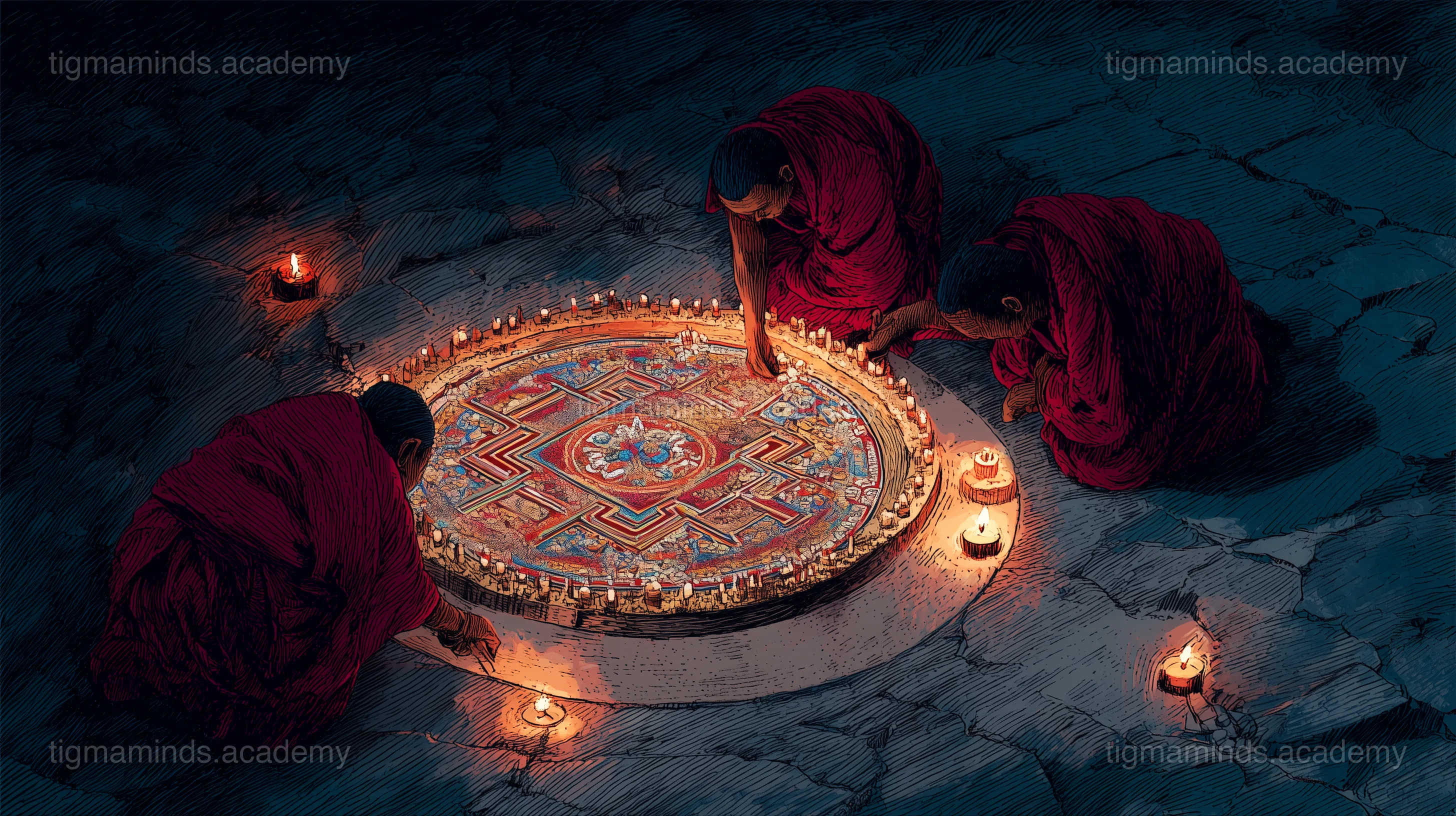
They came in winter, when the air in Tawang was so cold it hurt to breathe and the monastery walls were white with frost. Four monks from Dharamsala, carrying nothing but cloth bundles and quiet smiles.

The head monk's name was Lobsang. He was old, with hands that were steady as stone and eyes that crinkled when he spoke. He bowed to the abbot and said, "We have come to build a mandala."

Tenzin, a fourteen-year-old novice, was assigned to help. He watched with growing curiosity as they unpacked their tools: metal funnels called chak-pur, small brass scrapers, and dozens of sealed jars.

"What is in the jars?" Tenzin asked.

"Sand," said Lobsang. "Coloured sand. Ground from stone — marble for white, lapis lazuli for blue, malachite for green, cinnabar for red."

The First Lines

The next morning, the monks cleared a large wooden table in the prayer hall. Lobsang took a long string coated in white chalk, stretched it from corner to corner, and snapped it against the surface. A perfect straight line appeared. He did this again and again until the table was covered in a precise grid.

"Every mandala begins with geometry," Lobsang told Tenzin. "Perfect circles. Perfect symmetry. If the centre is wrong by even a grain of sand, the whole pattern will be crooked."

Then the monks picked up the chak-pur and filled them with coloured sand. One monk drew a metal rod along the ridged surface of the funnel, creating a vibration that released a thin, controlled stream of sand. Grain by grain, colour by colour, the mandala began to grow.

The Pattern Reveals Itself

Over five days, Tenzin watched the mandala emerge. It grew outward from the centre in perfect symmetry — whatever appeared on the north side appeared identically on the south, east, and west. Lotus petals in red and gold. Gates with tiny guardian figures. Rings of flame. Diamond patterns within diamond patterns, each one smaller than the last, like looking into a mirror reflected in another mirror.

"Why is everything the same on all four sides?" Tenzin asked.

"Because the mandala represents the universe," said Lobsang. "And the universe has balance. Turn it any direction — it should look the same."

Tenzin noticed something else. The patterns repeated at different sizes. A small lotus at the centre was echoed by a larger lotus at the second ring, echoed by an even larger one at the outer edge. The same shape, the same proportions, at three different scales.

"It is like a tree," Tenzin said. "A branch looks like a small copy of the whole tree."

Lobsang smiled for the first time. "You are learning to see."

The Destruction

On the seventh day, Lobsang gathered everyone in the prayer hall. He chanted a prayer. Then he picked up a small brush and, without hesitation, drew it through the centre of the mandala.

Tenzin gasped. The perfect lines blurred. Red bled into blue. Gold scattered across white. The other monks joined, sweeping the sand inward, collapsing days of work into a mound of mixed sand in less than five minutes.

"Why?" Tenzin whispered.

Lobsang scooped the sand into a jar and walked to the stream behind the monastery. He poured the sand into the flowing water and watched it disappear.

"The mandala teaches two things," Lobsang said. "The first is that you can create something perfect through patience, precision, and skill. The second is that nothing lasts. Not the mandala. Not the monastery. Not us."

"The purpose of the mandala is not to exist. It is to be made, and then to be released. That is what impermanence means."

Tenzin watched the last grains vanish into the stream. The mandala was gone. But the geometry was still in his mind — the perfect symmetry, the repeating patterns, the mathematics of something sacred.

That, he realised, was the part that lasted.

The end.

Try It Yourself

Choose your level. Everyone starts with the story — the code gets deeper as you go.

Story Progress

0%

Ready to Start Coding?

Here is a taste of what Level 1 looks like for this lesson:

Level 1: Explorer — Python
import turtle
t = turtle.Turtle()
t.speed(0)
turtle.Screen().bgcolor("black")
colors = ["#FF6B6B","#4ECDC4","#45B7D1","#96CEB4","#FFEAA7","#DDA0DD"]

def petal(size):
    for _ in range(2):
        t.circle(size, 60)
        t.left(120)

for ring in range(1, 6):
    t.color(colors[ring % len(colors)])
    for i in range(8):
        t.penup(); t.goto(0,0)
        t.setheading(i * 45)
        t.forward(ring * 30); t.pendown()
        petal(ring * 15)
# What happens if you change 8 to 12?
turtle.done()

This is just the first of 6 coding exercises in Level 1. By Level 4, you will build: Build a Mandala Generator.

By Level 4, enrolled students build: Build a Mandala Generator

Free

Level 0: Listener

Stories, science concepts, diagrams, quizzes. No coding.

You are here

Enrolled

Levels 1-4

Python, NumPy, Matplotlib, real projects, mentorship.

Sign Up Free

Stay Updated

Join Waitlist

Get notified when enrollment opens for your area.

Notify Me

Level 0 is always free. Coding levels (1-4) are part of our 12-Month Curriculum.