Why the Sal Tree Never Bends
Wood Science & Material Strength

Why the Sal Tree Never Bends

The strength of tropical hardwood.
Wood Science & Material Strength12-Month Curriculum 12h

The Story

Two Seeds

Long ago, before the forests of Assam had names, two seeds fell from the sky during a thunderstorm. They landed side by side in a clearing near the Kaziranga grasslands — so close their roots would tangle before the year was out.

One seed became a sal tree. The other became a bamboo.

They grew together, drinking from the same rain, warmed by the same sun. But from the very beginning, they were different.

The Sal's Choice

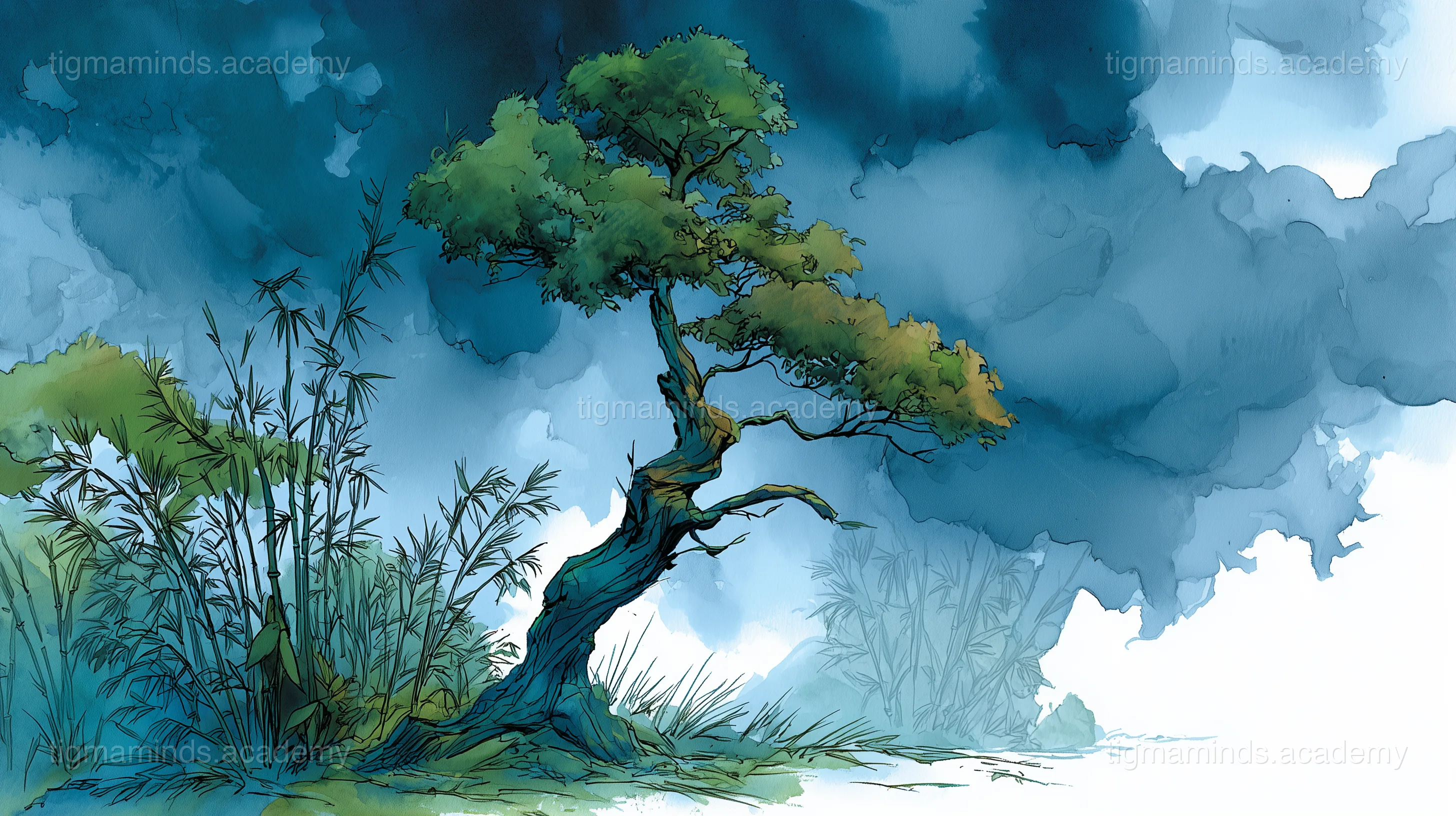
The sal tree grew upward — straight and thick, with bark as hard as stone. Her trunk was so solid that woodpeckers broke their beaks trying to drill into it. Her branches were heavy and wide, like the arms of a wrestler.

"Why do you make yourself so stiff?" asked the bamboo one breezy afternoon, swaying gently in the wind. "You can't even nod when the wind says hello."

"Because I chose strength," said the sal tree. "I want to stand firm no matter what comes. When the elephants rub their backs on me, I do not move. When the monsoon throws its worst, I do not lean. I am the same in every season — steady, strong, unbroken."

The Bamboo's Choice

The bamboo grew differently. She was tall — taller than the sal, even — but thin and hollow inside. When the wind blew, she bent almost to the ground, her leaves brushing the grass. When the wind stopped, she sprang back up, laughing.

"Why do you bend so easily?" asked the sal. "You look like you're about to snap."

"Because I chose flexibility," said the bamboo. "I bend so I do not break. The wind passes through me like water through a net. I am never fighting — always dancing."

The sal shook her heavy branches disapprovingly. "Dancing is not strength."

"And stiffness," said the bamboo gently, "is not the only kind of courage."

The Great Storm

One October, a cyclone came roaring up the Brahmaputra valley — the worst storm in a hundred years. The wind screamed through the forests like a freight train. Trees were uprooted. Whole hillsides were stripped bare.

The bamboo bent so far that her crown touched the earth. She lay flat, pressed against the ground like a prayer mat, while the wind howled above her. Every fibre in her body strained. But she held. She bent, and she held.

The sal tree did not bend at all. The wind hit her like a wall. Her trunk groaned. Her roots gripped the earth with everything they had. Branches snapped and flew away like kindling. Bark was stripped from her sides. But her trunk — that thick, iron-hard trunk — did not move.

When morning came, both the sal and the bamboo were still standing.

Two Kinds of Strength

The sal had lost half her branches. Her crown was ragged, her bark scarred. But she stood as straight as ever, her roots deep and unmoved.

The bamboo slowly uncurled from the ground, shook the rain from her leaves, and stood tall again — unmarked, unhurt, as if the storm had been nothing but a strong breeze.

They looked at each other in the grey morning light.

"You survived by not moving," said the bamboo.

"You survived by moving with everything," said the sal.

And for the first time, neither one said her way was better. Because the forest needs both — the tree that stands firm and the tree that bends low. The one that says I will not be moved and the one that says I will move with the wind and come back.

That is why, in the forests of Northeast India, you will always find the sal and the bamboo growing side by side. The sal never bends. The bamboo never stops bending. And together, they make a forest that no storm can destroy.

The end.

Try It Yourself

Choose your level. Everyone starts with the story — the code gets deeper as you go.

Story Progress

0%

Ready to Start Coding?

Here is a taste of what Level 1 looks like for this lesson:

Level 1: Explorer — Python
import matplotlib.pyplot as plt

# Compare wood species: density vs strength
species = ["Balsa", "Pine", "Oak", "Sal", "Teak"]
density = [0.16, 0.50, 0.60, 0.88, 0.65]  # g/cm³
strength = [12, 40, 55, 78, 62]            # MPa (along grain)

plt.scatter(density, strength, s=100, c='sienna')
for i, name in enumerate(species):
    plt.annotate(name, (density[i], strength[i]),
                 textcoords="offset points", xytext=(8, 5))
plt.xlabel("Density (g/cm³)")
plt.ylabel("Tensile Strength (MPa)")
plt.title("Denser Wood = Stronger Wood?")
plt.show()  # What pattern do you see?

This is just the first of 6 coding exercises in Level 1. By Level 4, you will build: Compare Wood Strength Across Tree Species.

By Level 4, enrolled students build: Compare Wood Strength Across Tree Species

Free

Level 0: Listener

Stories, science concepts, diagrams, quizzes. No coding.

You are here

Enrolled

Levels 1-4

Python, NumPy, Matplotlib, real projects, mentorship.

Sign Up Free

Stay Updated

Join Waitlist

Get notified when enrollment opens for your area.

Notify Me

Level 0 is always free. Coding levels (1-4) are part of our 12-Month Curriculum.