
A blind dolphin teaches a boy that seeing isn't the only way to understand the world.
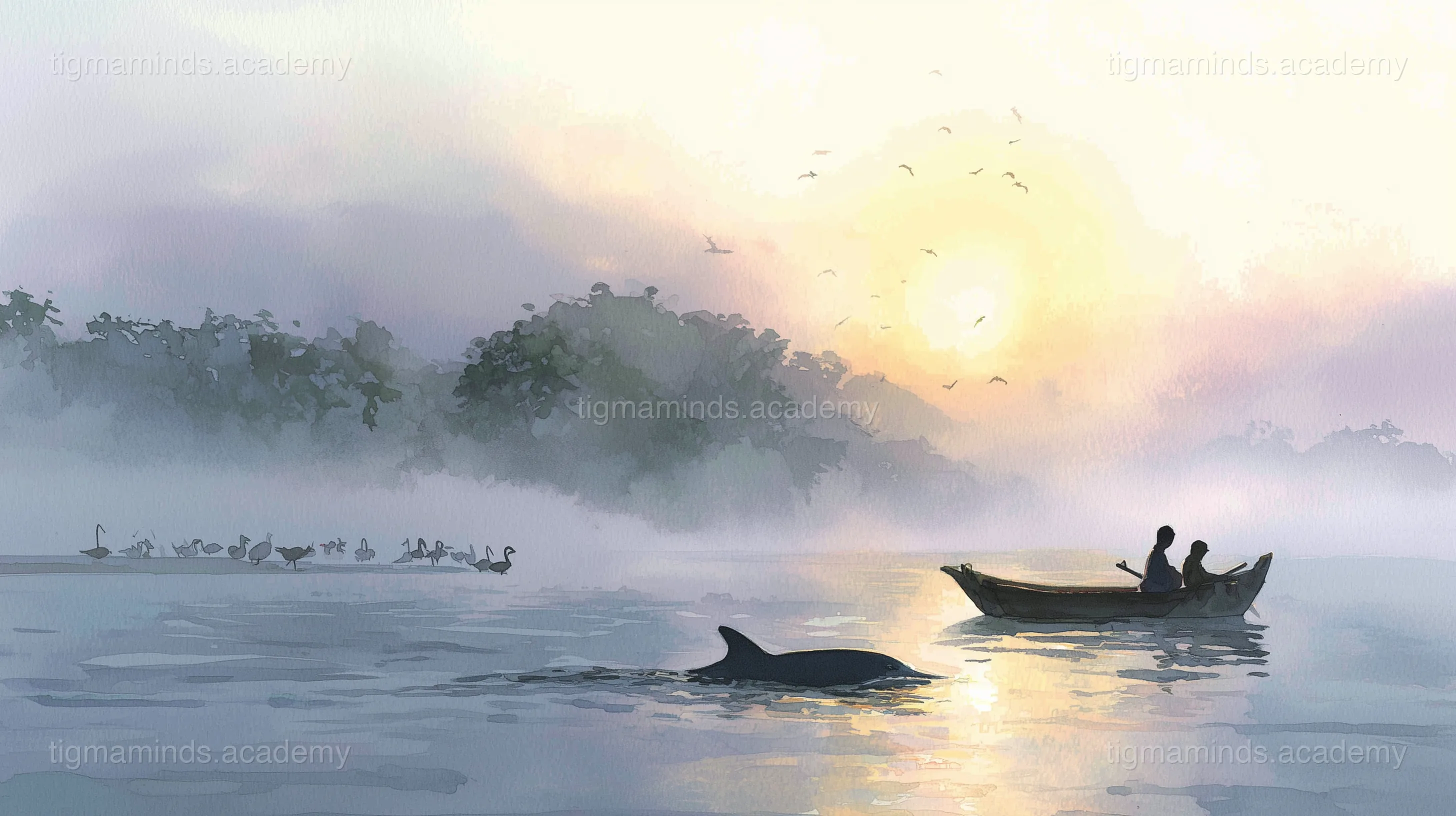
The Blind Swimmer
The Gangetic river dolphin is one of the strangest creatures in the Brahmaputra. It is almost completely blind — its eyes can only tell light from dark. It finds its way through the murky river using sound, sending out clicks and listening to the echoes. It has survived for millions of years without ever truly seeing the river it calls home.
A boy named Nabajit knew all of this because his father was a river guide in Guwahati. But knowing facts and understanding them are different things.
The Foggy Day
One winter morning, Nabajit and his father took their boat out on the Brahmaputra. The fog was so thick that Nabajit couldn't see his own hand in front of his face. His father turned off the motor and let the boat drift.
"I can't see anything," said Nabajit. "How will we get back?"
"Listen," said his father.
Nabajit listened. At first, all he heard was silence. Then, slowly, sounds emerged. The lap of water against the hull. The distant honk of a ferry. The splash of a fish. The soft, rhythmic pfffsshh of a river dolphin surfacing to breathe.
"There," said his father, pointing toward the sound. "Follow the dolphin. She knows where the deep channel is."
Following Sound
They drifted through the fog, following the dolphin's breathing. Pfffsshh. Left. Pfffsshh. Straight ahead. Pfffsshh. Slight right. The dolphin was navigating perfectly through water she had never seen, using nothing but echoes.
Nabajit closed his eyes and tried to build a picture of the river using only his ears. He could hear the water moving faster where the channel narrowed. He could hear waves lapping against the bank — which told him where the shore was. He could hear the ferry getting closer, which meant they were near the ghat.
"I can almost see it," said Nabajit, eyes still closed. "The river. The shore. The ferry. It's all there, in the sounds."
The Dolphin's Secret
When the fog lifted, Nabajit saw that the dolphin had led them to a sandbar covered with resting birds — bar-headed geese, cormorants, river terns. It was the most beautiful spot on the river, and Nabajit had never seen it before.
"The dolphin comes here every morning," said his father. "She can't see the birds, but she can hear their heartbeats. She likes the company."
Nabajit watched the dolphin surface one more time — her long, narrow snout breaking the water, her tiny eyes seeing nothing but grey light — and he understood something he hadn't before.
Seeing is just one way of knowing the world. The dolphin knew the river better than any human — every current, every sandbar, every deep pool — and she had never seen any of it. She had listened her way to understanding.
The New Habit
From that day on, every time Nabajit went on the river, he spent five minutes with his eyes closed, just listening. And every time, he heard something new — a sound he had been too busy looking to notice.
The river dolphin had taught him her secret: the world speaks to those who close their eyes and open their ears.
The end.
Choose your level. Everyone starts with the story — the code gets deeper as you go.
Here is a taste of what Level 1 looks like for this lesson:
import numpy as np
import matplotlib.pyplot as plt
# Simulate a sonar sweep (angle vs distance)
angles = np.arange(0, 181, 10) # 0 to 180 degrees
distances = [120, 95, 85, 45, 60, 200, 180, 150,
28, 35, 90, 110, 130, 85, 70, 95, 105, 88, 120]
# Convert polar to Cartesian (x, y)
rads = np.radians(angles)
x = distances * np.cos(rads)
y = distances * np.sin(rads)
plt.figure(figsize=(10, 6))
plt.scatter(x, y, c=distances, cmap="cool", s=60)
plt.colorbar(label="Distance (cm)")
plt.title("Sonar Sweep: Room Map from Sound")
plt.xlabel("x (cm)")
plt.ylabel("y (cm)")
plt.axis("equal")
plt.grid(True, alpha=0.3)
plt.show() # What shape is the room?This is just the first of 6 coding exercises in Level 1. By Level 4, you will build: Build a Sonar Range Finder.
By Level 4, enrolled students build: Build a Sonar Range Finder
Free
Level 0: Listener
Stories, science concepts, diagrams, quizzes. No coding.
You are here
Level 0 is always free. Coding levels (1-4) are part of our 12-Month Curriculum.
River dolphins "see" using echolocation — they send sound pulses and listen for echoes. Sonar sensors work the same way. You'll build a device that maps its surroundings using ultrasonic sound, just like a dolphin.
The big idea: "The River Dolphin's Secret" teaches us about Sonar Sensors & Arduino — and you don't need to write a single line of code to understand it.
Imagine you are standing in a completely dark room. You cannot see anything. But if you clap your hands, you hear the echo bounce off the walls — and from that echo, you can tell roughly how big the room is and where the walls are. That is the basic idea behind echolocation: sending out a sound and listening to what comes back.
The Ganges river dolphin does this hundreds of times per second. It produces sharp clicking sounds using structures called phonic lips inside its nasal passages. Each click lasts less than a thousandth of a second. The click travels outward through the water, hits an object — a fish, a rock, the riverbed — and bounces back as an echo. The dolphin’s brain measures how long the echo took to return and calculates how far away the object is.
Prediction before you read on: if the echo returns quickly, is the object close or far away? Think about it. The answer: close. A quick echo means the sound didn’t have to travel far. A slow echo means the object is distant. This one idea — time delay tells you distance — is the foundation of all sonar, radar, and ultrasound technology.
The dolphin doesn’t just get distance. The echo also carries information about what the object is. Hard objects like rocks produce loud, sharp echoes. Soft objects like fish produce quieter, more muffled echoes. Small objects reflect high-pitched sounds but let low-pitched sounds pass by. The dolphin’s brain reads all of these clues — loudness, pitch, timing — and assembles a detailed mental picture, like building a 3D model from sound alone.
Key idea: Echolocation is seeing with sound: send a click, listen for the echo, and measure how long it takes to return. Quick echo = close object. Slow echo = far object. The dolphin does this 100 times per second.
Sound is a vibration that travels through matter by bumping molecules into each other, like a chain of dominoes. The closer together the molecules are, the faster the vibration passes from one to the next. In air, molecules are spread far apart, so sound travels at about 343 meters per second (roughly the length of 3 football fields every second). In water, molecules are packed much more tightly, so sound travels at about 1,480 m/s — more than 4 times faster.
Check yourself: if sound is 4.3 times faster in water, and a dolphin’s click takes 0.01 seconds to echo back from a fish, how far away is the fish? Work it out: distance = speed × time / 2 = 1,480 × 0.01 / 2 = 7.4 meters. The division by 2 is because the sound travels to the fish and back — the round trip is twice the actual distance.
This speed difference is why sonar works so much better underwater than in air. In water, sound covers enormous distances before fading out. Whale songs can travel thousands of kilometres across the ocean. In air, sounds fade quickly because the molecules are too spread out to carry the vibration efficiently. A submarine’s sonar can detect objects 10 km away; an ultrasonic sensor in air maxes out at about 4 meters.
Temperature matters too. Warm water transmits sound faster than cold water (molecules move faster when heated). The formula for sound speed in air is: speed = 331.3 + (0.606 × temperature_°C) m/s. At 0°C, sound is 331 m/s; at 35°C, it’s 352.5 m/s. A sonar system that doesn’t account for temperature will give wrong distances — off by several centimetres, which matters for precision applications like medical ultrasound.
Key idea: Sound travels 4.3 times faster in water (1,480 m/s) than in air (343 m/s) because water molecules are packed tightly. This makes water the ideal medium for sonar — and is why dolphins evolved echolocation.
Access all 130+ lessons, quizzes, interactive tools, and offline activities
You can build your own echolocation device using an Arduino microcontroller and an **HC-SR04 ultrasonic sensor** — a small, inexpensive circuit board ...
The Ganges river dolphin (Platanista gangetica) is one of the most extreme examples of adaptation on Earth. It lives in the silt-laden waters of the G...