Why Rivers Braid Near the Sea
River Geomorphology

Why Rivers Braid Near the Sea

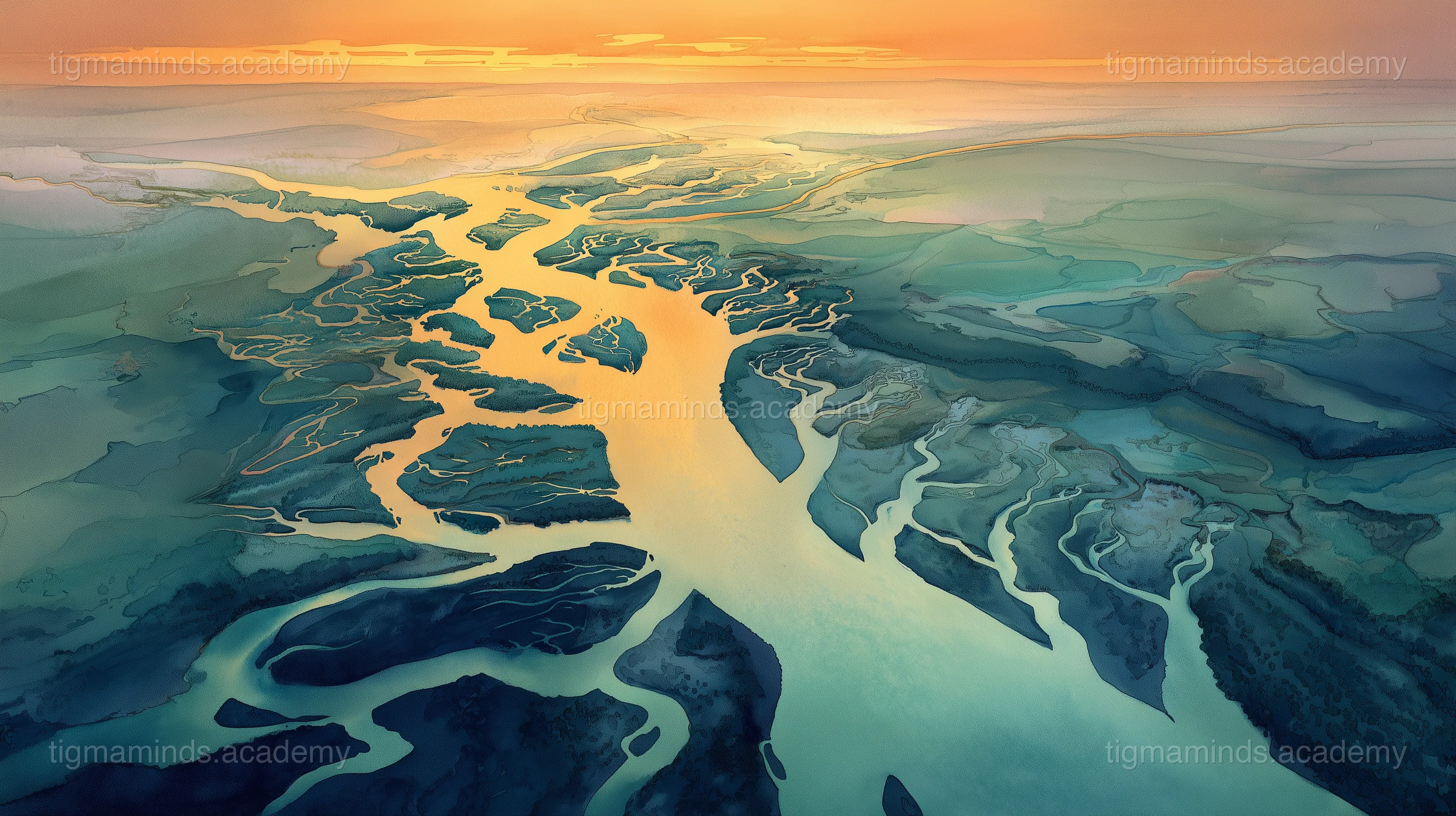
River patterns — braided channel geomorphology.
River Geomorphology12-Month Curriculum 12h

The Story

The River That Loved the Land

The Brahmaputra is one of the mightiest rivers in the world. It is born in the snows of Tibet, crashes through the gorges of Arunachal Pradesh, and then spreads wide across the plains of Assam like a great silver hand. For thousands of kilometres, the river and the land travel together — the river giving water, the land giving a bed to rest in.

But every journey has an end. And the Brahmaputra's end is the Bay of Bengal, where the river must leave the land forever and become the sea.

This is the story of why the Brahmaputra cannot bear to go.

The River's Memories

As the Brahmaputra flowed south through Assam, it collected memories the way a child collects shells on a beach. It remembered the tea gardens of Dibrugarh, where the bushes grew right to the water's edge and the air smelled of green leaves. It remembered Majuli, the great island it had built grain by grain from its own silt. It remembered the one-horned rhinos of Kaziranga, who bathed in its shallows on hot afternoons.

It remembered children. So many children — splashing in its waters, folding paper boats, calling out to the river dolphins. The Brahmaputra loved those children the way a grandparent loves — deeply, quietly, without needing anything in return.

"I don't want to become the sea," the river whispered as it entered Bangladesh. "If I become the sea, I will forget all of this."

The River's Plan

So the Brahmaputra made a plan. Instead of flowing straight to the Bay of Bengal in one great rush, it would slow down. It would spread out. It would split itself into a hundred narrow channels, weaving back and forth across the land like a weaver's shuttle on a loom.

Each channel was a way of holding on — one more touch of the earth, one more embrace of the soil, one more moment with the land before the sea took it away.

The channels braided together and apart, together and apart, like the plaits in a girl's hair. The river flowed left, then right, then left again, making islands of silt between its fingers. It was the river's way of saying: I'm not ready. Let me stay a little longer.

The Sea's Answer

The Bay of Bengal was patient. It had waited for the Brahmaputra for millions of years, and it could wait a little longer.

"Take your time," the sea said softly. "Braid as much as you like. Touch the land as many times as you need. But when you are ready, I will be here."

And so the Brahmaputra braids. Even today, if you fly over the river delta in Bangladesh, you can see it — a thousand silver threads woven across the green land, each one a channel the river made because it loved the earth too much to leave in a straight line.

What the Braids Mean

The people of Assam say that when a river braids, it is saying goodbye. Not a quick goodbye — the kind you shout from a train window — but a long, slow goodbye, the kind you give when you know you will not come back.

Every channel is a letter of love. Every island is a memory the river refused to let go. Every sandbar is a place where the Brahmaputra paused and said, "Remember me."

And the land does remember. The fields are the richest where the braids are thickest, because the river leaves behind its finest silt — its last gift — in the places where it lingers longest.

So the next time you see a river braid, know this: it is not confused, and it is not lost. It is in love. And it is saying goodbye the only way a river knows how — slowly, beautifully, and with all its heart.

The end.

Try It Yourself

Choose your level. Everyone starts with the story — the code gets deeper as you go.

Story Progress

0%

Ready to Start Coding?

Here is a taste of what Level 1 looks like for this lesson:

Level 1: Explorer — Python
import numpy as np
import matplotlib.pyplot as plt

# Your first data analysis with Python
data = [45, 52, 38, 67, 41, 55, 48]  # measurements
mean = np.mean(data)

plt.bar(range(len(data)), data)
plt.axhline(mean, color='red', linestyle='--', label=f'Mean: {mean:.1f}')
plt.xlabel("Sample")
plt.ylabel("Value")
plt.title("River Geomorphology — Sample Data")
plt.legend()
plt.show()

This is just the first of 6 coding exercises in Level 1. By Level 4, you will build: Simulate River Braiding in a Sand Tray.

Free

Level 0: Listener

Stories, science concepts, diagrams, quizzes. No coding.

You are here

Enrolled

Levels 1-4

Python, NumPy, Matplotlib, real projects, mentorship.

Sign Up Free

Stay Updated

Join Waitlist

Get notified when enrollment opens for your area.

Notify Me

Level 0 is always free. Coding levels (1-4) are part of our 12-Month Curriculum.