
A shy mountain animal receives a mask of courage from the forest.
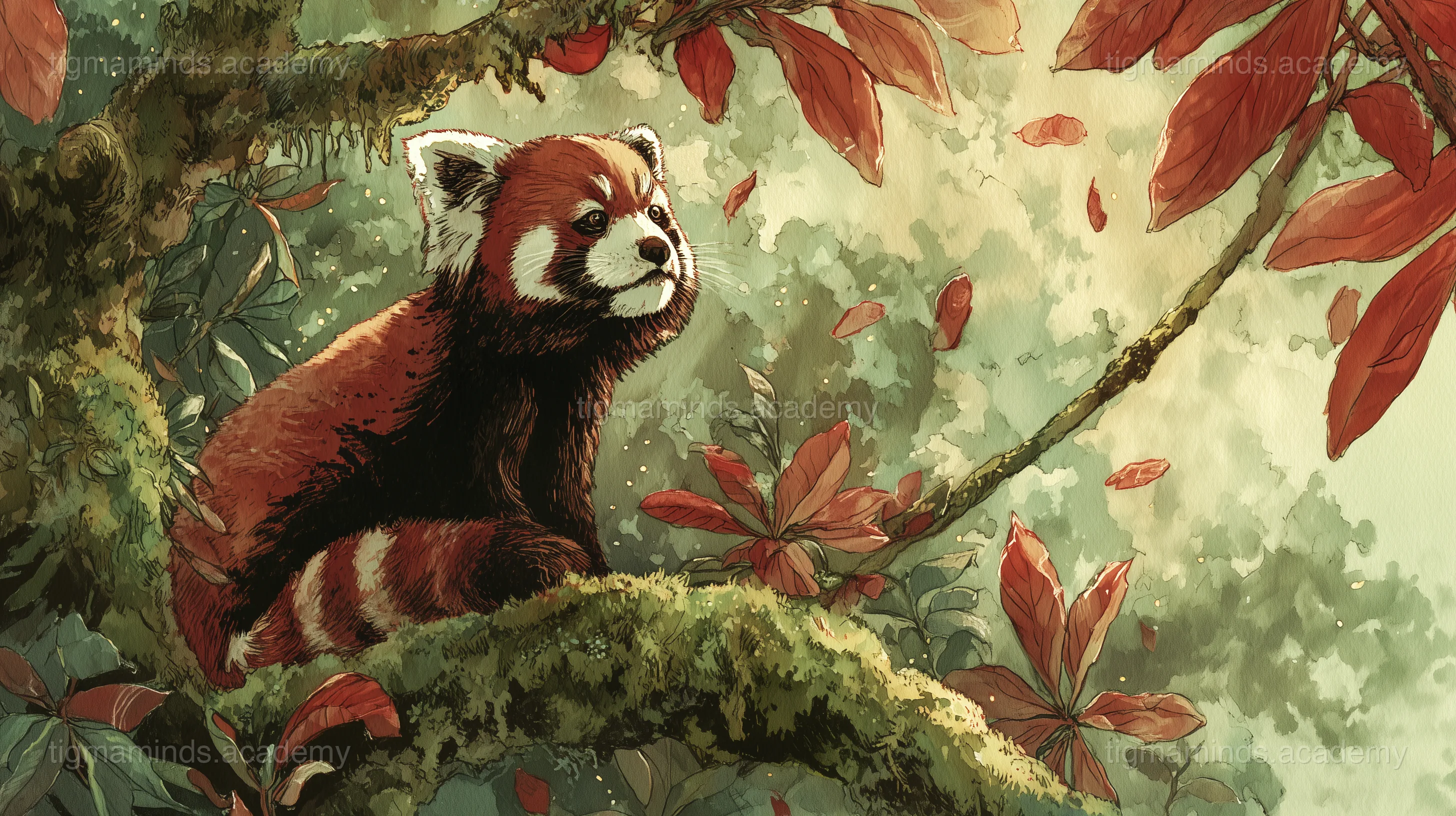
The Shyest Animal
In the misty forests of Arunachal Pradesh, where rhododendrons bloom red against the snow, there lived a small, furry creature who was afraid of absolutely everything.
She was afraid of loud birds. She was afraid of falling leaves. She was afraid of her own shadow, which — to be fair — did look a bit like a larger, scarier version of herself.
Her name was Ningma, and she was a red panda — though in those days, red pandas weren't red at all. They were plain brown, the colour of bark, the colour of mud, the colour of trying not to be noticed.
"Why are you always hiding?" asked the snow leopard, who was afraid of nothing.
"Because everything is scary," said Ningma, from behind a mossy log.
The Forest's Offer
The old forest spirit — a gnarled oak who had watched a thousand seasons pass — felt sorry for Ningma. One autumn evening, when the leaves were turning every shade of fire, the spirit spoke.
"Ningma, I cannot take away your fear. Fear is useful — it keeps you alive. But I can give you something to help you face the world."
"A bigger hiding spot?" asked Ningma hopefully.
"A mask," said the spirit. "Not to hide behind — but to remind you that you are braver than you think."
The Painting
The spirit gathered colours from the forest. Rust-red from the autumn leaves. White from the first snow. Black from the rich mountain soil. And a dash of gold from the last ray of sunset.
Gently, the spirit painted Ningma's face — white tear-drops under her eyes, rust-red fur across her cheeks, dark ears that stood out against the snow. The spirit painted her tail in thick rings of red and gold, like the bangles worn at festivals.
"There," said the spirit. "Now look at your reflection."
Ningma crept to the stream and looked down. She gasped. The creature looking back at her was beautiful — fierce and gentle at the same time, like a tiny warrior dressed for a celebration.
"That's me?" she whispered.
The First Brave Step
The next morning, Ningma climbed out of her hollow tree and walked along the highest branch. The birds stared. The monkeys stopped chattering. Even the snow leopard paused.
"You look different," said the leopard.
"I feel different," said Ningma. And she did. The mask didn't make her fearless — she still jumped at loud noises and preferred to be alone. But when she caught her reflection in a puddle or a stream, she saw the mask and remembered: the forest believes in me.
That was enough.
The Mask That Stayed
Ningma's children were born with the same mask. And their children. And theirs. Every red panda in the mountains of Northeast India wears the forest spirit's gift — rust and white and gold, painted by autumn leaves and first snow.
If you ever see a red panda in the wild — curled on a branch, peering at you with those big, masked eyes — know that she is probably a little scared. But she's also a little brave. And the mask is there to remind her which one matters more.
The end.
Choose your level. Everyone starts with the story — the code gets deeper as you go.
Here is a taste of what Level 1 looks like for this lesson:
# Simulating natural selection on fur colour
# Watch how a population shifts over generations
import random
# Start with 100 animals: colour 0 (light) to 100 (dark)
population = [random.randint(0, 100) for _ in range(100)]
background = 75 # dark forest floor
for gen in range(20):
# Fitness = how close to background (closer = harder to spot)
fitness = [1 / (1 + abs(c - background)) for c in population]
total = sum(fitness)
probs = [f / total for f in fitness]
# Reproduce proportional to fitness (+ small mutation)
population = [
min(100, max(0, random.choices(population, probs)[0]
+ random.randint(-3, 3)))
for _ in range(100)
]
avg = sum(population) / len(population)
print(f"After 20 generations, average colour: {avg:.0f}")
print(f"Background colour: {background}")
print(f"The population evolved toward the background!")This is just the first of 6 coding exercises in Level 1. By Level 4, you will build: Test How Well Camouflage Works Against a Background.
By Level 4, enrolled students build: Test How Well Camouflage Works Against a Background
Free
Level 0: Listener
Stories, science concepts, diagrams, quizzes. No coding.
You are here
Level 0 is always free. Coding levels (1-4) are part of our 12-Month Curriculum.
A shy mountain animal receives a mask of courage from the forest.
The big idea: "How the Red Panda Got Its Mask" teaches us about Evolution & Camouflage — and you don't need to write a single line of code to understand it.
Imagine you are a small animal in a forest. Eagles soar above. Leopards stalk below. You cannot run faster than them. You cannot fight them. Your only hope is to not be seen. This is the survival problem that camouflage solves — and nature has invented three completely different solutions.
Solution 1: Crypsis (background matching). The simplest trick: look like your background. A brown moth on brown bark. A green grasshopper on a green leaf. A sandy-coloured mouse on sandy soil. The animal's colour and texture match the place it lives, so predators look right past it. The peppered moth is the most famous example — during the Industrial Revolution, when tree bark turned dark with soot, the dark-coloured moths suddenly survived better than light ones. When the air cleaned up, light moths came back. Same species, same trees, but the "best" colour flipped because the background changed.
Solution 2: Disruptive coloration. Instead of blending in, some animals use bold, contrasting patches that break up their body outline. A predator's brain recognises prey by shape — it looks for "animal-shaped" objects. Zebra stripes, for example, make it hard to see where one zebra ends and another begins in a running herd. The red panda's face mask works this way too — the sharp white-and-dark patches make the face harder to recognise as a face in dappled forest light.
Solution 3: Mimicry. Some harmless animals copy the appearance of dangerous ones. The harmless king snake has red, black, and yellow bands that look almost identical to the deadly coral snake. Predators who have learned to avoid coral snakes avoid king snakes too — even though king snakes are completely harmless. The mimic gets protection without paying the cost of actually being venomous.
Check yourself: A white Arctic hare turns brown in summer. Which type of camouflage is this? (Answer: crypsis — background matching. The hare changes colour to match the changing background, from white snow to brown earth.)
Key idea: Animals use three main camouflage strategies: crypsis (matching the background), disruptive coloration (breaking up the outline), and mimicry (copying a dangerous species). Each solves the same problem — avoid being eaten — in a different way.
Here is a puzzle: if camouflage helps animals survive, how did it develop? Did animals choose to be camouflaged? Did they try to match their background? No. The answer is natural selection — arguably the most important idea in all of biology.
Let’s walk through it step by step with a thought experiment. Imagine a population of 100 mice living on dark volcanic rock. Most mice are light brown (easy to spot against dark rock), but a few are dark brown (hard to spot). Hawks hunt by sight.
This is natural selection in four sentences: variation (differences exist), pressure (something kills some variants more than others), inheritance (survivors pass traits to offspring), shift (the population changes over time). No plan. No goal. No designer. Just survival and reproduction, repeated over thousands of generations.
Darwin figured this out by studying finches on the Galápagos Islands. He noticed that finches on different islands had different beak shapes — thick beaks on islands with hard seeds, thin beaks on islands with insects. The beaks weren’t designed for the food. The food selected which beaks survived.
Prediction question: If the volcanic rock in our mouse example gets covered by white sand (say, after a sandstorm), what happens to the dark mice? (Think about it before reading on.) Answer: Now the dark mice are easy to see and the light mice are hidden. Hawks eat the dark mice. Over generations, the population shifts back to light. Natural selection reversed direction because the environment changed.
Key idea: Natural selection requires four ingredients: variation in a trait, selective pressure (some variants survive better), inheritance (survivors pass genes to offspring), and time. No planning needed — just differential survival.
Access all 130+ lessons, quizzes, interactive tools, and offline activities
Now that you understand camouflage types and natural selection, let’s look at the red panda’s famous face with scientific eyes. That "mask" — dark pat...
Here is a surprising fact: the red panda is **not a bear**. Despite sharing the name "panda" with the giant panda, the two are not closely related at ...