
Fish that shimmer — the optics of iridescence.
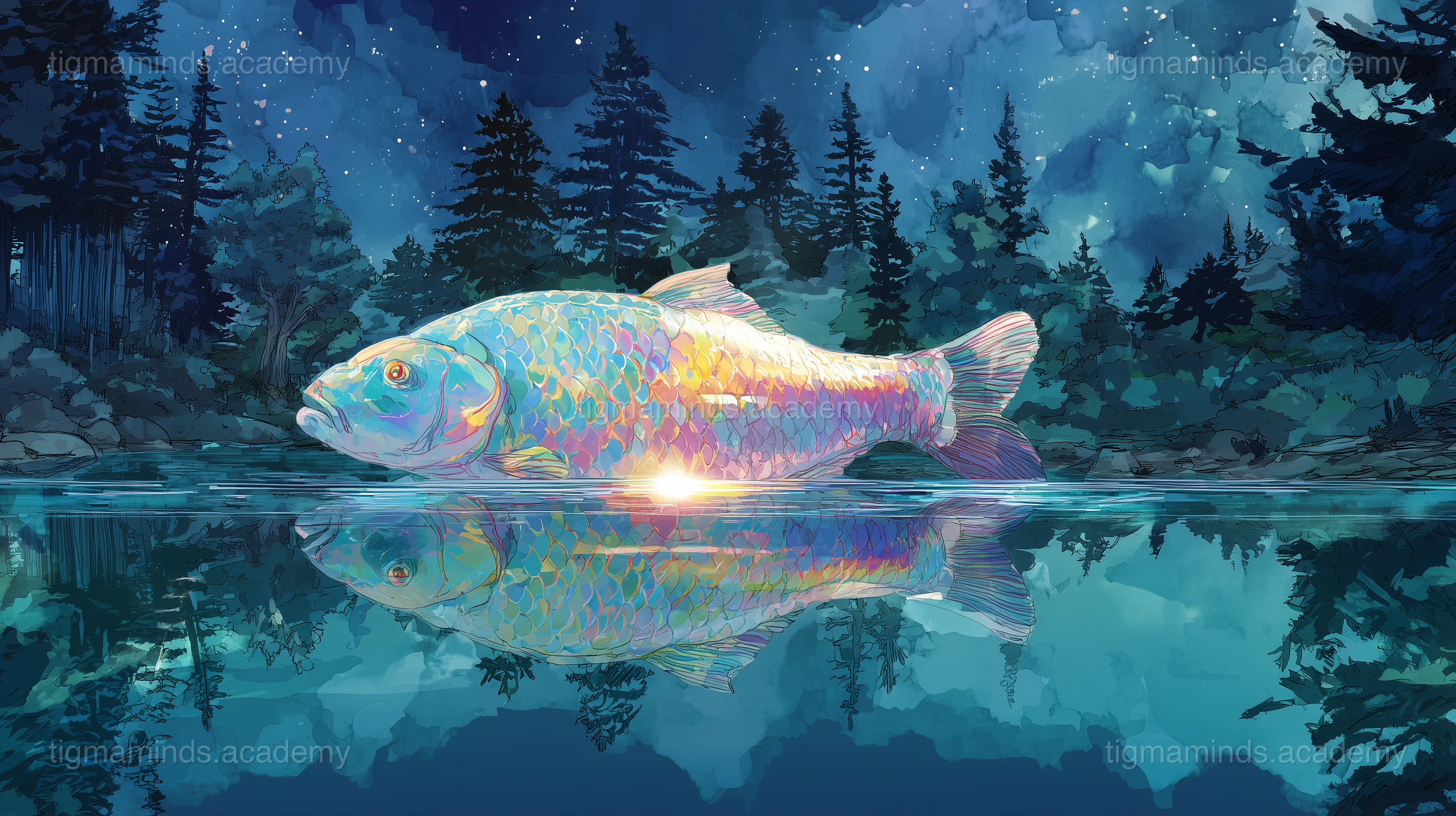
The Lake Above the Clouds
High in the Khasi Hills of Meghalaya, cradled between pine-covered ridges, lies Umiam Lake. The people of the hills call it the lake above the clouds, because on misty mornings the water floats in a white sea of fog as if it has left the earth entirely.
Many fish live in Umiam — silver fish, brown fish, quick little fish that dart between the rocks. But there is one fish that is different from all the others. The elders call her Ka Ri Bneng — the Sky Fish — and they say her scales are made of captured rainbows.
Nobody agrees on what colour she is. That is what makes her magical.
The Girl Who Wanted to See
A Khasi girl named Daphisha lived in the village above the lake. She was twelve, sharp-eyed, and stubborn — the kind of girl who would argue with a thunderstorm and win.
One morning, her grandmother told her about Ka Ri Bneng. "When a happy person looks at the fish, her scales shine gold. When a sad person looks, she turns blue. When an angry person looks, she burns red. The fish shows you what you're feeling, even when you don't know yourself."
"That's impossible," said Daphisha. "A fish can't change colour because of someone else's mood."
"Then go see for yourself," said her grandmother, smiling.
Three Visits
Daphisha went to the lake that very afternoon. She was excited — almost giddy — because she loved a mystery. She sat on the mossy bank, looked into the clear water, and waited.
After twenty minutes, a large fish drifted out from behind a submerged rock. Her scales caught the light and shimmered a brilliant, blazing gold. Daphisha gasped. The fish was the most beautiful thing she had ever seen.
Gold, she thought. Grandmother said gold means happy. I suppose I am happy right now.
She came back the next day. This time, she had fought with her best friend that morning. The argument was about something stupid — whose turn it was to carry the water — but it had left a sour knot in Daphisha's chest. She sat by the lake and waited.
Ka Ri Bneng appeared again. But today, her scales were a deep, bruised violet — the colour of a thundercloud before it breaks. Daphisha stared. The fish hadn't changed shape or size. Only the colour was different.
On the third day, Daphisha came to the lake after her little brother had fallen from a tree and broken his arm. She was frightened and shaken, her heart racing with worry. When Ka Ri Bneng appeared, her scales pulsed a pale, trembling white — the colour of lightning, the colour of fear.
The Fish's Secret
Daphisha ran home to her grandmother. "The fish really does change colour!" she said. "She was gold, then violet, then white. How does she do that?"
Her grandmother poured her a cup of sha lamet — the smoky Khasi tea — and sat down slowly. "The fish doesn't change, my heart. The fish has every colour in her scales, all the time. What changes is which colour your eyes choose to see."
Daphisha frowned. "My eyes don't choose."
"Oh, but they do. When you are happy, your eyes are drawn to warmth and gold. When you are hurt, they seek out bruise-colours. When you are afraid, they find the cold, white flicker. The fish is a mirror, Daphisha. She shows you yourself."
What Daphisha Learned
Daphisha went back to the lake many more times that year. She learned to read her own moods by watching the fish — and slowly, she learned something even more important. She could change the colour she saw. If she arrived angry and sat quietly, breathing the pine air, watching the clouds drift below her, the red would fade to amber, then to gold.
She couldn't control the fish. But she could steer herself.
Years later, when Daphisha became a teacher, she would take her students to Umiam Lake on the first day of every school year. "Look into the water," she would say. "Tell me what colour you see. Then we'll talk about why."
And somewhere below the surface, Ka Ri Bneng would drift past — her scales shimmering with every colour at once, waiting to show each child exactly what they needed to see.
The end.
Choose your level. Everyone starts with the story — the code gets deeper as you go.
Here is a taste of what Level 1 looks like for this lesson:
import numpy as np
import matplotlib.pyplot as plt
# Thin-film interference: which color wins?
thickness = 120 # nm (guanine platelet thickness)
n_guanine = 1.83 # refractive index of guanine
wavelengths = np.linspace(380, 700, 300) # visible light, nm
# Constructive interference when 2nt = m * wavelength
path_diff = 2 * n_guanine * thickness # ~439 nm
# Intensity peaks where path difference = whole number of wavelengths
intensity = np.cos(np.pi * path_diff / wavelengths)**2
plt.figure(figsize=(10, 5))
plt.fill_between(wavelengths, intensity, alpha=0.3, color='dodgerblue')
plt.plot(wavelengths, intensity, linewidth=2, color='dodgerblue')
plt.xlabel("Wavelength (nm)")
plt.ylabel("Reflected intensity")
plt.title(f"Fish scale iridescence: ${thickness} nm guanine platelet")
plt.axvline(path_diff, color='red', linestyle='--', label=f'Peak at ${path_diff:.0f} nm')
plt.legend()
plt.show() # Which color is brightest? What happens if the platelet is thicker?This is just the first of 6 coding exercises in Level 1. By Level 4, you will build: Investigate Iridescence in Everyday Objects.
By Level 4, enrolled students build: Investigate Iridescence in Everyday Objects
Free
Level 0: Listener
Stories, science concepts, diagrams, quizzes. No coding.
You are here
Level 0 is always free. Coding levels (1-4) are part of our 12-Month Curriculum.
Fish that shimmer — the optics of iridescence.
The big idea: "The Rainbow Fish of Umiam Lake" teaches us about Optics of Water & Iridescence — and you don't need to write a single line of code to understand it.
Look at a fish in sunlight and tilt your head. The colors on its scales shift — green becomes blue, blue becomes purple. This shifting rainbow effect is called iridescence, and it is one of the most beautiful tricks in nature. But how does a fish produce a rainbow without any paint?
The secret is hidden inside the fish’s skin, in cells called iridophores. Each iridophore is packed with tiny, flat crystals of a chemical called guanine (the same molecule that appears in your DNA). These guanine platelets are stacked in layers, separated by thin gaps of watery cytoplasm — like a microscopic sandwich with many layers of transparent bread and transparent filling.
Each platelet is only about 5–20 nanometers thick. A nanometer is one billionth of a meter. To put that in perspective: a human hair is about 80,000 nm wide. You could stack 5,000 guanine platelets side by side across the width of a single hair.
When white light (which contains all colors) hits this stack, something remarkable happens. A tiny fraction of the light reflects off the top surface of each platelet, and another tiny fraction reflects off the bottom surface. These reflected waves travel slightly different distances, so they arrive back at your eye slightly out of step with each other. For one particular color, the waves happen to arrive perfectly in sync — their peaks line up, and they reinforce each other. That color blazes brightly. All other colors arrive out of sync and cancel each other out.
This is thin-film interference, and it is why the color depends on the angle. When you tilt your head, the light path through the layers changes, so a different color ends up in sync. Gold becomes green. Green becomes blue. The fish hasn’t changed — your viewing angle has.
Check yourself: If a fish’s guanine platelets were all exactly the same thickness, would you see one color or many colors at a single angle? (Answer: One color. The rainbow effect comes from slight variations in platelet thickness and the fact that different parts of the curved scale present different angles to your eye.)
Key idea: Fish shimmer because stacked guanine crystal platelets in their skin reflect light waves that interfere constructively for one color at each viewing angle. Tilt your head, and the winning color shifts — that is iridescence.
There are two fundamentally different ways to make color. The first is pigment color — the familiar kind. A red T-shirt is red because dye molecules in the fabric absorb every color of light except red, which bounces back to your eye. A flamingo is pink because it eats shrimp full of pink carotenoid pigments. In both cases, a chemical molecule is doing the work: absorbing some wavelengths and reflecting others.
The second way is structural color. Here, no molecule absorbs anything. Instead, a physical structure — layers, ridges, or holes at the nanoscale — interferes with light waves so that only certain wavelengths reflect strongly. A peacock feather, a morpho butterfly wing, a soap bubble, and a fish scale all get their shimmer this way.
Here is the critical difference: pigments fade, structures don’t. Leave a red T-shirt in the sun for a year. The UV light breaks the chemical bonds in the dye molecules — they literally fall apart — and the shirt turns pink, then white. This is called photodegradation. Every pigment on Earth is vulnerable to it. That is why old paintings in museums look duller than when they were new.
But UV light cannot destroy a shape. A peacock feather that is 100 years old still shimmers as vividly as a fresh one, because the melanin rods and air gaps that create the color are physical features, not fragile molecules. You could scrub the feather with bleach (which destroys pigments) and the structural color would survive, because the nanostructure remains intact.
Prediction exercise: You have two blue objects: a blue towel dyed with indigo, and a morpho butterfly wing. You leave both in direct sunlight for six months. Which one will still be blue? (The butterfly wing — its color is structural. The towel’s indigo dye will degrade.)
Fish have both types. Chromatophores (pigment cells) give background color using melanin, carotenoids, and pteridins. Iridophores (structural cells) add the iridescent shimmer on top using guanine crystals. The combination lets a single fish display rich base colors and shifting metallic highlights.
Key idea: Pigment color comes from molecules that absorb light and eventually fade under UV. Structural color comes from physical nanostructures that interfere with light and never fade, because UV cannot destroy a shape.
Access all 130+ lessons, quizzes, interactive tools, and offline activities
Before we can understand how Daphisha saw Ka Ri Bneng shimmer in Umiam Lake, we need to understand what happens to light when it enters water. Light i...
High in the **Khasi Hills** at about 1,000 meters elevation sits Umiam Lake — a 220-hectare reservoir created in 1965 by damming the Umiam River. The ...