
The ancient flying chariot that anticipated the science of aerodynamics and flight.
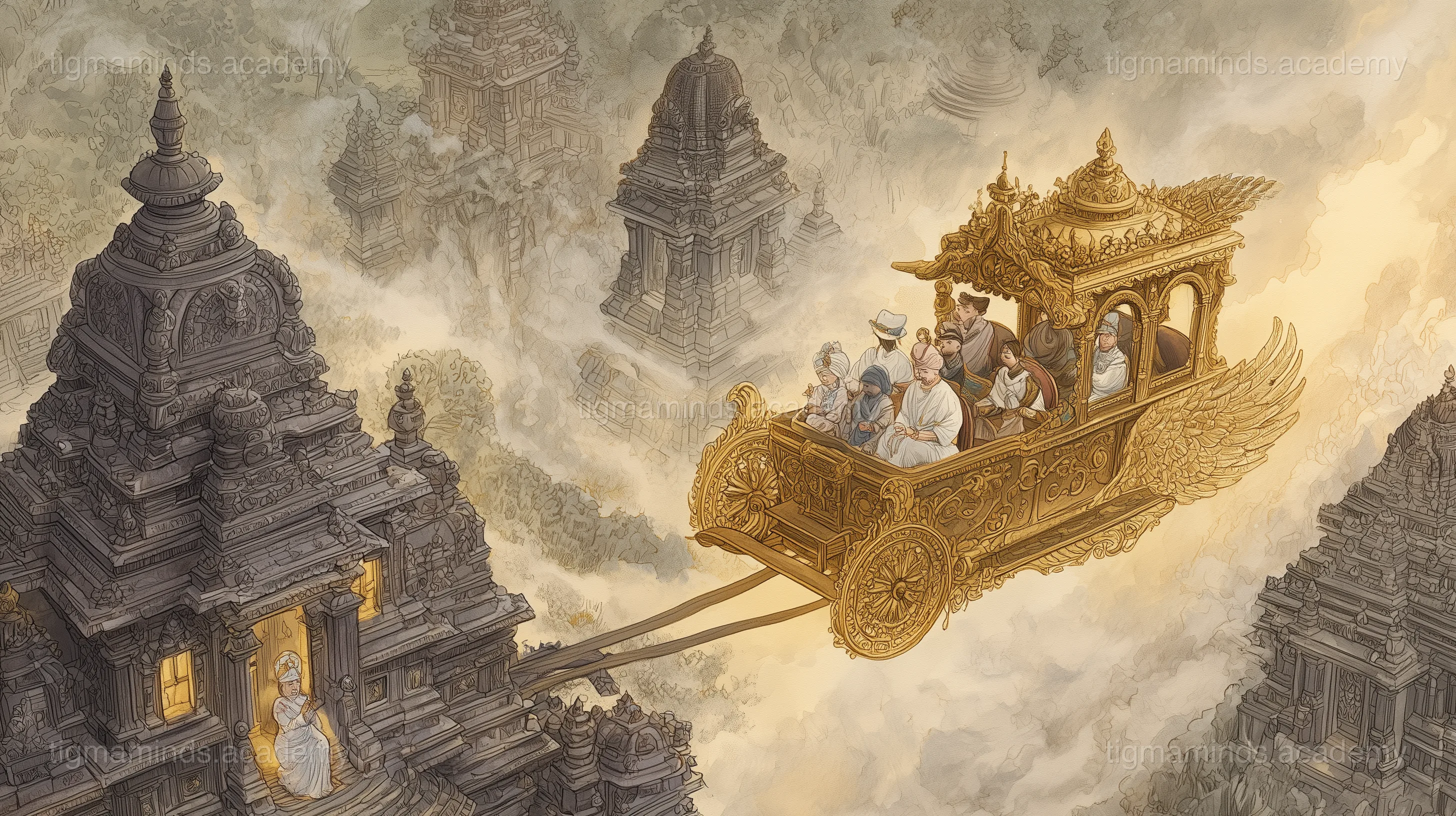
The Chariot That Flew
In the age when the world was younger, the architect of the gods, Vishwakarma, fashioned something that had never existed before: a vehicle that could fly. He called it the Pushpaka Vimana — a flying chariot, vast as a city, gleaming like the Sun, capable of travelling anywhere its rider wished, at the speed of thought.
Vishwakarma built it for Brahma, the creator. It was not a simple cart with wings strapped on. The texts describe it as a self-propelled aerial craft, multi-storeyed, with rooms and gardens inside, decorated with gems and precious metals. It moved through the air without horses, without wheels on the ground, without any visible means of support. It simply rose and flew.
Brahma gave the Vimana to Kubera, the god of wealth, who used it to travel between his golden city of Lanka and his kingdom in the Himalayas. For ages, the Pushpaka carried Kubera across mountains and oceans, above the clouds, through storms and starlight.
The Theft
Then came Ravana.
Ravana, the ten-headed king of the Asuras, was Kubera’s half-brother. He was brilliant, powerful, and consumed by ambition. He had performed such intense austerities that Brahma himself had granted him near-invincibility. And Ravana wanted Lanka — Kubera’s beautiful island kingdom — and everything in it.
He attacked Lanka with an army of Rakshasas. Kubera, a god of commerce rather than war, could not hold the city. He fled. And Ravana seized the throne, the treasury, and the Pushpaka Vimana.
Under Ravana’s command, the Vimana became an instrument of conquest. He flew it across the world, challenging gods and kings, kidnapping anyone who caught his eye. The Vimana obeyed him because it was designed to respond to its master’s will — whoever sat on its throne controlled it.
It was in the Pushpaka Vimana that Ravana flew to the forest of Panchavati, where Rama and Sita lived in exile. It was in this chariot that he abducted Sita, carrying her across the ocean to Lanka while she cried out for help. The great vulture Jatayu tried to stop the Vimana mid-flight, tearing at it with his talons, but Ravana cut off his wings and flew on.
The War and the Return
The abduction of Sita sparked the great war of the Ramayana. Rama, aided by Hanuman and the army of Vanaras, crossed the ocean on a bridge of stones, besieged Lanka, and fought Ravana in a battle that shook the three worlds.
When Rama finally killed Ravana with the Brahmastra, the war ended. And the Pushpaka Vimana, freed from its conqueror, submitted to Rama. Vibhishana, Ravana’s righteous brother who had sided with Rama, presented the chariot to him.
Rama, Sita, and Lakshmana boarded the Pushpaka Vimana for the journey home to Ayodhya. The Ramayana describes this flight in extraordinary detail. As the Vimana rose, Rama pointed out landmarks below to Sita: the battlefield of Lanka, the bridge across the ocean, the mountain where Hanuman had found the healing herbs, the forests where they had lived, the rivers they had crossed on foot. All of it now lay below them, visible as a map.
The flight from Lanka to Ayodhya covered the entire length of the Indian subcontinent. When they arrived, the people of Ayodhya lit thousands of oil lamps to guide the Vimana down from the sky — the origin, some say, of Diwali.
After the homecoming, Rama returned the Pushpaka Vimana to Kubera, its rightful owner. The chariot ascended one last time and disappeared into the northern sky.
The Science in the Story
The Pushpaka Vimana is one of the oldest descriptions of human flight in any literature. The concept appears not just in the Ramayana but across multiple Sanskrit texts — the Mahabharata, the Samarangana Sutradhara, and later works that attempted to describe the mechanics of vimanas in technical terms.
The ancient authors imagined flight long before humans understood what would actually be required: overcoming gravity with lift, defeating air resistance called drag, generating forward thrust, and managing the downward pull of weight. These are the four forces that govern every aircraft, from a paper airplane to a space shuttle.
The Pushpaka Vimana flew by divine will. Real aircraft fly by engineering. But the dream was the same: to break free from the ground and see the world from above. Every airplane that takes off today is a Pushpaka Vimana built not by gods, but by physics.
The end.
Choose your level. Everyone starts with the story — the code gets deeper as you go.
Here is a taste of what Level 1 looks like for this lesson:
# Four Forces Flight Balance Check
mass_kg = 80000 # aircraft mass
g = 9.8 # gravity (m/s^2)
thrust_N = 200000 # engine thrust
drag_N = 180000 # air drag
lift_N = 785000 # wing lift
weight_N = mass_kg * g
print("=== Flight Force Balance ===")
print(f"Weight: {weight_N:,.0f} N (down)")
print(f"Lift: {lift_N:,.0f} N (up)")
print(f"Thrust: {thrust_N:,.0f} N (forward)")
print(f"Drag: {drag_N:,.0f} N (backward)")
if lift_N > weight_N:
print("\nVertical: CLIMBING (lift > weight)")
elif lift_N == weight_N:
print("\nVertical: LEVEL (lift = weight)")
else:
print("\nVertical: DESCENDING (lift < weight)")
if thrust_N > drag_N:
print("Horizontal: ACCELERATING")
else:
print("Horizontal: DECELERATING")This is just the first of 6 coding exercises in Level 1. By Level 4, you will build: Build a Flight Simulator.
By Level 4, enrolled students build: Build a Flight Simulator
Free
Level 0: Listener
Stories, science concepts, diagrams, quizzes. No coding.
You are here
Level 0 is always free. Coding levels (1-4) are part of our 12-Month Curriculum.
The real-world science of flight — lift, drag, thrust, weight, wing design, jet engines, and rocket propulsion.
The big idea: "The Pushpaka Vimana" teaches us about Aerodynamics & Flight — and you don't need to write a single line of code to understand it.
The Pushpaka Vimana flew by divine will. Every real aircraft — from a paper airplane to a Boeing 747 — flies by balancing four forces. Understanding these forces is the foundation of all aerodynamics.
Lift is the upward force that holds the aircraft in the air. It is generated by the wings. When air flows over a wing, the special curved shape forces the air above the wing to move faster than the air below. Faster-moving air exerts less pressure (we will explain why in the next section). So the pressure below the wing is higher than the pressure above — and this pressure difference pushes the wing up. That upward push is lift.
Weight is gravity pulling the aircraft down. It equals the aircraft’s mass times the gravitational acceleration (W = mg). For a 747 at takeoff, that is about 400,000 kg × 9.8 m/s² = nearly 4 million newtons of downward force. To get off the ground, lift must exceed weight.
Thrust is the forward force produced by the engines. Jet engines, propellers, and rockets all generate thrust by pushing air or exhaust gas backward — Newton’s third law then pushes the aircraft forward. Without thrust, the aircraft would slow down and eventually stop flying.
Drag is the backward force caused by air resistance. Every object moving through air experiences drag. It depends on speed (faster = more drag), shape (streamlined = less drag), and the aircraft’s surface area. Engineers spend billions designing shapes that minimize drag.
The key insight: For an aircraft in steady, level flight, lift equals weight (vertical balance) and thrust equals drag (horizontal balance). Change any one of these four forces and the aircraft climbs, dives, accelerates, or decelerates.
Check yourself: If a pilot increases engine thrust without changing anything else, what happens to the aircraft? Think about which balance is disrupted.
Key idea: Every aircraft in flight is governed by four forces: lift (up), weight (down), thrust (forward), and drag (backward). Steady flight means lift = weight and thrust = drag. Changing any force changes the flight.
Why does air moving faster exert less pressure? This puzzled scientists for centuries until Daniel Bernoulli figured it out in 1738. His principle states: in a flowing fluid, when speed increases, pressure decreases (and vice versa).
Here is an intuition. Imagine water flowing through a garden hose. You squeeze the end of the hose, making the opening narrower. What happens? The water speeds up and shoots out faster. The same amount of water has to pass through a smaller space, so it accelerates. Bernoulli’s equation describes this precisely: P + ½pv² = constant (ignoring height changes). If velocity v goes up, pressure P must go down to keep the total constant.
Now apply this to a wing. The cross-section of a wing is called an airfoil. It is not symmetrical — the top surface is more curved than the bottom. When air hits the front of the wing (the leading edge), it splits. The air going over the top has a longer path because of the curve. It must travel faster to rejoin the air going under the bottom at the trailing edge. Faster air above = lower pressure above. Slower air below = higher pressure below. The wing gets pushed up.
This is not the whole story. Wings also deflect air downward (the angle of attack effect), and Newton’s third law says if you push air down, the air pushes you up. Real lift is a combination of Bernoulli’s pressure difference AND Newton’s reaction force. But Bernoulli’s principle is the easiest to understand and measure.
You can feel Bernoulli’s principle right now. Hold a sheet of paper by its edge so it droops. Blow hard across the top surface. The paper lifts. Your breath moves fast across the top, creating low pressure. The still air below has higher pressure and pushes the paper up. You have just created lift.
Check yourself: If you could design a wing where the top surface was even MORE curved, would it produce more or less lift? What is the trade-off?
Key idea: Bernoulli’s principle: faster fluid = lower pressure. A wing’s curved upper surface forces air to speed up, creating lower pressure above and higher pressure below. This pressure difference is lift.
Access all 130+ lessons, quizzes, interactive tools, and offline activities
The Pushpaka Vimana flew by willpower. Modern aircraft fly by pushing enormous volumes of air backward at high speed. **Newton’s third law** does the ...
The Pushpaka Vimana could fly to the heavens. To actually leave Earth, you need a **rocket** — and rockets work on a principle so simple it is almost ...