How the Pitcher Plant Learned to Catch
Carnivorous Plants & Adaptation

How the Pitcher Plant Learned to Catch

A plant that eats insects — the ultimate adaptation.
Carnivorous Plants & Adaptation12-Month Curriculum 12h

The Story

The Hungry Plant

In the misty hills of Meghalaya, where the rain never quite stops and the clouds live in the valleys like sleeping sheep, there once lived a very small, very ordinary plant. Her name was Nepenthes, though nobody called her that — everyone just called her Nepi.

Nepi had thin green leaves, a modest stem, and roots that clung to the rocky soil of the Khasi Hills. She was, by all accounts, the most unremarkable plant on the hillside. And she was always hungry.

"The soil here has no food," Nepi complained to the moss beside her. "No minerals. No nutrients. Nothing. I'm starving."

"Try photosynthesis," said the moss, who was perfectly happy with sunlight and rain.

"I am photosynthesising," said Nepi. "But it's not enough. I need more."

The Clever Idea

One afternoon, Nepi watched a spider catch a fly in its web. The fly buzzed and struggled, and then it was still. The spider wrapped it neatly and ate it for dinner.

"Interesting," said Nepi. "That spider eats animals. Animals are full of nutrients. What if I could eat animals too?"

The moss laughed so hard it nearly dried out. "You're a plant. Plants don't eat animals. That's not how the world works."

"Maybe the world needs to work differently," said Nepi.

She thought and thought. She couldn't chase insects — she had no legs. She couldn't spin webs — she had no silk. But she could grow, slowly and deliberately, into any shape she wanted. That was the one superpower every plant had.

The First Pitcher

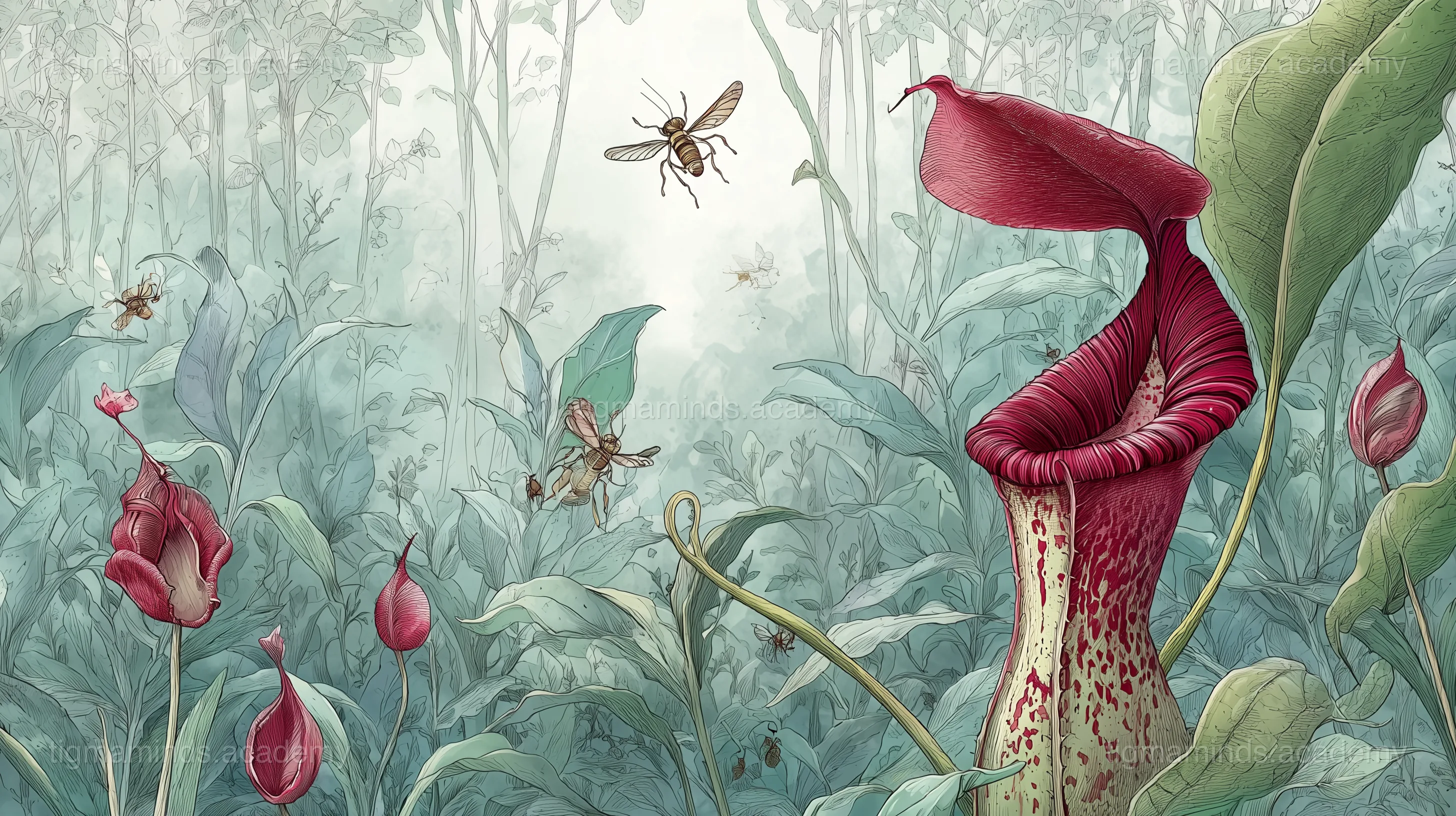
Nepi began to experiment. She curled one of her leaves into a tube — like a rolled-up newspaper. Then she made the inside of the tube slippery by coating it with a waxy liquid. At the bottom, she filled a tiny pool with a special juice that could dissolve soft things.

Then she waited.

An ant wandered by, attracted by the sweet smell coming from the rim of the tube. The ant leaned in for a taste, slipped on the waxy edge, and tumbled down into the pool. It struggled for a moment, then went still.

Within a day, Nepi had absorbed the nutrients from the ant. She felt stronger than she had in months.

"It works!" she cried.

"That's disgusting," said the moss.

"That's survival," said Nepi.

The Refinements

Over many seasons, Nepi improved her design. She made the pitcher deeper, so larger insects couldn't climb out. She added bright colours — reds and purples — to attract curious flies. She produced sweeter nectar at the rim, an irresistible invitation. She grew tiny downward-pointing hairs inside the tube, so that anything that crawled in could only go one way — down.

Other plants on the hillside watched in amazement. Some of them were hungry too.

"Teach us," they said.

And Nepi did. She shared her secret with her children and her children's children, and soon the hills of Meghalaya were dotted with pitcher plants of every size — some as small as a thimble, some as large as a water bottle, all of them catching insects, all of them thriving in soil where no ordinary plant could survive.

The Lesson of the Pitcher

Today, if you trek through the Khasi Hills or visit the sacred groves of Meghalaya, you can still find Nepi's descendants. They hang from mossy branches and cling to rocky ledges, their pitchers glowing red and green in the misty light. Flies buzz around them, drawn by the sweet nectar, and one by one, they slip inside.

The moss is still there too, perfectly happy with its sunlight and rain. And if you listen carefully on a quiet morning, you might hear it whisper to a passing beetle: "Don't go near the pretty plant. She's not what she seems."

But the people of Assam and Meghalaya tell the story differently. They say Nepi wasn't sneaky — she was clever. When the world didn't give her what she needed, she didn't complain and wither. She changed shape. She invented something new. She found a way to thrive where others couldn't.

And if that's not a lesson worth learning, what is?

The end.

Try It Yourself

Choose your level. Everyone starts with the story — the code gets deeper as you go.

Story Progress

0%

Ready to Start Coding?

Here is a taste of what Level 1 looks like for this lesson:

Level 1: Explorer — Python
import numpy as np
import matplotlib.pyplot as plt

# Compare nitrogen from soil vs from insects
soil_n_mg_per_day = 0.5     # mg N absorbed from poor bog soil
ant_n_mg = 1.2              # mg N per ant (dry mass ~2mg, 16% N)
# One ant = how many days of soil absorption?
days_equivalent = ant_n_mg / soil_n_mg_per_day

ants_per_month = np.array([0, 1, 3, 5, 8, 12])
soil_n = 30 * soil_n_mg_per_day  # monthly soil N
total_n = soil_n + ants_per_month * ant_n_mg

plt.bar(ants_per_month, total_n, color='#22c55e')
plt.xlabel("Ants caught per month")
plt.ylabel("Total nitrogen (mg/month)")
plt.title(f"One ant = ${days_equivalent:.0f} days of soil nitrogen!")
plt.show()  # Why is carnivory worth the cost?

This is just the first of 6 coding exercises in Level 1. By Level 4, you will build: Measure Pitcher Plant Trap Efficiency.

By Level 4, enrolled students build: Measure Pitcher Plant Trap Efficiency

Free

Level 0: Listener

Stories, science concepts, diagrams, quizzes. No coding.

You are here

Enrolled

Levels 1-4

Python, NumPy, Matplotlib, real projects, mentorship.

Sign Up Free

Stay Updated

Join Waitlist

Get notified when enrollment opens for your area.

Notify Me

Level 0 is always free. Coding levels (1-4) are part of our 12-Month Curriculum.