
Tidal physics and fluid dynamics hidden in one of the most dramatic escapes ever told.
The Pursuit
The Israelites had been slaves in Egypt for generations. Pharaoh’s overseers drove them to make bricks under a burning sun, building monuments they would never enjoy. Then came Moses, a man raised in Pharaoh’s own household, who returned from the desert with a message: let my people go.
Pharaoh refused. Plague after plague struck Egypt — water turning to blood, frogs covering the land, darkness blotting out the sun. Finally, after the most terrible plague of all, Pharaoh relented. The Israelites gathered their belongings — bread dough that had not yet risen, livestock, children — and fled east toward the wilderness.
But Pharaoh changed his mind. He mustered six hundred chariots, the finest in Egypt, and sent them thundering after the fleeing slaves.
Trapped
The Israelites reached the shore of the Yam Suph — the Sea of Reeds, often translated as the Red Sea. Before them: water stretching to the horizon. Behind them: the dust cloud of Pharaoh’s chariots growing closer by the minute. They were trapped.
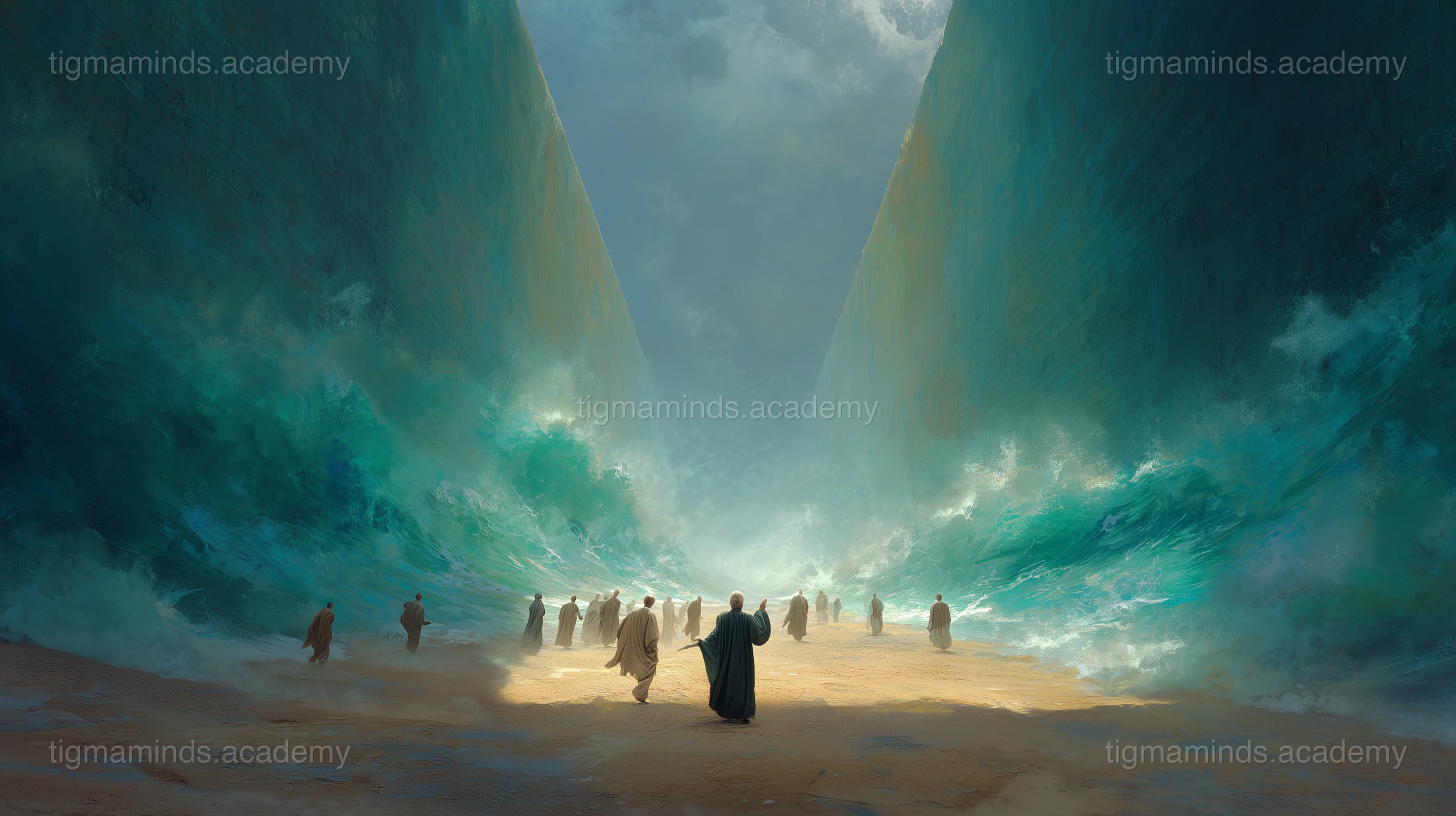
Moses stretched his staff over the water. Then, according to the text, a strong east wind blew all night. By morning, the water had drawn back, exposing a path of dry ground through the sea. The Israelites crossed. When Pharaoh’s chariots followed, the water returned and swallowed them.
What Actually Happens When Wind Blows Over Shallow Water?
This is where the science begins. The phenomenon Moses may have witnessed has a name: wind setdown. When a sustained, powerful wind blows over a shallow body of water, it physically pushes the surface water downwind. On the upwind side, the water level drops — sometimes dramatically. On the downwind side, it piles up.
In 2010, researchers at the National Center for Atmospheric Research (NCAR) used computational fluid dynamics to model an east wind of 100 km/h blowing for 12 hours over a reconstructed ancient lakebed near the modern Suez Canal. Their simulation showed the water parting exactly as described — a dry corridor appearing at a point where two bodies of water meet, lasting about four hours before collapsing when the wind stopped.
The Science of the Crossing
The story is not about magic overriding physics. It is about physics doing something so dramatic that it looked miraculous to people who did not yet have the mathematics to explain it. Tides, wind stress, shallow-water dynamics, and fluid mechanics — the same forces that shape coastlines and drive weather patterns — can, under the right conditions, expose the seafloor.
For a science student, this story is a gateway to some of the most powerful equations in physics: the Navier-Stokes equations that govern all fluid flow, the mathematics of tidal forces driven by the Moon’s gravity, and computational fluid dynamics — the tool that modern engineers use to design everything from aircraft to blood pumps.
The sea did not need to break the laws of physics to part. It needed the right wind, the right geometry, and the right timing. Understanding how is far more wonderful than not asking why.
The end.
Choose your level. Everyone starts with the story — the code gets deeper as you go.
Here is a taste of what Level 1 looks like for this lesson:
# Wind Setdown Calculator
import math
wind_speed = 100 # km/h
fetch = 30_000 # metres (30 km)
depth = 2.5 # metres
g = 9.81 # gravity
# Convert wind to m/s
v = wind_speed / 3.6
# Wind stress (empirical): tau = rho_air * Cd * v^2
rho_air = 1.225
Cd = 1.5e-3 # drag coefficient
tau = rho_air * Cd * v**2
# Setdown formula: delta_h = tau * fetch / (rho_water * g * depth)
rho_water = 1025
delta_h = tau * fetch / (rho_water * g * depth)
print(f"Wind: {wind_speed} km/h over {fetch/1000} km")
print(f"Water depth: {depth} m")
print(f"Setdown: {delta_h:.2f} m")
print(f"Exposed? {'YES' if delta_h >= depth else 'No'}") This is just the first of 6 coding exercises in Level 1. By Level 4, you will build: Build a Wind Setdown Simulator.
By Level 4, enrolled students build: Build a Wind Setdown Simulator
Free
Level 0: Listener
Stories, science concepts, diagrams, quizzes. No coding.
You are here
Level 0 is always free. Coding levels (1-4) are part of our 12-Month Curriculum.
The real science behind water parting — tides, wind setdown, shallow-water equations, and computational fluid dynamics.
The big idea: "The Parting of the Red Sea" teaches us about Tidal Physics & Fluid Dynamics — and you don't need to write a single line of code to understand it.
Stand on any beach and wait. Over about six hours, the water creeps up the sand, reaching higher and higher. Then it stops and begins to retreat. Six hours later, it is at its lowest point. This rhythm — two high tides and two low tides every 24 hours and 50 minutes — has been happening since before humans existed.
The cause is the Moon’s gravity. The Moon pulls on the Earth, and the water nearest the Moon gets pulled a little more than the solid ground beneath it. This creates a bulge of water on the Moon-facing side. On the opposite side, the Earth is pulled away from the water, creating a second bulge. As the Earth rotates, different coastlines pass through these bulges, experiencing high tides.
The Sun also contributes. When the Sun and Moon line up (new moon and full moon), their gravitational pulls add together, creating extra-large spring tides. When they are at right angles (quarter moons), the pulls partially cancel, producing smaller neap tides.
In the shallow waters near the Suez region, tidal range can reach 1.5 to 2 metres. That may not sound like much, but in a basin that is only 2 metres deep at its deepest, a low tide can expose vast stretches of mudflat.
Check yourself: If the Moon were twice as far from the Earth, would tides be stronger or weaker? (Hint: gravity decreases with the square of distance.)
Key idea: Tides are caused by the Moon’s gravitational pull creating bulges of water on both sides of the Earth. Spring tides (Sun + Moon aligned) are largest; neap tides (at right angles) are smallest.
Blow across a bowl of soup. Watch what happens. The surface ripples, and if you blow hard enough, the soup piles up on the far side while the near side dips. You have just demonstrated wind setdown — the same phenomenon that scientists believe may explain the parting of the sea.
When a strong, sustained wind blows over shallow water, friction between the air and the water surface drags the surface layer downwind. This creates a slope in the water surface: higher on the downwind end, lower on the upwind end. The strength of the setdown depends on three things: wind speed (faster = more push), fetch (the distance over which the wind blows — longer = more effect), and depth (shallower water is displaced more easily).
The NCAR researchers modelled an east wind of 100 km/h (a severe storm but not unprecedented) blowing for 12 hours over a shallow lagoon near the modern Suez Canal. Their simulation showed the water level dropping by over 2 metres on the upwind side — enough to expose the bottom and create a dry path up to 4 km long and 3 km wide.
When the wind stopped, the water returned. Not slowly — it rushed back like water released from a dam, refilling the dry corridor in less than 30 minutes. Anyone caught in that corridor would have been engulfed.
Think about this: Hurricane-force winds regularly push water out of bays along the US Gulf Coast. In 2017, Hurricane Irma actually drained Tampa Bay — people walked on the exposed seafloor. The water returned hours later as a devastating storm surge.
Key idea: Wind setdown occurs when sustained wind over shallow water physically pushes the surface layer downwind, lowering the water level on the upwind side. Stronger winds, longer fetch, and shallower depth all amplify the effect.
Access all 130+ lessons, quizzes, interactive tools, and offline activities
How did the NCAR scientists know the sea could part? They could not go back in time. They could not recreate the crossing in a laboratory. Instead, th...
Every fluid in the universe — air, water, blood, magma, the gas clouds between stars — obeys the same fundamental equations: the **Navier-Stokes equat...