Paper engineering and waterproofing.
The Leftover Silk
In the weaving village of Sualkuchi, on the banks of the Brahmaputra, every family owned a loom. The click-clack of shuttles was the village's heartbeat, and the air always smelled of raw silk and tamarind dye. Meghali, a girl of ten, was the daughter of the finest weaver in the village — her mother, Bandana, who could weave a mekhela chador so fine it could pass through a ring.
But fine weaving meant fine leftovers. After every mekhela chador, there were scraps — strips of silk too narrow for clothing, too short for scarves, too small for anything useful. Bandana tossed them into a basket in the corner.
"Such waste," sighed Meghali, running the scraps through her fingers. They were beautiful — gold and red and peacock blue, soft as clouds.
"Silk is not wasted if it is loved," said her mother. "Find a use for it."
The Rainy Idea
The monsoon came early that year, as it always does in Assam. Rain hammered the tin roofs and turned the lanes into rivers of mud. Meghali's school was a fifteen-minute walk away, and she arrived every day soaked to the bone.
"I need an umbrella," she told her mother.
"We cannot afford one," said Bandana. "Use a banana leaf."
Banana leaves worked, but they tore in the wind and smelled of green sap. Meghali wanted something better. She looked at the basket of silk scraps and had an idea.
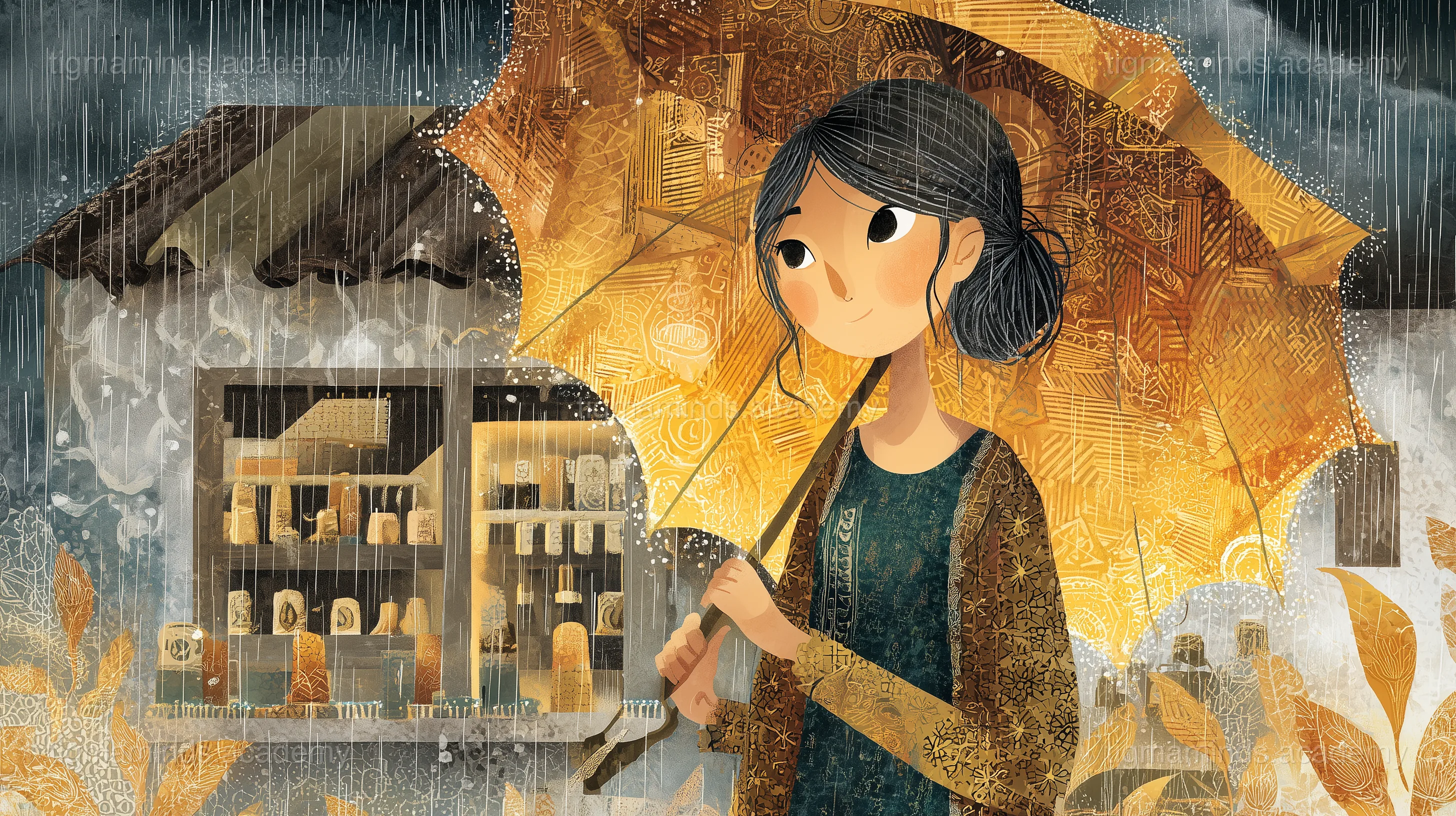
She took a bamboo frame that her grandfather had made for drying fish and bent it into a dome. Then she stitched the silk scraps together — gold next to red, blue next to green — and stretched the patchwork over the frame. She sealed the seams with a paste of tree resin and beeswax, the way the boat-makers waterproofed their hulls.
When she opened it, the umbrella bloomed like a flower — a patchwork dome of every colour the looms of Sualkuchi could produce. It was the most beautiful umbrella anyone in the village had ever seen.
More Than Rain
Meghali carried her silk umbrella to school the next morning. The rain hammered it, but the resin held. The water slid off the silk in silver beads. She arrived at school completely dry for the first time in weeks.
"Where did you get that?" asked her friend Ritu.
"I made it," said Meghali. "From leftover silk."
By the end of the week, every child in school wanted one. Meghali taught them how — the bamboo frame, the stitching, the resin seal. Soon the lane to school was a parade of colourful patchwork umbrellas, each one different, each one made from scraps that would have been thrown away.
But the umbrellas did more than keep out rain. Old Baideu, who sat on her veranda watching the lane, said the umbrellas cheered her up on grey days. The postman borrowed one when his broke. A mother used one to shade her baby from the sun. A boy used one as a basket to carry mangoes from the tree.
The Umbrella Festival
That autumn, when the rains stopped, Meghali hung her umbrella on the veranda to dry. Other families did the same. Soon, every house in Sualkuchi had a patchwork silk umbrella hanging outside — gold, red, blue, green — turning the village into a gallery of colour.
A photographer from Guwahati came and took pictures. A journalist wrote a story. People from other villages came to see the "umbrella village." And the weavers of Sualkuchi, who had always been famous for their silk, became famous for something new: turning leftovers into beauty.
The Weaver's Lesson
Bandana looked at the umbrella hanging on her veranda and smiled. "You know what you did, Meghali? You wove something more than silk. You wove the village together."
Meghali shrugged. "I just didn't want to get wet."
"The best inventions start that way," said her mother. "Someone has a problem. Someone has scraps. And someone has the imagination to see that the scraps are the solution."
In Sualkuchi, the silk umbrella tradition continues. Every monsoon, the patchwork domes bloom over the lanes like flowers after rain. And every scrap of silk — no matter how small — is saved, because the weavers now know that nothing is too small to be useful, and nothing is too broken to be beautiful.
The end.
Choose your level. Everyone starts with the story — the code gets deeper as you go.
Here is a taste of what Level 1 looks like for this lesson:
import numpy as np
import matplotlib.pyplot as plt
# Your first data analysis with Python
data = [45, 52, 38, 67, 41, 55, 48] # measurements
mean = np.mean(data)
plt.bar(range(len(data)), data)
plt.axhline(mean, color='red', linestyle='--', label=f'Mean: {mean:.1f}')
plt.xlabel("Sample")
plt.ylabel("Value")
plt.title("Paper Engineering — Sample Data")
plt.legend()
plt.show()This is just the first of 6 coding exercises in Level 1. By Level 4, you will build: Test Waterproofing Methods on Paper.
Free
Level 0: Listener
Stories, science concepts, diagrams, quizzes. No coding.
You are here
Level 0 is always free. Coding levels (1-4) are part of our 12-Month Curriculum.
The science of waterproofing.
The big idea: "The Paper Umbrella of Sualkuchi" teaches us about Paper Engineering — and you don't need to write a single line of code to understand it.
Cellulose is the most abundant organic polymer on Earth, making up roughly 40–50% of wood by weight. It is a long chain of glucose (sugar) molecules linked by beta-1,4-glycosidic bonds — the same sugar that fuels your cells, but linked in a way that humans cannot digest (unlike starch, which uses alpha linkages). These chains pack together in parallel, forming strong microfibrils held together by hydrogen bonds.
Paper is made by breaking wood into individual cellulose fibers (pulping), suspending them in water, then draining the water through a screen so the fibers mat together randomly. As the mat dries, hydrogen bonds form between adjacent fibers, creating a sheet with tensile strength comparable to some metals on a per-weight basis. The strength of paper comes entirely from inter-fiber hydrogen bonding — millions of weak bonds that collectively create a strong material.
The traditional paper umbrellas of Sualkuchi and other parts of Asia use mulberry bark or bamboo paper — fibers that are longer than wood pulp fibers, creating stronger, more flexible sheets. The longer fibers interlock more extensively, like weaving a tighter fabric, which is why handmade paper from these sources is often more durable than machine-made wood-pulp paper.
Key idea: Paper's strength comes from hydrogen bonds between matted cellulose fibers — longer fibers (from mulberry or bamboo) create stronger sheets, which is why traditional handmade paper often outperforms machine-made paper.
Cellulose is naturally hydrophilic — it attracts and absorbs water because its surface is covered in hydroxyl (-OH) groups that form hydrogen bonds with water molecules. Untreated paper absorbs water readily, losing its strength as the inter-fiber hydrogen bonds are disrupted by water molecules inserting themselves between fibers.
Waterproofing paper requires either blocking the hydroxyl groups or coating the surface with a hydrophobic layer. Traditional methods include applying tung oil (from tung tree seeds), lacquer, or wax — all of which are nonpolar molecules that coat the cellulose fibers and prevent water from reaching the hydroxyl groups. The oil fills the pores between fibers, creating a continuous hydrophobic barrier.
Modern waterproofing uses synthetic treatments: sizing agents (like alkyl ketene dimer, AKD) react with cellulose hydroxyl groups to replace them with hydrophobic chains, and fluoropolymer coatings create extremely low surface energy that repels both water and oil. The key measurement is the contact angle — the angle a water droplet makes with the surface. Below 90 degrees, the surface is hydrophilic; above 90 degrees, hydrophobic; above 150 degrees, superhydrophobic (water rolls off like a ball). A well-oiled paper umbrella achieves contact angles around 100–110 degrees.
Key idea: Paper absorbs water because cellulose has hydrophilic hydroxyl groups — waterproofing works by coating or chemically modifying these groups to create a hydrophobic surface with a high contact angle.
Access all 130+ lessons, quizzes, interactive tools, and offline activities
How do you know if a paper umbrella will survive a monsoon? You test it. **Material testing** is the systematic measurement of a material's mechanical...