Why the Owl Is the Wisest
Owl Adaptations & Night Vision

Why the Owl Is the Wisest

Silent flight and night vision — owl physics.
Owl Adaptations & Night Vision12-Month Curriculum 12h

The Story

The Great Debate

In the forests of Kaziranga, where the trees are so thick that daylight comes in stripes, the birds decided they needed a Chief Thinker — a bird wise enough to settle arguments, answer hard questions, and advise the flock when danger came.

"We will hold a council," announced the greater adjutant stork, who was tall enough to be heard above everyone. "Each bird will speak. The wisest will be chosen."

The birds gathered on a great banyan tree near the park boundary. There were hundreds of them — bulbuls, barbets, kingfishers, mynas, drongos, egrets, and eagles. The tree looked like it was blooming with feathers.

The Boasting

The brahminy kite went first. "I am the wisest," she said, circling overhead. "I can see a mouse from a thousand feet in the air. Knowledge begins with seeing, and no one sees more than I do."

The common myna hopped forward. "I am the wisest," he said. "I can speak the languages of humans. I have learned their words, their songs, even their laughter. Knowledge is language, and I know more languages than any of you."

The Asian fairy-bluebird fluttered her cobalt wings. "I am the wisest," she said. "I know where every fruiting tree in the forest stands. Knowledge is memory, and my memory is perfect."

Bird after bird spoke. The woodpecker claimed wisdom through persistence. The weaver bird claimed wisdom through craft. The cuckoo claimed wisdom through timing. Each bird was certain. Each bird was loud.

The Owl's Turn

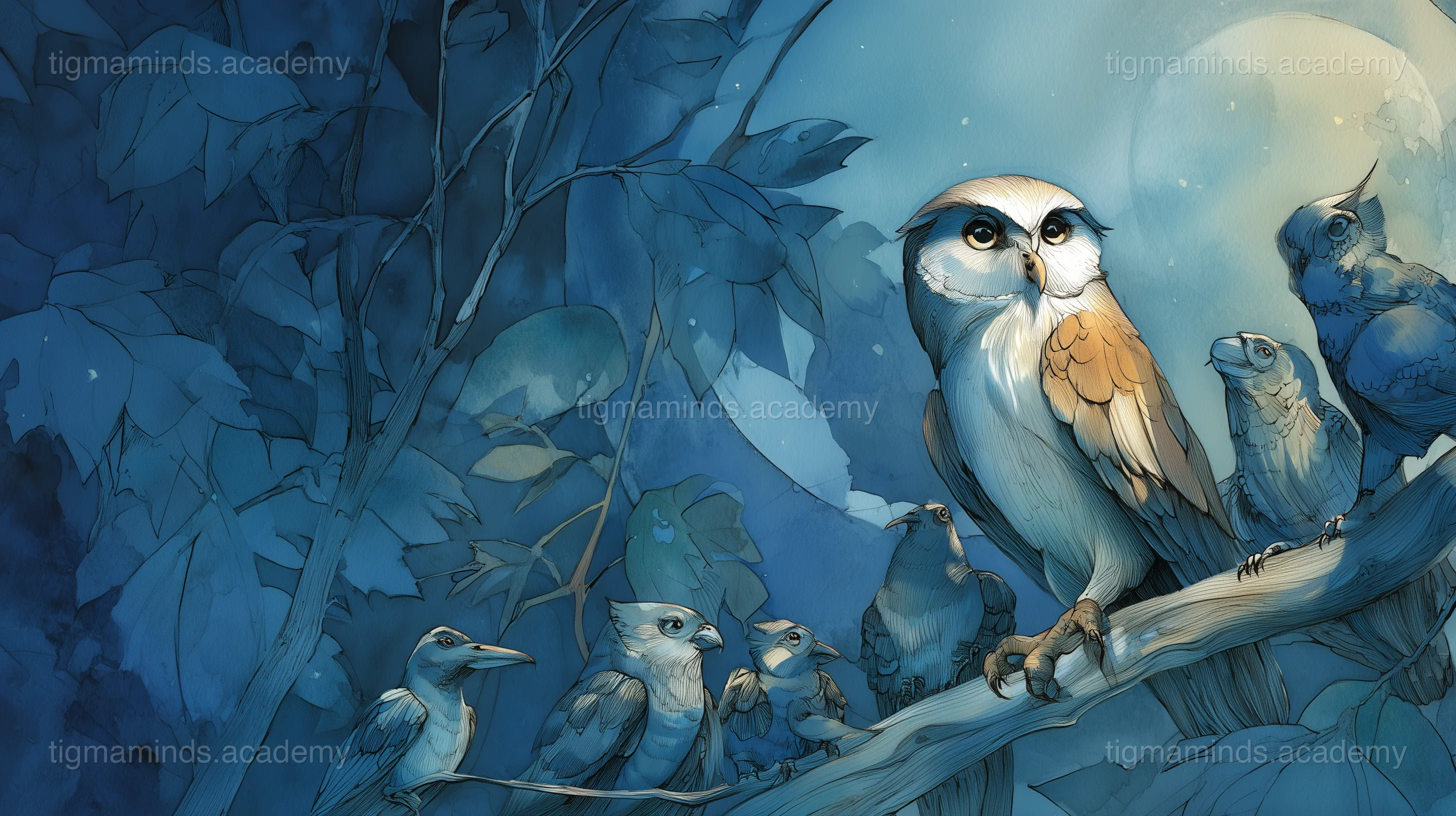
At last, the stork turned to the brown fish owl, who had been sitting silently on a high branch, her enormous amber eyes half-closed.

"And you, Owl? What makes you wise?"

The owl opened her eyes fully. Every bird in the tree went quiet — there was something about those eyes, deep and round as the moon, that made you want to listen.

"I am not sure I am wise," said the owl. Her voice was low and unhurried. "The kite sees farther than I do. The myna speaks more languages. The fairy-bluebird remembers more. I cannot claim to know more than any of you."

The birds murmured. This was unexpected.

"But I know one thing," the owl continued. "I know what I do not know. I know that the forest is larger than my understanding. I know that every season brings something I haven't seen before. I know that the answer to most questions is not 'I know' but 'let me think.'"

The Choosing

The banyan tree was silent for a long moment. Then the old stork nodded slowly.

"Every bird here told us what they know," he said. "The owl is the only one who told us what she doesn't know. And that — understanding the edges of your own knowledge — is the beginning of real wisdom."

The birds voted. It wasn't even close. The brown fish owl became the Chief Thinker of the forest — not because she had the most answers, but because she was honest about her questions.

The Owl's Way

From that day on, whenever the birds had a disagreement, they came to the owl. She never gave quick answers. She asked more questions. She said "I don't know" more often than "I do." She sent the birds away to think and come back the next evening.

Slowly, the birds of Kaziranga learned something new: wisdom isn't a pile of facts you sit on like a nest. It is the habit of asking, doubting, wondering, and admitting — with courage — that there is always more to learn.

And that is why, among the people of Assam and across the forests of the Northeast, the owl is still called the wisest bird. Not because it knows everything. Because it knows it doesn't.

The end.

Try It Yourself

Choose your level. Everyone starts with the story — the code gets deeper as you go.

Story Progress

0%

Ready to Start Coding?

Here is a taste of what Level 1 looks like for this lesson:

Level 1: Explorer — Python
import numpy as np
import matplotlib.pyplot as plt

light_levels = np.logspace(-4, 4, 100)
rod_response = light_levels / (light_levels + 0.01)
cone_response = np.where(light_levels > 1,
    (light_levels - 1) / (light_levels + 100), 0)

plt.figure(figsize=(10, 5))
plt.semilogx(light_levels, rod_response, label="Rod cells (night)", linewidth=2)
plt.semilogx(light_levels, cone_response, label="Cone cells (day)", linewidth=2)
plt.axvline(x=0.1, color="gray", linestyle="--", label="Starlight level")
plt.xlabel("Light intensity (relative)")
plt.ylabel("Response strength")
plt.title("Rod vs Cone: Why Owls See at Night")
plt.legend()
plt.show()  # Which works in starlight?

This is just the first of 6 coding exercises in Level 1. By Level 4, you will build: Test Sound Localization Accuracy.

Free

Level 0: Listener

Stories, science concepts, diagrams, quizzes. No coding.

You are here

Enrolled

Levels 1-4

Python, NumPy, Matplotlib, real projects, mentorship.

Sign Up Free

Stay Updated

Join Waitlist

Get notified when enrollment opens for your area.

Notify Me

Level 0 is always free. Coding levels (1-4) are part of our 12-Month Curriculum.