How the Orchid Got Its Colors
Plant Pigments & Pollination

How the Orchid Got Its Colors

An Arunachal tale about the most diverse flower family.
Plant Pigments & Pollination12-Month Curriculum 12h

The Story

The Contest in the Forest

In the misty forests of Arunachal Pradesh, where the trees grow so tall they disappear into the clouds, the flowers once held a grand contest. The prize: the title of Most Beautiful Flower in the Forest.

Every flower wanted to win. The rhododendron polished her red petals until they gleamed. The magnolia fluffed her white blossoms until they looked like fresh snow. The marigold deepened his orange until it glowed like a sunset. The blue poppy of the high meadows sharpened her blue until it matched the sky itself.

In a quiet corner of the forest, on the mossy trunk of an old oak, a small orchid named Kopou watched all of this and felt worried. Kopou was plain — just a simple green bud with no colour at all.

"I can't compete," Kopou whispered to the moss. "I don't even have a colour yet."

Asking for a Colour

Kopou decided to ask the other flowers for help.

She went to the rhododendron. "Could you share a little red?"

The rhododendron laughed. "Red is mine. Find your own."

She went to the magnolia. "Could I borrow some white?"

"White is what makes me special," said the magnolia. "I can't give it away."

She asked the marigold for orange, the blue poppy for blue, the jasmine for cream. Every flower said no. Every colour belonged to someone, and nobody wanted to share.

Kopou returned to her oak tree, colourless and sad.

The Forest Spirit's Gift

That night, as Kopou hung on her branch in the dark, the forest spirit appeared — an old woman made of mist and moonlight, with bark for skin and leaves in her hair.

"Why are you crying, little bud?" asked the spirit.

"Because I have no colour," said Kopou. "And the contest is tomorrow. Every other flower is beautiful, and I'm just green."

The forest spirit smiled. "The other flowers each chose one colour and refused to share. But you — you asked everyone. You wanted all the colours. That tells me something about your heart."

The spirit reached into the moonlight and gathered a handful of silver. She reached into the dawn sky and pulled out a ribbon of pink. She scooped yellow from a firefly's belly, purple from a twilight cloud, red from a maple leaf, white from morning frost, and orange from the last ember of a campfire.

Then she pressed them all into Kopou's petals.

"There," said the spirit. "You wanted every colour? Now you have them. Not because you stole them, but because you were brave enough to ask — and humble enough to keep asking even when everyone said no."

The Contest

The next morning, when Kopou opened her petals, the forest went silent.

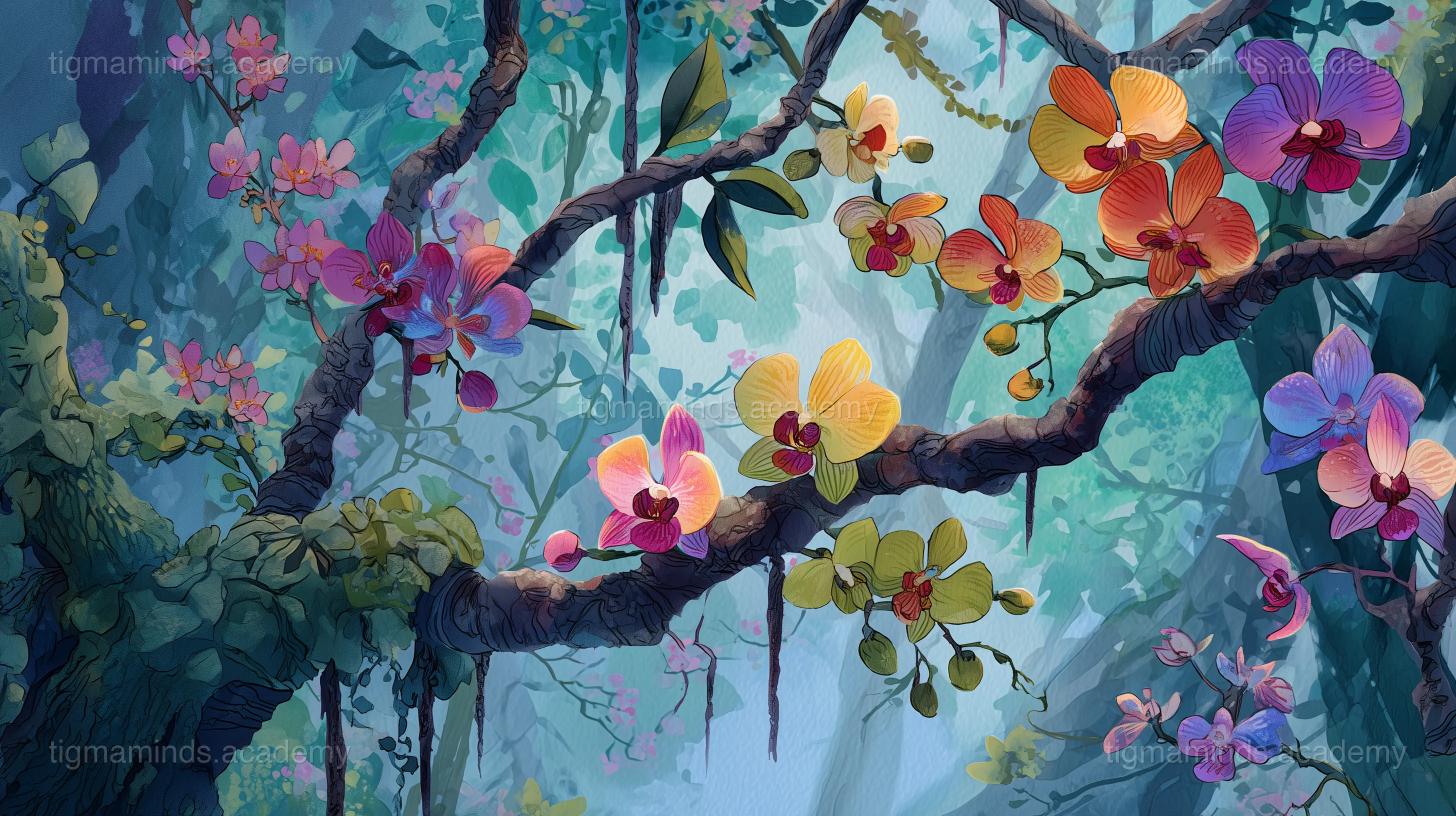
She was pink at the edges, white at the centre, with streaks of purple and flecks of gold. Her lip was crimson with a pattern like a tiny painted mask. Her petals were thin as silk and shaped like the wings of a butterfly.

She wasn't just one colour. She was all of them.

The rhododendron stared. The magnolia gasped. The marigold forgot to glow. Even the proud blue poppy dipped her head in admiration.

"How?" they all asked. "How do you have every colour?"

"Because I asked," said Kopou simply. "You each kept your colour to yourselves. I wanted to share. The forest spirit decided that the one who wanted to hold all colours deserved to wear them."

The Orchid's Legacy

Kopou won the contest that day. But she never boasted about it. She stayed on her quiet oak tree, blooming in her patchwork of colours, attracting bees and butterflies from every corner of the forest.

And from that day on, orchids have come in every colour imaginable — pink, white, purple, yellow, red, orange, spotted, striped, and shades that don't even have names yet. There are over six hundred species of orchid in Arunachal Pradesh alone, more than almost anywhere else on Earth. Each one wears the colours that the forest spirit gave to a humble little bud who wasn't afraid to ask for what she wanted.

The people of Assam and Arunachal Pradesh still call the orchid Kopou Phool. It is a flower that reminds us: you don't have to choose just one thing to be. You can be all of them — as long as your heart is big enough to hold every colour.

The end.

Try It Yourself

Choose your level. Everyone starts with the story — the code gets deeper as you go.

Story Progress

0%

Ready to Start Coding?

Here is a taste of what Level 1 looks like for this lesson:

Level 1: Explorer — Python
import numpy as np
import matplotlib.pyplot as plt

# Three pigment absorption spectra
wavelength = np.linspace(380, 750, 500)

def gaussian(x, mu, sigma, amp):
    return amp * np.exp(-0.5 * ((x - mu) / sigma) ** 2)

# Anthocyanin absorbs green -> reflects purple/red
anthocyanin = gaussian(wavelength, 530, 40, 0.8)

# Carotenoid absorbs blue-violet -> reflects yellow/orange
carotenoid = gaussian(wavelength, 450, 30, 0.85)

plt.fill_between(wavelength, anthocyanin, alpha=0.3, color='purple')
plt.fill_between(wavelength, carotenoid, alpha=0.3, color='orange')
plt.xlabel("Wavelength (nm)")
plt.title("What pigments absorb vs reflect")
plt.show()  # Which colors are LEFT for your eye?

This is just the first of 6 coding exercises in Level 1. By Level 4, you will build: Map the Color Spectrum of Local Flowers.

By Level 4, enrolled students build: Map the Color Spectrum of Local Flowers

Free

Level 0: Listener

Stories, science concepts, diagrams, quizzes. No coding.

You are here

Enrolled

Levels 1-4

Python, NumPy, Matplotlib, real projects, mentorship.

Sign Up Free

Stay Updated

Join Waitlist

Get notified when enrollment opens for your area.

Notify Me

Level 0 is always free. Coding levels (1-4) are part of our 12-Month Curriculum.