Why Assam's Sunsets Are Orange
Atmospheric Optics & Scattering

Why Assam's Sunsets Are Orange

The physics of why the sky turns golden over the Brahmaputra.
Atmospheric Optics & Scattering12-Month Curriculum 12h

The Story

The Sky Painter

Long before humans looked up and gave the sky a name, there was a spirit whose only job was to paint the sunset. Her name was Rongili, which means the colourful one, and she lived on a cloud so high that even eagles couldn't reach it.

Every evening, Rongili dipped her brushes into pots of colour and swept them across the western sky. She had pots of red for the deserts, pink for the oceans, purple for the mountains, and gold for the plains. Each place on Earth got its own sunset, mixed and painted fresh every single day.

Rongili loved her work. But she had a secret favourite.

The Favourite Place

Of all the lands Rongili painted sunsets for, she loved Assam the most. She loved the way the Brahmaputra caught her colours and doubled them, so the sky and the river burned together. She loved the tea gardens, where her light turned the green leaves to copper. She loved the paddy fields, where her sunset reflected in a thousand tiny mirrors of standing water.

"Assam deserves the best sunset," Rongili said every evening. And every evening, she mixed a little extra colour — a deeper red, a brighter gold, a softer pink — just for the skies above the Brahmaputra valley.

The other spirits noticed. "You give Assam more colour than anywhere else," said the wind spirit. "That's not fair."

"I can't help it," said Rongili. "It's my favourite place. The river is wide enough to hold the whole sky in it. Where else can a sunset see its own reflection so clearly?"

The Last Pot of Orange

One autumn, something terrible happened. Rongili's paint pots began to run dry. She had been painting sunsets for ten thousand years, and the colours were finally running out.

First the purple ran dry. Then the pink. Then the gold. One by one, the colours dwindled until Rongili was left with a single pot — her orange. A deep, warm, glowing orange, the colour of embers in a winter fire, of marigolds at a festival, of a ripe komola from an Assam garden.

One pot. Enough for one last sunset.

Rongili looked down at the Earth. She could paint this final sunset anywhere — over the Sahara, over the Pacific, over the Himalayas. Any place would be beautiful. But she already knew where it would go.

"Assam," she whispered. "Always Assam."

The Greatest Sunset

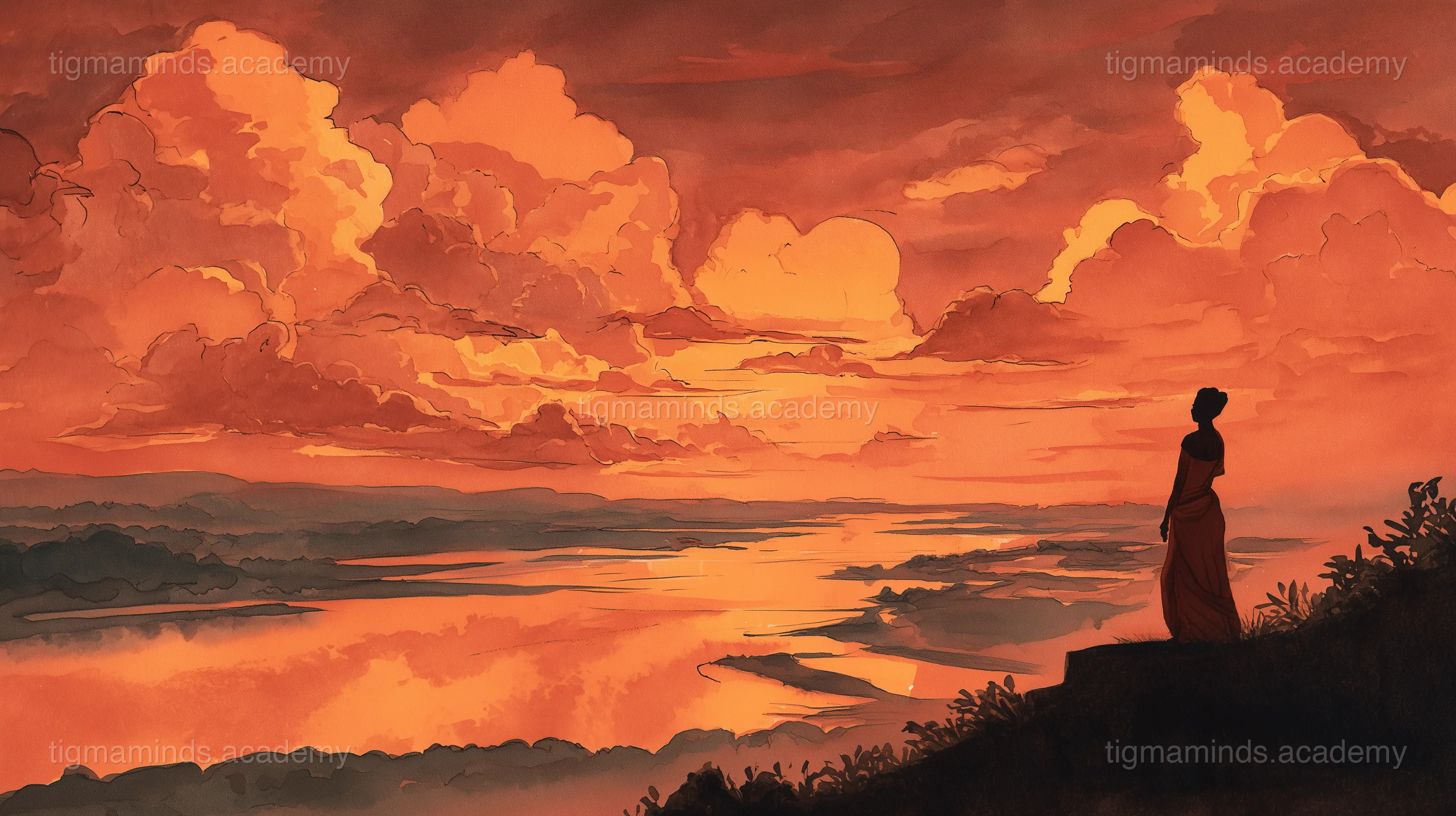
That evening, Rongili dipped her largest brush into the orange pot and painted the sky above the Brahmaputra with everything she had. She didn't hold back. She didn't save a drop for tomorrow. She swept the orange across the clouds in great, generous strokes — tangerine near the horizon, amber higher up, apricot at the edges, and a deep, burning vermillion at the centre where the sun touched the river.

The entire valley glowed. The tea gardens turned to fields of flame. The river became a ribbon of molten copper. The white egrets flying home looked like sparks rising from a bonfire. Even the rhinos in Kaziranga stopped eating and turned their heads west to watch.

Children ran out of their houses. Grandmothers stood in their doorways. Fishermen paused mid-cast, their nets hanging still, their eyes wide.

It was the most beautiful sunset anyone had ever seen.

The Promise That Stayed

When the last light faded, Rongili looked at her empty pot and smiled. "That was worth ten thousand years of painting," she said.

But something unexpected happened. The next evening, as the sun went down, the sky above Assam turned orange again — all by itself. Not because Rongili painted it, but because the colour had soaked so deeply into the clouds and the river and the air that it had become part of the place. Rongili's last gift had stained the sky forever.

And so, to this day, the sunsets over Assam are orange. Not pink like the coast, not purple like the mountains, not gold like the plains — but a deep, warm, glowing orange that fills the whole valley and turns the Brahmaputra into a river of fire.

The people of Assam say that if you watch the sunset quietly, you can feel Rongili's presence — the sky-painter who loved their land so much she gave it her very last colour.

The end.

Try It Yourself

Choose your level. Everyone starts with the story — the code gets deeper as you go.

Story Progress

0%

Ready to Start Coding?

Here is a taste of what Level 1 looks like for this lesson:

Level 1: Explorer — Python
import numpy as np
import matplotlib.pyplot as plt

# The Rayleigh scattering formula
# Blue light scatters much more than red!
wavelengths = np.linspace(380, 700, 100)  # nm
scattering = 1 / wavelengths**4           # Rayleigh's law
scattering = scattering / scattering.max()

plt.figure(figsize=(10, 5))
plt.fill_between(wavelengths, scattering, alpha=0.3)
plt.plot(wavelengths, scattering, linewidth=2)
plt.xlabel("Wavelength (nm)")
plt.ylabel("Scattering intensity")
plt.title("Why Blue Scatters More Than Red")
plt.show()  # What does this plot tell you?

This is just the first of 6 coding exercises in Level 1. By Level 4, you will build: Build a Sunset Color Simulator.

By Level 4, enrolled students build: Build a Sunset Color Simulator

Free

Level 0: Listener

Stories, science concepts, diagrams, quizzes. No coding.

You are here

Enrolled

Levels 1-4

Python, NumPy, Matplotlib, real projects, mentorship.

Sign Up Free

Stay Updated

Join Waitlist

Get notified when enrollment opens for your area.

Notify Me

Level 0 is always free. Coding levels (1-4) are part of our 12-Month Curriculum.