
A tree that lives for centuries — the biology of longevity.
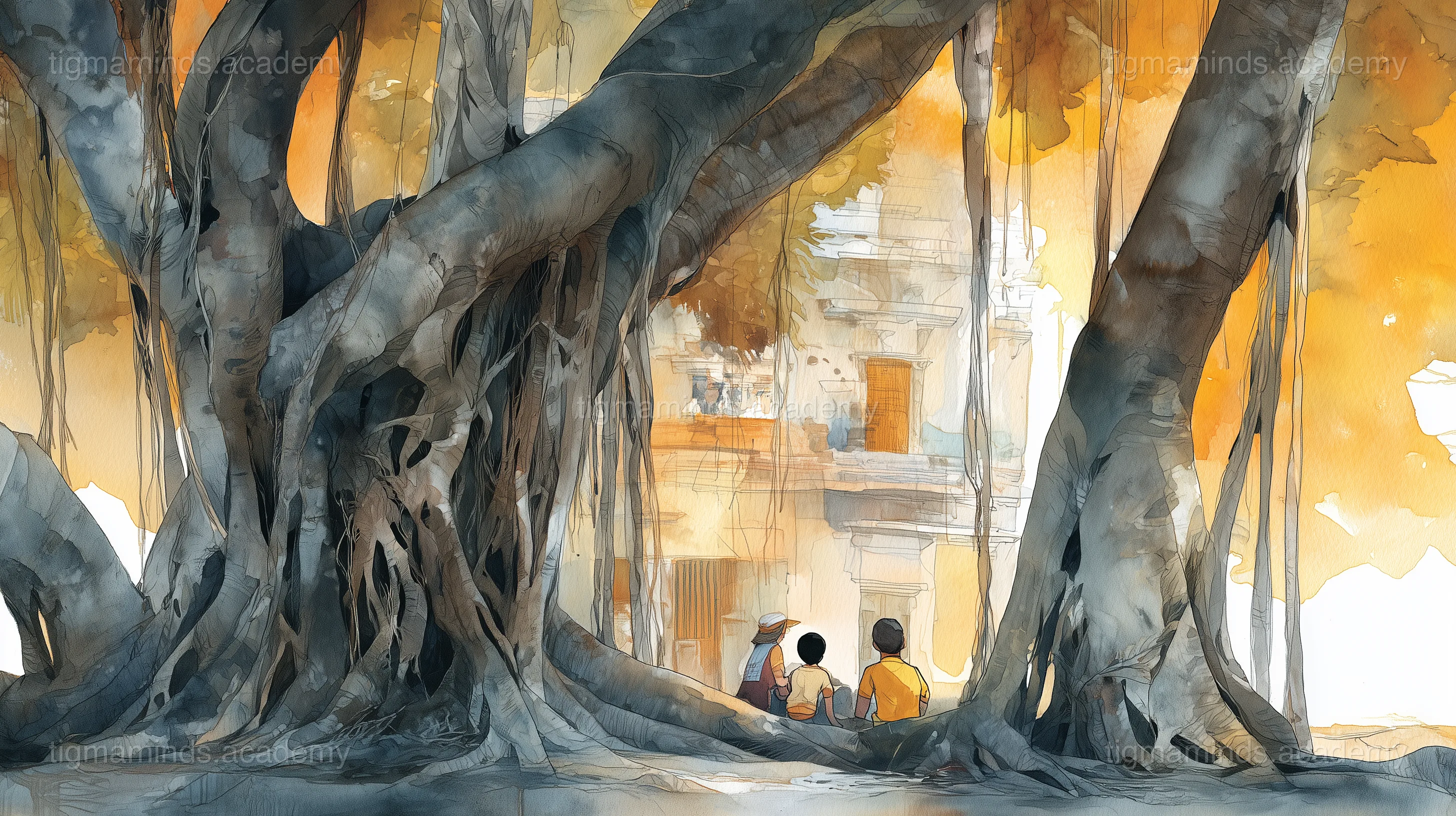
The Oldest Resident
In a village near Sivasagar, Assam, there stands a banyan tree so old and so large that its aerial roots have become trunks, and its trunks have become a small forest. The villagers say it was planted two hundred years ago, though nobody remembers by whom.
The tree has a name. The villagers call it Borua Bor Gos — the Great Old Tree. It covers an area as large as a school playground, and its shade is so deep and cool that even in the burning heat of April, the ground beneath it stays damp.
A girl named Dimpi liked to sit in the crook of Borua Bor Gos's lowest branch, her feet dangling, her notebook open on her knees. She was twelve and wanted to be a writer, but she never knew what to write about.
"I wish I had stories," she said aloud one evening.
And the tree answered.
The Tree Speaks
The voice was deep and slow, like the creaking of ancient wood. It came from everywhere and nowhere — from the roots, the bark, the leaves.
"You want stories? I have two hundred years of them."
Dimpi nearly fell off the branch. "You can talk?"
"I've always been able to talk. But only children who sit still long enough can hear me. Adults are too busy."
Dimpi gripped the branch and leaned in. "Tell me a story."
"Which one? I have seen the Ahom kings ride past on elephants. I have seen the Brahmaputra flood so high that fish swam through my branches. I have watched British soldiers march down the road and freedom fighters march after them. I have sheltered a hundred monsoons, a thousand weddings, and more arguments between neighbours than I care to count."
The Flood Story
"In 1950," said the tree, "the great earthquake came. The ground shook so hard that my roots hummed like a tuning fork. Then the river rose — not slowly, the way it does in monsoon, but all at once, a wall of brown water that swallowed the fields in minutes."
"The villagers climbed into my branches. Forty-three people — men, women, children, even two goats and a cat. They stayed in my arms for three days while the water swirled below. I held them. I didn't let a single branch break, though some were so heavy with people that they bent to the water."
"On the third day, the water receded. The people climbed down, and every one of them touched my trunk and said thank you. That was the proudest day of my two hundred years."
Dimpi was writing furiously. "What else?"
The Wedding Story
"In 1985, a young couple from the village wanted to marry, but the girl's family said the boy was too poor. They came to me at midnight and held their wedding under my branches with only the stars and the fireflies as witnesses. The boy tied a thread around my trunk as a promise. The thread is still there — look, that ridge in my bark, that's where the thread grew into me."
Dimpi ran her fingers over the ridge. It was smooth and old and real.
"They've been married forty-one years now. They still come and sit under me on their anniversary. He brings her tea. She brings him paan. They don't say much. They don't need to."
The Children's Story
"But my favourite stories," said the tree, "are about the children. I have watched five generations of children grow up under my shade. They climb my branches and think they've conquered the world. They hide behind my trunks during games of hide-and-seek. They carve their names into my bark — which hurts, by the way — and come back twenty years later to show their own children."
"Right now, there's a girl named Dimpi sitting on my branch, writing stories. In twenty years, she'll bring her daughter here and say, 'This is where I became a writer.' And I'll still be here, waiting, with another two hundred years of stories to tell."
Dimpi closed her notebook. Her eyes were shining. "Thank you," she whispered.
"Don't thank me," said the tree. "Just write it down. That's what stories are for — so the things that happened don't disappear when the ones who remember them are gone."
Dimpi climbed down from the branch, walked home in the golden evening light, and began to write. She wrote all night. And when she finally slept, she dreamed of a tree that held forty-three people in a flood and never let go.
The end.
Choose your level. Everyone starts with the story — the code gets deeper as you go.
Here is a taste of what Level 1 looks like for this lesson:
# How much carbon does a tree store?
trunk_diameter = 1.5 # metres (a large banyan)
height = 15 # metres
# Approximate volume (simplified cylinder)
import math
volume = math.pi * (trunk_diameter/2)**2 * height # cubic metres
wood_density = 600 # kg per cubic metre (average wood)
mass = volume * wood_density
carbon = mass * 0.5 # trees are ~50% carbon by dry weight
print(f"Trunk volume: {volume:.1f} cubic metres")
print(f"Wood mass: {mass:.0f} kg")
print(f"Carbon stored: {carbon:.0f} kg")
print(f"That is {carbon * 3.67:.0f} kg of CO2 pulled from the air!")This is just the first of 6 coding exercises in Level 1. By Level 4, you will build: Analyze Tree Growth Using Ring Data.
Free
Level 0: Listener
Stories, science concepts, diagrams, quizzes. No coding.
You are here
Level 0 is always free. Coding levels (1-4) are part of our 12-Month Curriculum.
A tree that lives for centuries — the biology of longevity.
The big idea: "The Old Banyan Tree's Stories" teaches us about Tree Biology & Longevity — and you don't need to write a single line of code to understand it.
A banyan tree can weigh over 50 tonnes. Where did all that material come from? Most people say "from the soil." It seems obvious — the roots are in the soil, so the tree must be made of soil. But if you weighed the soil around a tree before and after it grew, you would find the soil barely lost any weight. The tree is not made of dirt.
Here is the surprising answer: a tree is mostly made of air. Specifically, carbon dioxide (CO₂) from the atmosphere. Through a process called photosynthesis, leaves capture CO₂ and water, use sunlight as energy, and rearrange the atoms into glucose (a sugar). The oxygen gets released — that is the oxygen you breathe. The carbon from the CO₂ gets built into wood, bark, roots, and leaves.
When you look at Borua Bor Gos — the great banyan in the story — you are looking at tonnes of carbon that used to be invisible gas floating in the air. The tree pulled it out of the atmosphere and turned it solid. This is the single most important chemical reaction on Earth: it produces food, releases oxygen, and removes carbon from the air.
Check yourself: If a tree gains 10 kg of wood in a year, where did most of that 10 kg come from? (a) The soil (b) The water (c) The air. (Answer: c — most of the mass is carbon from atmospheric CO₂.)
Key idea: Trees are mostly made from air, not soil. Photosynthesis captures CO₂ from the atmosphere and converts the carbon into solid wood — this is why trees matter for climate.
Most trees can only grow outward until their branches get too heavy. At some point, a branch extending 10 or 15 metres from the trunk simply cannot support its own weight — it would snap. This limits how wide the canopy can get. The banyan tree solved this problem.
Banyans grow aerial roots — thin strands that dangle down from branches like ropes. When a root reaches the soil, it digs in, starts absorbing water, and gradually thickens. Over years, it becomes as thick and woody as a trunk. Now that branch has its own support pillar. It can keep growing outward, send down more aerial roots, which become more pillars, allowing the canopy to expand further… indefinitely.
The Great Banyan Tree near Kolkata has over 3,000 aerial root pillars and covers about 14,500 square metres — larger than a football field. From a distance, it looks like a small forest, but it is one single organism. If you cut down any one "trunk," the rest survives, because each pillar is independently connected to the soil.
This is a biological solution to an engineering problem. Architects actually use the same principle: Gothic cathedrals have flying buttresses — external support pillars that let walls be thinner and windows wider. The banyan invented this design millions of years before humans did.
Think about this: Why do banyans grow better in humid climates like Assam than in dry climates? (Hint: the aerial roots need moisture from the air while they are dangling, before they reach the soil.)
Key idea: Banyan aerial roots grow down from branches to become new trunks — like adding pillars to a building. This lets one tree expand into a forest-sized canopy with no limit.
Access all 130+ lessons, quizzes, interactive tools, and offline activities
Remember: a tree is solid carbon pulled from the air. A large banyan tree may contain **20–40 tonnes of carbon** locked in its wood. That is the same ...
Inside a Living Leaf
The Hidden Half — Life Underground