
The engineering and biology behind history's most ambitious vessel.
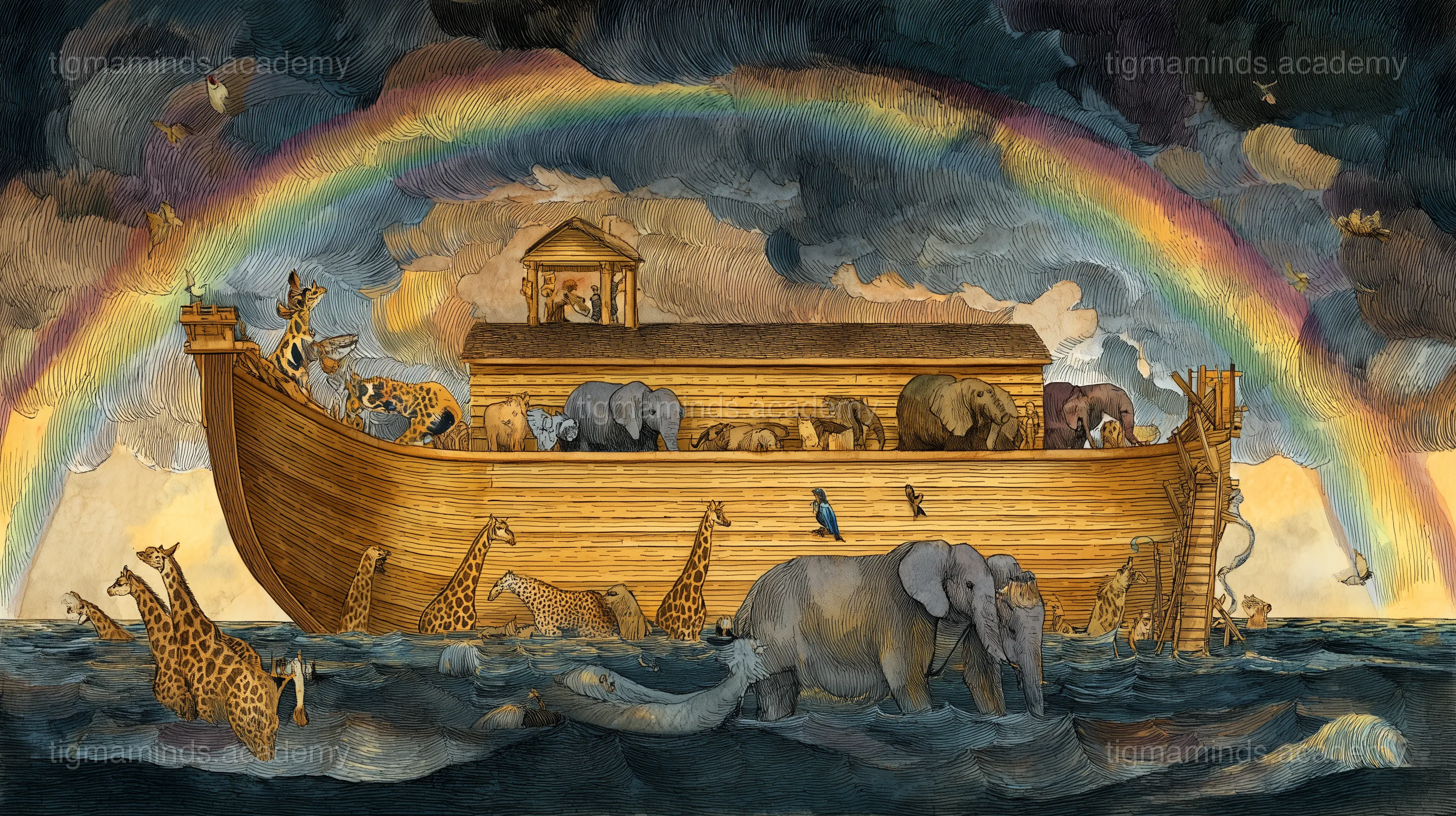
The Warning
The world had gone wrong, and God was grieved. Violence and cruelty had spread everywhere — among people, among nations. Only one family still lived with integrity: Noah, his wife, their three sons Shem, Ham, and Japheth, and their wives.
God spoke to Noah directly. A great flood was coming — water that would cover even the mountaintops. Everything on land would be destroyed. But God made a covenant with Noah: "Build an ark. I will tell you exactly how."
Noah had never built a ship. He was not a shipwright. He lived far from any ocean. But he listened.
The Blueprint
The dimensions were precise: 300 cubits long, 50 cubits wide, 30 cubits high. A cubit was the length from a man's elbow to his fingertips — roughly 45 centimetres. That made the ark about 135 metres long, 22.5 metres wide, and 13.5 metres high. Three decks. One door in the side. A roof with a cubit-high opening for ventilation.
Those proportions — a length-to-width ratio of 6:1 — are remarkably close to what modern naval architects use for cargo vessels. A ship too narrow capsizes easily. Too wide, and it wallows in waves. The 6:1 ratio balances stability and seaworthiness.
Noah built the ark from gopher wood — a term whose exact meaning is lost, but likely a dense, resinous timber. He coated it inside and out with pitch, a waterproof tar. Every plank sealed against the water that was coming.
The construction took years. Decades, some traditions say. Neighbours watched and mocked. A giant ship, on dry land, far from any sea. Noah hammered on.
The Gathering
Then came the impossible part. God told Noah to bring aboard two of every living creature — male and female — along with seven pairs of every "clean" animal (those suitable for sacrifice and food). Birds, livestock, wild animals, creatures that creep on the ground. Every kind.
Think about what this means. The ark was not just a boat. It was a floating ecosystem — a closed system that had to keep thousands of species alive for over a year. Food for herbivores. Food for carnivores (or stored feed). Fresh water. Ventilation. Waste management. Disease prevention. Temperature regulation.
Noah loaded grain, dried fodder, fruits, seeds. Water casks. Bedding. He built pens and cages and roosts. He divided the three decks: heavy animals low for ballast and stability, birds high where air circulated, supplies in between.
The animals came. The text says they came to Noah — drawn by something beyond human arrangement. Two by two they entered the ark, and Noah's family guided them into their places.
The Flood
On the seventeenth day of the second month, the "fountains of the great deep" burst open and the "windows of heaven" were opened. Rain fell for forty days and forty nights. The waters rose. The ark lifted off the ground and floated.
Everything outside perished. The water covered the highest mountains by fifteen cubits. The world became an ocean with no shore.
Inside the ark, Noah's family worked. Feeding. Watering. Cleaning. Keeping predators away from prey. Managing the stench and the noise and the sheer logistics of a floating zoo. Day after day, week after week, for 150 days the waters prevailed.
Then God sent a wind. The waters began to recede. On the seventeenth day of the seventh month, the ark came to rest on the mountains of Ararat. Noah opened the window and sent out a raven, which flew back and forth. He sent a dove, which found no resting place and returned. Seven days later, he sent the dove again — and it came back with a fresh olive leaf in its beak. Life was returning.
Seven days more, the dove did not return. The ground was dry.
The Covenant
Noah opened the ark. The animals poured out across the empty, washed world. Noah built an altar and made an offering. God set a rainbow in the sky as a sign of the covenant: never again would a flood destroy all life.
Eight people and thousands of creatures had survived. The ark had held. The engineering was sound. The biology was sustained. Against all odds, life continued.
And the first thing Noah did on dry land was plant a vineyard. After a year on a floating zoo, the man needed a drink.
The end.
Choose your level. Everyone starts with the story — the code gets deeper as you go.
Here is a taste of what Level 1 looks like for this lesson:
# Ark Buoyancy Calculator
length = 135 # metres
width = 22.5 # metres
draft = 7.0 # how deep the ark sits in water (metres)
# Volume of water displaced
displaced_volume = length * width * draft # cubic metres
water_density = 1000 # kg per cubic metre (freshwater)
# Buoyant force = weight of displaced water
buoyant_force_kg = displaced_volume * water_density
buoyant_force_tonnes = buoyant_force_kg / 1000
print(f"Displaced volume: {displaced_volume:,.0f} m^3")
print(f"Maximum cargo: {buoyant_force_tonnes:,.0f} tonnes")
print(f"That's about {buoyant_force_tonnes / 0.5:,.0f} average animals")
# What happens if you increase the draft to 10m?This is just the first of 6 coding exercises in Level 1. By Level 4, you will build: Build an Ark Capacity Calculator.
By Level 4, enrolled students build: Build an Ark Capacity Calculator
Free
Level 0: Listener
Stories, science concepts, diagrams, quizzes. No coding.
You are here
Level 0 is always free. Coding levels (1-4) are part of our 12-Month Curriculum.
The real-world engineering of ship design and the biology of sustaining thousands of species in a closed system.
The big idea: "Noah's Ark — Floating a Zoo" teaches us about Naval Architecture & Biodiversity — and you don't need to write a single line of code to understand it.
Here is a puzzle. A steel nail sinks in water. But a steel ship — weighing thousands of tonnes — floats. Same material. Why does shape matter so much?
The answer was discovered by a Greek mathematician named Archimedes around 250 BC. He noticed that when you lower an object into water, the water pushes back. This upward push is called buoyancy, and Archimedes figured out exactly how strong it is: the buoyant force equals the weight of the water that the object displaces (pushes aside).
A steel nail is solid. It is denser than water (steel is about 7.8 g/cm cubed, water is 1.0 g/cm cubed), so the tiny amount of water it displaces is not heavy enough to support the nail. It sinks. But a steel ship is shaped like a hollow bowl. It pushes aside a huge volume of water — far more than the thin steel walls alone would. The weight of that displaced water is greater than the weight of the ship. So the ship floats.
Think of it this way. A solid steel cube 10 cm on each side weighs about 7.8 kg. It displaces only 1 kg of water. It sinks — the water cannot push hard enough. Now hammer that same steel into a thin-walled box 50 cm on each side. It still weighs 7.8 kg, but now it displaces water equal to 50 x 50 x (however deep it sinks) cubic centimetres. It only needs to sink about 6 cm to displace 7.8 kg of water. It floats with most of the box above the waterline.
Check yourself: If you crumple a sheet of aluminium foil into a tight ball and drop it in water, it sinks. But if you shape the same foil into a little boat, it floats. Why? The boat shape displaces more water relative to its weight — exactly Archimedes' principle in action.
Key idea: An object floats when the weight of water it displaces equals or exceeds its own weight. Shape determines how much water is displaced — hollow shapes displace more water per kilogram of material, which is why steel ships float.
The Bible gives specific dimensions for Noah's ark: 300 cubits long, 50 cubits wide, 30 cubits high. Using a cubit of 45 cm, that is roughly 135 m x 22.5 m x 13.5 m. Three decks inside. What is the total volume?
Volume = length x width x height = 135 x 22.5 x 13.5 = roughly 41,000 cubic metres. For comparison, a standard shipping container holds about 33 cubic metres. So the ark had the volume of about 1,250 shipping containers — comparable to a mid-sized modern cargo ship.
Now the hard question: how many animals need to fit? Scientists estimate there are about 8.7 million species on Earth, but most are insects, marine creatures, and microorganisms. Land vertebrates — mammals, birds, reptiles, amphibians — number about 35,000 species. If we take two of each, that is 70,000 animals.
But most animals are small. About 80% of land vertebrate species weigh less than 10 kg (think rats, songbirds, frogs, lizards). Only about 15% are medium-sized (sheep, dogs, eagles). Fewer than 5% are large (cattle, horses, bears). And only a handful are truly massive (elephants, rhinos, hippos).
If we assume an average pen size of about 0.5 square metres per animal (generous for small species, tight for large ones), 70,000 animals would need about 35,000 square metres of floor space. The ark's three decks provide roughly 3 x 135 x 22.5 = 9,100 square metres of floor space. That is enough for about 18,000 animal pens — which means the ark would need creative stacking for small species, or a focus on "kinds" (broader categories like the dog family rather than every individual breed).
Think about it: Zoos today house about 800 species in a facility the size of a large park. The ark needed to fit 35 times more species in the volume of a cargo ship. The logistics are staggering — which is exactly what makes this a fascinating engineering problem.
Key idea: The ark had roughly 41,000 cubic metres of internal volume — about 1,250 shipping containers. Fitting 70,000+ animals requires understanding that most species are small, and space planning is the key engineering challenge.
Access all 130+ lessons, quizzes, interactive tools, and offline activities
The ark was not just a boat. It was a **closed ecosystem** — a sealed environment where thousands of living things had to survive for over a year with...
Noah was told to save two of **every kind** of creature. But why does every species matter? Could you skip a few — say, mosquitoes, or parasitic worms...