
Commerce and community — market economics.
The Market of Mothers
In the heart of Imphal, the capital of Manipur, there is a market like no other in the world. It is called Ima Keithel — the Market of Mothers — and it has been run entirely by women for over five hundred years. No men sell here. Only imas — mothers, grandmothers, aunts, sisters — sitting behind their stalls with the calm authority of queens on their thrones.
A boy named Tomba had heard about Ima Keithel his whole life. His own mother, Ima Memma, had a stall there, selling handwoven phanek — the traditional wraparound cloth worn by the women of Manipur. But Tomba had never been allowed to visit the market at night, when it came truly alive.
"You're too young," Ima Memma always said. "The night market is overwhelming. You'll get lost."
"I'm ten," said Tomba. "I won't get lost."
On the evening of his tenth birthday, Ima Memma finally relented. "Stay close," she said. "And keep your eyes open. This market has more lessons than any school."
The First Stall
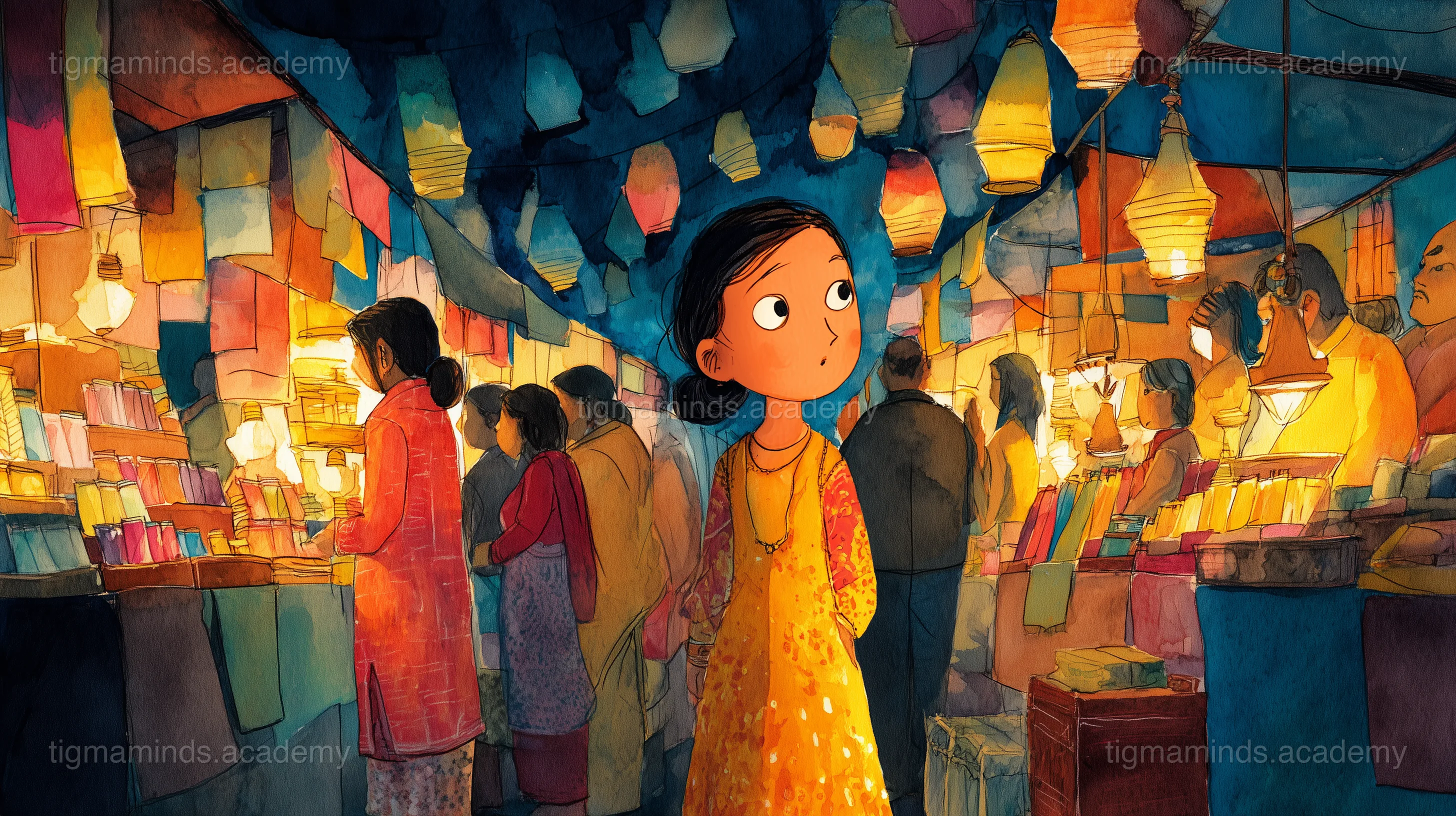
The market was a universe. Three enormous buildings and hundreds of stalls spilling out onto the streets, lit by bare bulbs and flickering tube lights. The air was thick with smells — fermented fish, fresh vegetables, incense, raw silk, and the warm, earthy scent of black rice being measured into bags.
The first stall they passed belonged to Ima Ibemhal, who sold dried fish. She was eighty years old, with hands like leather and eyes like a hawk.
"Tomba!" she called. "Your mother's boy. Come, taste this." She held out a piece of ngari — fermented fish that smelled terrible and tasted, somehow, wonderful. Tomba chewed carefully.
"Good?" asked Ima Ibemhal.
"Good," said Tomba, surprised.
"Lesson one," said Ima Ibemhal. "Never judge food by its smell. And never judge people by their appearance. The best things in life don't look or smell the way you'd expect."
The Cloth Sellers
Ima Memma's stall was in the cloth section — rows and rows of women selling fabrics in colours so vivid they made Tomba's eyes ache. Deep reds, royal blues, forest greens, all woven with intricate patterns that told stories.
"See this pattern?" said Ima Memma, holding up a phanek with a border of interlocking diamonds. "This is the moirang phee pattern. It tells the story of the great love of Khamba and Thoibi, the most famous legend of Manipur. Every diamond represents a test they overcame."
"And this one?" Tomba pointed to a cloth with wave-like patterns.
"That's the Loktak pattern — named after our great lake. The waves represent the floating islands, the phumdis, that drift on the water."
Tomba looked at the fabrics differently now. They weren't just cloth. They were stories you could wear.
The Vegetable Queens
The vegetable section was the loudest part of the market. Here, the imas argued about prices with the cheerful ferocity of warriors. They sat on low platforms surrounded by pyramids of tomatoes, hills of chillies, bundles of herbs, and baskets of mushrooms foraged from the hills.
One ima — Ima Sanatombi — saw Tomba staring at her mountain of green chillies and laughed. "You want to know why we women run this market and no men?"
Tomba nodded.
"Because five hundred years ago, the men were called away to fight wars and do forced labour for the king. The women were left behind with children to feed and no income. So we built this market. We grew the food, we wove the cloth, we sold the fish. We kept Imphal alive while the men were gone."
"And when the men came back?" asked Tomba.
Ima Sanatombi grinned. "By then, we were running things perfectly well. Why would we stop?"
The Walk Home
It was past nine o'clock when Ima Memma closed her stall and took Tomba's hand. The market was quieter now, the tube lights casting long shadows. A few imas were still counting their earnings, folding their unsold cloth, stacking their vegetables neatly for tomorrow.
"What did you learn tonight?" Ima Memma asked as they walked home through the warm Imphal night.
Tomba thought carefully. "I learned that the market isn't just a place to buy things. It's a place where women kept a whole city alive. And every stall is a story. And every ima is a teacher."
Ima Memma squeezed his hand. "Now you understand why I go there every day. It's not just work, Tomba. It's where I feel strongest. Five hundred years of women standing in that market, selling, arguing, laughing, surviving. When I sit at my stall, I sit with all of them."
Tomba looked back at the market, its lights glowing softly in the night. He could still hear the murmur of voices — the imas of Imphal, closing up for the night but never closing down. Five hundred years and counting.
He decided, right then, that when he grew up, he would tell the world about Ima Keithel. Not because it was unusual for a market to be run by women — but because it was proof that when the world takes something away from you, you can build something even better in its place.
The end.
Choose your level. Everyone starts with the story — the code gets deeper as you go.
Here is a taste of what Level 1 looks like for this lesson:
import numpy as np
import matplotlib.pyplot as plt
# Your first data analysis with Python
data = [45, 52, 38, 67, 41, 55, 48] # measurements
mean = np.mean(data)
plt.bar(range(len(data)), data)
plt.axhline(mean, color='red', linestyle='--', label=f'Mean: {mean:.1f}')
plt.xlabel("Sample")
plt.ylabel("Value")
plt.title("Supply Chains & Market Economics — Sample Data")
plt.legend()
plt.show()This is just the first of 6 coding exercises in Level 1. By Level 4, you will build: Simulate a Market Economy.
Free
Level 0: Listener
Stories, science concepts, diagrams, quizzes. No coding.
You are here
Level 0 is always free. Coding levels (1-4) are part of our 12-Month Curriculum.
Commerce and community — market economics.
The big idea: "The Night Market of Imphal" teaches us about Supply Chains & Market Economics — and you don't need to write a single line of code to understand it.
The most fundamental concept in economics is supply and demand. When many people want a product (high demand) but little is available (low supply), the price rises. When supply exceeds demand, the price falls. This mechanism operates without any central authority — it emerges from millions of individual buying and selling decisions.
At a night market, you can see supply and demand in real time. Early in the evening, when vendors have full stocks and few customers, prices may be flexible — sellers are willing to negotiate. Late at night, popular items sell out (supply drops to zero) and cannot be bought at any price, while unsold items may be discounted as vendors try to avoid carrying inventory home.
The equilibrium price is where supply equals demand — the quantity sellers want to sell matches the quantity buyers want to buy. In formal markets, this happens through posted prices. In informal markets like Imphal's night bazaars, it happens through haggling — a real-time negotiation that reveals each buyer's willingness to pay and each seller's minimum acceptable price.
Key idea: Supply and demand determine prices through the interaction of buyers and sellers. Equilibrium price emerges where the quantity supplied equals the quantity demanded — visible in real time at informal markets through haggling.
The Ima Keithel (Mothers' Market) in Imphal, Manipur, is one of the oldest and largest markets in Asia run entirely by women. Dating back at least 500 years, it is a unique economic institution where approximately 5,000 women vendors control trade in vegetables, fish, textiles, household goods, and handicrafts.
Ima Keithel is an example of a gendered economic institution — the Meitei social system historically assigned marketplace trade to women while men engaged in warfare, farming, and governance. This division created a remarkable concentration of commercial expertise among women, passed down through generations. Today, the market generates significant economic power for women in a region where formal employment opportunities are limited.
Economically, Ima Keithel functions as a self-regulating marketplace. Senior vendors (known as ima) enforce informal rules about pricing, quality, and behavior. New vendors must earn the right to a stall through apprenticeship. This social regulation substitutes for formal market regulation (licenses, inspections, price controls), demonstrating that markets can function effectively through community governance rather than government oversight.
Key idea: Ima Keithel demonstrates that markets can self-regulate through community governance. Its 500-year history as an all-women institution shows how social structures shape economic organization.
Access all 130+ lessons, quizzes, interactive tools, and offline activities
The **informal economy** encompasses all economic activity that is not formally registered, taxed, or regulated by the government. This includes stree...