The Moonlit Boat Race of Majuli
Fluid Dynamics & Boat Design

The Moonlit Boat Race of Majuli

A girl's team wins not by rowing hardest, but by reading the river's currents.
Fluid Dynamics & Boat Design12-Month Curriculum 12h

The Story

The Moonlit Boat Race of Majuli

The Challenge

Once a year, on the night of the Kati Bihu full moon, the villages of Majuli held a boat race unlike any other. It was not raced in daylight, when you could see the water and steer by sight. It was raced at night, under the moon, when the Brahmaputra became a silver mystery and the currents hid beneath a glittering surface.

The rules were simple: row from the Kamalabari ghat to the old banyan tree at the island's southern tip and back. First boat home wins. No lanterns. No torches. Only the moon.

This year, four teams entered. Three were made up of the strongest rowers on the island — young men with arms like tree trunks who trained all year. The fourth team was different.

"You cannot be serious," said Biren, captain of the favourites, when he saw the fourth boat. "That's Jonaki's team. Half of them are girls."

"All of them are girls," corrected Jonaki, a wiry fifteen-year-old with river mud on her bare feet. "And we are going to win."

The Start

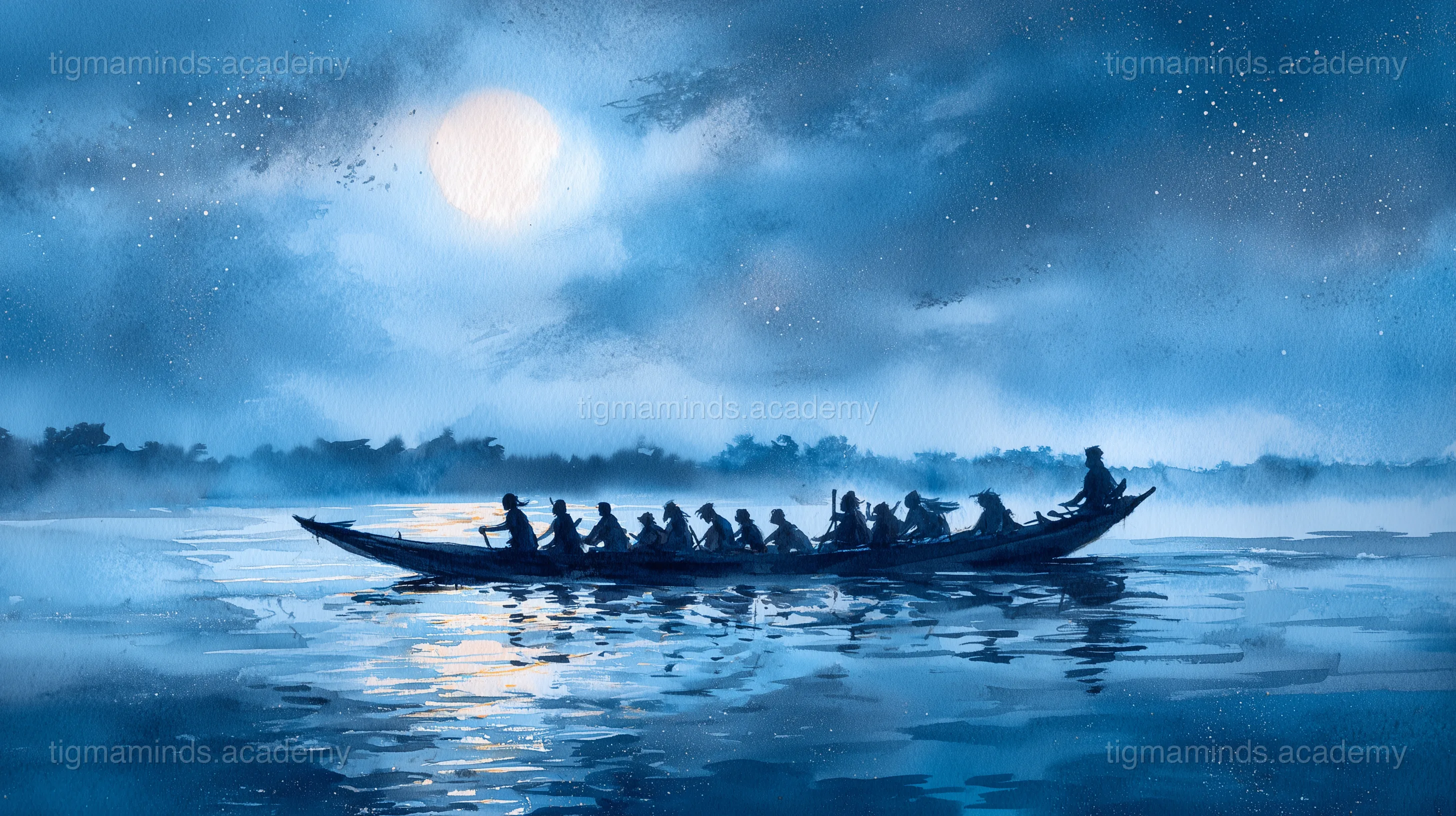
The moon rose fat and orange over the Brahmaputra. The four boats lined up at Kamalabari ghat — long, narrow wooden boats, freshly oiled. The starter blew a buffalo horn, and the race began.

The three men's teams dug their oars in hard, churning the silver water into froth. Their boats leaped forward. Biren's team took the lead immediately, their muscles driving the boat like a machine.

Jonaki's team rowed steadily — not slowly, but not frantically. Jonaki sat at the stern, one hand trailing in the water, her eyes half-closed.

"Row left," she said quietly. Her team shifted. "Now straight. Now a touch right."

She was reading the river.

The River's Secrets

Jonaki's grandmother was a fisherwoman who had spent sixty years on the Brahmaputra. She had taught Jonaki things no coach could: how to feel the current through your fingertips, how to read the moonlight on the water's surface to find the fast channels, how to spot the still water that meant a sandbar underneath.

"The river has roads," her grandmother had said. "You can't see them, but they are there. The fast water runs in certain channels, and if you find those channels, the river does half the rowing for you."

Jonaki found the first fast channel two hundred metres from the ghat. She felt it — a gentle tug on her trailing fingers, the water moving faster, cooler, deeper. She steered her team into it, and the boat surged forward as if pushed by an invisible hand.

Biren's team, rowing with brute force, was fighting the current — they had strayed into the slow water near the bank without realising it. Their oars churned, but the boat barely moved.

The Turn

At the old banyan tree, the boats had to turn and race back. This was the hardest part — the current ran against you on the return, and the moonlight made it impossible to judge distance.

The men's teams turned wide, losing precious seconds. Jonaki turned tight — she knew the exact depth at the banyan because her grandmother had fished there every Tuesday for forty years. The water was deep enough for a sharp turn, and Jonaki's boat whipped around like a dancer.

"Now," Jonaki said. "The return channel is twenty metres to the right. It runs with us all the way home."

Her team adjusted. The boat caught the channel, and the river — the beautiful, generous Brahmaputra — carried them north like a gift.

The Finish

Jonaki's team crossed the finish line at Kamalabari ghat two boat-lengths ahead of Biren's team. The crowd on the bank erupted. Lanterns were lit. Children cheered. The old fisherwoman, Jonaki's grandmother, sat on the ghat with tears rolling down her face.

"How?" Biren panted, pulling his boat up on the sand. "Your team barely rowed."

"We rowed plenty," said Jonaki. "But we also listened. The river wanted to help us. We just had to ask it nicely."

Biren looked at the Brahmaputra — silver, calm, ancient — and understood. The strongest arms in the world cannot beat someone who knows the water. Power is useful, but knowledge is faster.

The Tradition

From that year on, every team in the moonlit boat race included someone who could read the river — a grandmother's apprentice, a fisherwoman's child, someone who listened more than they pulled. The race was no longer about strength alone. It was about understanding.

And on full-moon nights, when the Brahmaputra shines like hammered silver, you can still see Jonaki's granddaughter trailing her fingers in the water, feeling for the river's hidden roads.

The end.

Try It Yourself

Choose your level. Everyone starts with the story — the code gets deeper as you go.

Story Progress

0%

Ready to Start Coding?

Here is a taste of what Level 1 looks like for this lesson:

Level 1: Explorer — Python
import numpy as np
import matplotlib.pyplot as plt

# Hull speed formula: V = 1.34 * sqrt(L)
# V in knots, L in feet
lengths_ft = np.linspace(5, 40, 100)
hull_speeds = 1.34 * np.sqrt(lengths_ft)

plt.figure(figsize=(10, 5))
plt.plot(lengths_ft, hull_speeds, linewidth=2, color='#0891b2')
plt.fill_between(lengths_ft, hull_speeds, alpha=0.1, color='#0891b2')
plt.xlabel('Waterline Length (feet)')
plt.ylabel('Hull Speed (knots)')
plt.title('Longer Boats Have Higher Maximum Speeds')
plt.grid(alpha=0.3)
plt.show()  # Why does the curve flatten?

This is just the first of 6 coding exercises in Level 1. By Level 4, you will build: Design and Test Boat Hull Shapes.

Free

Level 0: Listener

Stories, science concepts, diagrams, quizzes. No coding.

You are here

Enrolled

Levels 1-4

Python, NumPy, Matplotlib, real projects, mentorship.

Sign Up Free

Stay Updated

Join Waitlist

Get notified when enrollment opens for your area.

Notify Me

Level 0 is always free. Coding levels (1-4) are part of our 12-Month Curriculum.