How the Monsoon Found Its Way Home
Climate Patterns & Jet Streams

How the Monsoon Found Its Way Home

Climate science in a story about rain.
Climate Patterns & Jet Streams12-Month Curriculum 12h

The Story

The Monsoon's Problem

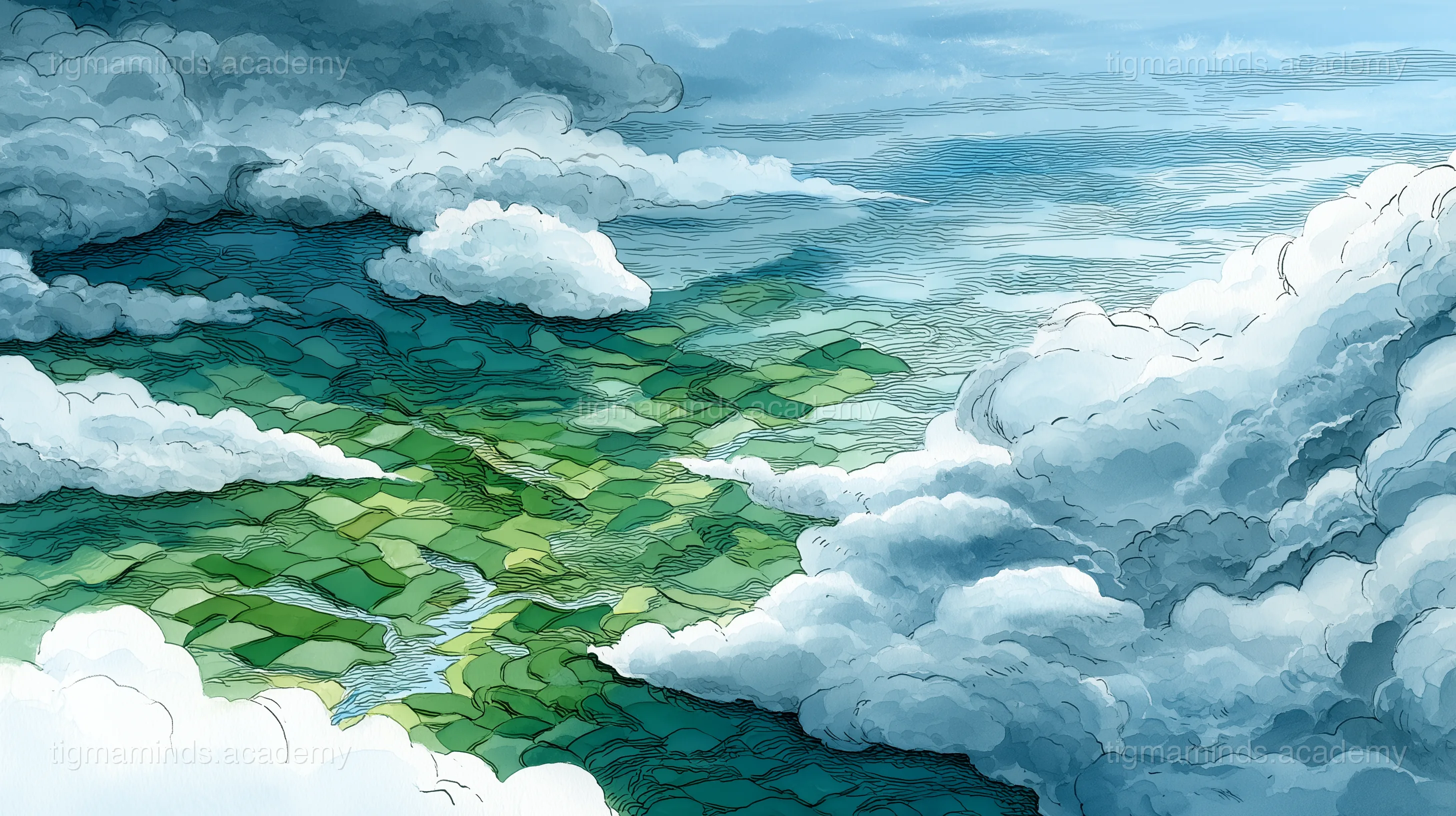
The monsoon is a traveller. Every summer, she leaves her home in the Indian Ocean, gathers up as much water as she can carry, and flies north to deliver rain to the land. She has been doing this for millions of years. You would think she would know the way by now.

But the monsoon has a problem: she has no eyes.

She can feel the warmth of the land pulling her north. She can hear the rivers calling. But she cannot see where she is going. Every year, she starts her journey full of confidence, and every year, somewhere over the middle of India, she gets confused.

"Was it left at the mountains?" she mutters, her clouds piling up against the Himalayas. "Or right? Or straight up?"

The Wrong Turns

One year — the year of this story — the monsoon took a particularly bad wrong turn. She veered west and dumped half her rain on a desert that didn't need it. The camels were horrified. She swung east and accidentally soaked a city that was in the middle of a cricket match. The spectators were furious.

"I can't find Northeast India!" the monsoon wailed, her clouds grey and heavy and lost. "It's always the hardest place to reach — tucked behind mountains, hidden in valleys, surrounded by hills. Why can't it be somewhere obvious?"

She drifted aimlessly over the plains, leaking drizzle and feeling sorry for herself.

The Smell

And then she caught it. A smell. Faint at first, riding on a warm updraft from the east — a smell so particular, so unmistakable, that the monsoon stopped mid-drift and lifted her nose (which is really just a warm front, but it works the same way).

Tea.

Not the tea you drink from a cup. The tea that grows — the living, breathing, green smell of a million tea bushes unfurling their leaves in the humid air. It smelled like earth and sweetness and morning and home.

"I know that smell," whispered the monsoon. "That's Assam."

Following the Fragrance

The monsoon turned east and followed the scent. It grew stronger as she crossed the hills — past the Meghalaya plateau, where Cherrapunji was already putting out its rain barrels, past the Brahmaputra valley, where the river was low and waiting. The tea smell was everywhere now, rising from Jorhat and Dibrugarh and Tinsukia and a hundred small gardens whose names only the people who love them know.

The monsoon breathed it in and felt her clouds grow heavy with purpose. This was where she was supposed to be. This was where the land was thirstiest.

She opened herself up and let the rain fall.

It fell on the tea gardens, and the bushes drank it up and grew two new leaves each. It fell on the paddy fields, and the farmers looked up at the sky and smiled. It fell on the Brahmaputra, and the great river swelled with joy. It fell on children who ran out of their houses to dance in it, mouths open, arms wide.

The Secret Path

From that year on, the monsoon never got lost again. Not because she suddenly grew eyes, but because she learned to follow the smell of the tea gardens. Every June, when the bushes are at their greenest and most fragrant, the monsoon lifts her nose, finds that unmistakable scent, and follows it home.

The people of Assam have always known this. That is why they say the first rains always fall on the tea gardens. Not because the gardens are lucky — but because the monsoon is following the tea.

And if you ever stand in a tea garden at the very start of monsoon season — just as the first fat drops are falling — breathe in deeply. You will smell tea and rain mixed together, and you will understand why the monsoon, year after year, always comes back to this place.

Some places are just easy to love. And even the clouds know it.

The end.

Try It Yourself

Choose your level. Everyone starts with the story — the code gets deeper as you go.

Story Progress

0%

Ready to Start Coding?

Here is a taste of what Level 1 looks like for this lesson:

Level 1: Explorer — Python
import numpy as np

# The monsoon engine: land vs ocean heating
# Water needs 5x more energy than rock per degree

specific_heat_rock = 800    # J/kg·K
specific_heat_water = 4186  # J/kg·K
solar_energy = 50000        # Joules absorbed per kg

temp_rise_land = solar_energy / specific_heat_rock
temp_rise_ocean = solar_energy / specific_heat_water
temp_gap = temp_rise_land - temp_rise_ocean

print(f"Land heats up: +{temp_rise_land:.1f}°C")
print(f"Ocean heats up: +{temp_rise_ocean:.1f}°C")
print(f"Temperature gap: {temp_gap:.1f}°C")
print(f"This gap drives monsoon winds from sea to land!")

This is just the first of 6 coding exercises in Level 1. By Level 4, you will build: Analyze Monsoon Rainfall Patterns Over Decades.

By Level 4, enrolled students build: Analyze Monsoon Rainfall Patterns Over Decades

Free

Level 0: Listener

Stories, science concepts, diagrams, quizzes. No coding.

You are here

Enrolled

Levels 1-4

Python, NumPy, Matplotlib, real projects, mentorship.

Sign Up Free

Stay Updated

Join Waitlist

Get notified when enrollment opens for your area.

Notify Me

Level 0 is always free. Coding levels (1-4) are part of our 12-Month Curriculum.