
Primates crossing a river — forest canopy science.
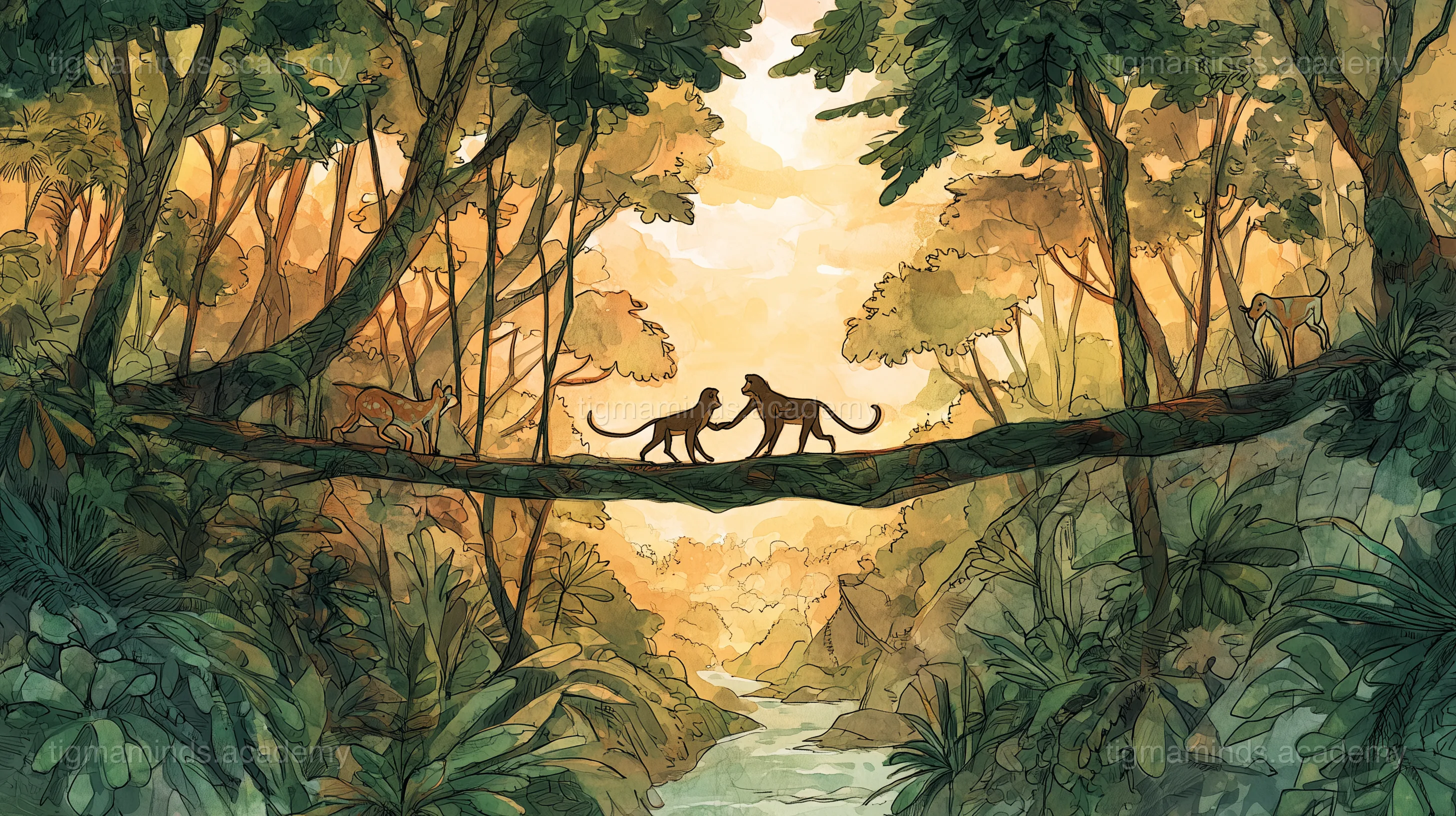
The Rising Waters
Deep in the Namdapha National Park, where Arunachal Pradesh meets Myanmar and the forest is so thick that sunlight has to fight its way to the ground, the monsoon arrived three weeks early.
It began with a whisper of rain on the canopy. Then a drumroll. Then a roar. Within hours, the little streams that crisscrossed the forest floor had swollen into angry brown rivers. The animals scrambled for higher ground — the elephants to the ridges, the clouded leopards to the tallest trees, the red pandas to their hidden hollows.
But not everyone made it.
On a narrow ledge above a ravine that was now a churning torrent, a baby barking deer stood trembling. She was no bigger than a house cat, her spotted coat plastered flat with rain, her thin legs shaking. Behind her was a cliff wall. In front of her, the ravine — ten metres across, with water crashing through it like a freight train.
She was trapped.
The Troop on the Other Side
On the far side of the ravine, a troop of Assamese macaques huddled in a fig tree. Their leader, a scarred old male named Dohu, watched the baby deer with worried eyes.
"She'll be swept away when the water rises another foot," said Mili, a young female macaque with a torn ear. "We have to do something."
"What can we do?" said another monkey. "We can't swim that current. We can't fly. We're monkeys, not miracles."
Dohu was quiet for a long time. He looked at the ravine. He looked at the old hollong tree that leaned out over the water from their side, its longest branch reaching halfway across. He looked at the fig tree they were sitting in, whose roots gripped the edge of the far bank.
Then he looked at his troop — twenty-three monkeys, each one strong, each one afraid.
"We can't fly," said Dohu. "But we can reach."
Building the Bridge
Dohu climbed to the end of the hollong branch. It bent under his weight, swaying over the churning water. He wrapped his tail and hind legs around the branch and stretched his arms out as far as they would go.
"Mili — grab my hands," he said.
Mili climbed out and gripped Dohu's wrists. She let her body hang, then swung forward, extending her own legs toward the far side. But the gap was still too wide.
"Next!" called Dohu.
One by one, the macaques climbed out. Each monkey grabbed the ankles of the one before and stretched toward the opposite bank. Three monkeys. Five. Eight. Twelve. A living chain of fur and muscle, swaying in the rain, each one holding the weight of those below.
Dohu's arms burned. The branch groaned. Rain lashed their faces. But nobody let go.
The twelfth monkey — a young male named Kaju — finally caught the roots of the fig tree on the far side. He wrapped his tail around a root and pulled himself tight.
The chain went taut. Twelve monkeys, stretched across a ten-metre ravine, their bodies forming a swaying, breathing, living bridge.
The Crossing
The baby deer stared at the bridge of monkeys with enormous brown eyes. She didn't understand what she was seeing. Animals don't build bridges. Animals run, hide, fight, or freeze. But these monkeys were doing something she had never seen — they were reaching for her.
Mili, who was nearest the deer's ledge, spoke softly. "Come on, little one. Walk across us. We'll hold you."
The deer took one trembling step. Her tiny hoof pressed into Kaju's back. He grunted but held firm. She took another step, then another, her delicate hooves finding the spaces between monkey ribs and shoulder blades.
Halfway across, the branch dipped. Water sprayed up and soaked the deer's belly. She froze.
"Don't stop!" called Dohu through gritted teeth. His arms were shaking. The branch was bending lower. "Keep walking, little one. We've got you."
The deer walked. Step by careful step, across the backs of twelve monkeys who were holding her weight and each other's, she crossed the ravine. When she reached Dohu's end, she leaped onto the solid branch of the hollong tree and scrambled to safety on the high ground.
The Cost and the Reward
The monkeys pulled themselves in, one by one, collapsing in a pile of wet fur and heavy breathing. Dohu's hands were raw. Mili's shoulders ached for days. Kaju had claw marks on his back where the deer's hooves had pressed too hard.
Nobody complained.
The baby deer stood on the ridge, looking back at the monkeys who had saved her. She couldn't say thank you — deer don't have the words. But she dipped her head, the way deer do when they meet something they respect, and then she turned and vanished into the forest to find her mother.
The macaques watched her go. Then Mili said, quietly, "We did that. We built a bridge out of ourselves."
Dohu smiled — a rare thing for a scarred old macaque. "That's what troops are for," he said. "Not just for finding food or fighting enemies. A troop is for being strong when one of you can't be."
In Namdapha, the people of Assam and Arunachal Pradesh tell this story when the monsoon comes. When the water rises, be a bridge. You don't need rope or wood or steel. You just need to reach out your hands and hold on tight.
The end.
Choose your level. Everyone starts with the story — the code gets deeper as you go.
Here is a taste of what Level 1 looks like for this lesson:
import numpy as np
import matplotlib.pyplot as plt
# Your first data analysis with Python
data = [45, 52, 38, 67, 41, 55, 48] # measurements
mean = np.mean(data)
plt.bar(range(len(data)), data)
plt.axhline(mean, color='red', linestyle='--', label=f'Mean: {mean:.1f}')
plt.xlabel("Sample")
plt.ylabel("Value")
plt.title("Primatology & Forest Canopy — Sample Data")
plt.legend()
plt.show()This is just the first of 6 coding exercises in Level 1. By Level 4, you will build: Model Forest Canopy Connectivity as a Network.
Free
Level 0: Listener
Stories, science concepts, diagrams, quizzes. No coding.
You are here
Level 0 is always free. Coding levels (1-4) are part of our 12-Month Curriculum.
Primates crossing a river — forest canopy science.
The big idea: "The Monkey Bridge of Namdapha" teaches us about Primatology & Forest Canopy — and you don't need to write a single line of code to understand it.
Brachiation — swinging hand-over-hand through the tree canopy — is the primary mode of locomotion for gibbons, the only apes found in Northeast India (the hoolock gibbon, Hoolock hoolock). The physics of brachiation is elegantly described by pendulum mechanics. As the gibbon swings beneath a handhold, its body acts as a pendulum: gravitational potential energy at the top of the arc converts to kinetic energy at the bottom, and back to potential energy at the top of the next arc.
An ideal pendulum would swing forever, but a real gibbon loses energy to air resistance and internal friction at each swing. To compensate, gibbons use a "ricochetal" brachiation technique where they release one handhold at the peak of the upswing, become briefly airborne, and catch the next handhold at the start of the downswing. This ballistic phase allows them to cover gaps between handholds that exceed the pendulum arc length. A hoolock gibbon can bridge gaps of 3-4 meters in a single ricochetal swing.
The biomechanics of brachiation require extraordinary anatomical adaptations. Gibbons have elongated arms (arm span exceeds height by about 40%), ball-and-socket wrist joints that allow 180° rotation, curved fingers that form passive hooks (requiring minimal muscular effort to grip), and reduced thumbs that do not interfere with the hook grip. Their shoulder joints are the most mobile of any primate, allowing full 360° arm rotation. These adaptations trade ground-based ability for arboreal excellence — gibbons are graceful in trees but awkward on the ground.
Key idea: Gibbon brachiation follows pendulum physics — gravitational potential energy converts to kinetic energy at the bottom of each swing, with airborne phases bridging gaps.
A simple pendulum (a mass on a string swinging in a gravitational field) demonstrates one of the most fundamental principles in physics: the conservation of energy. At the highest point of its swing, the pendulum has maximum gravitational potential energy (E_p = mgh, where m is mass, g is gravitational acceleration, and h is height above the lowest point) and zero kinetic energy (it momentarily stops). At the lowest point, all potential energy has converted to kinetic energy (E_k = ½mv², where v is velocity). The total energy E_p + E_k remains constant throughout the swing.
The period of a simple pendulum (the time for one complete back-and-forth swing) depends only on the length of the string and the gravitational acceleration: T = 2π√(L/g). Crucially, it does not depend on the mass or the amplitude of the swing (for small angles). This is why Galileo, watching a chandelier swing in the cathedral of Pisa, realized that pendulums could be used to measure time. This discovery led directly to the invention of the pendulum clock by Christiaan Huygens in 1656.
For brachiating gibbons, the pendulum period determines their maximum swing frequency. A gibbon with an arm length of about 0.6 meters has a natural pendulum period of about 1.5 seconds per swing. Swinging faster than this natural frequency requires energy input (like pumping a playground swing), while swinging at the natural frequency requires minimal energy — this is resonance. Gibbons instinctively match their swing frequency to their natural pendulum frequency, minimizing the energy cost of locomotion. This is why longer-armed gibbons swing more slowly but cover more distance per swing.
Key idea: A pendulum's period depends only on length and gravity — gibbons minimize energy by swinging at their natural pendulum frequency (resonance).
Access all 130+ lessons, quizzes, interactive tools, and offline activities
The forest canopy — the continuous layer of treetops 20-40 meters above the ground — is one of the least explored habitats on Earth, often called "the...