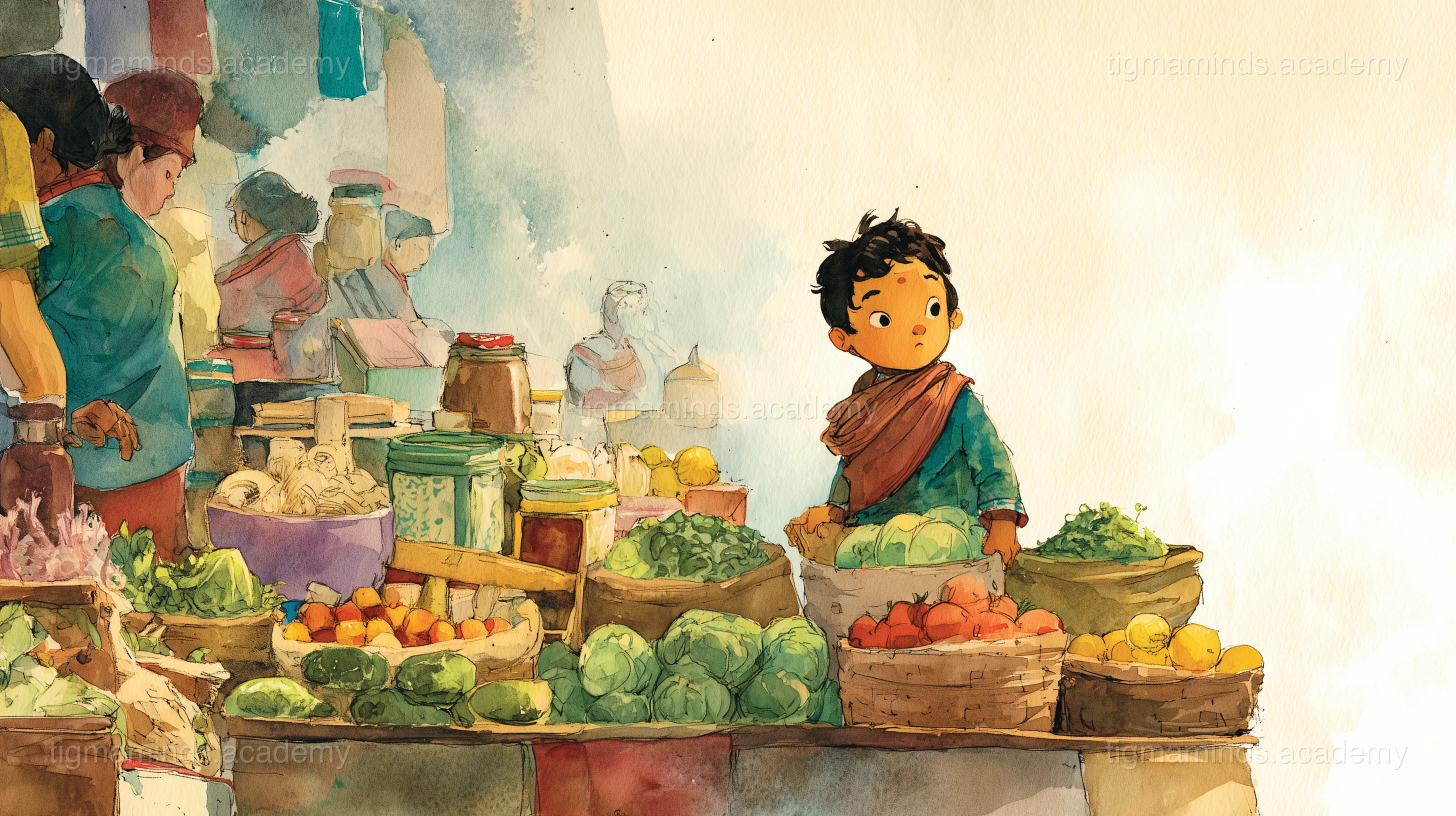
Economics and trade in a hill town.
Market Morning
Every Saturday, the Tura market in the Garo Hills of Meghalaya came alive like a creature waking from sleep. By six in the morning, the stalls were up — bamboo poles and blue tarpaulins stretching down the main road. By seven, the road was a river of people, animals, and the most wonderful smells in the world.
Rikme, a Garo girl of eight, loved market day more than any other day of the week. She loved the colours — pyramids of red tomatoes, bundles of green beans, baskets of orange turmeric root. She loved the sounds — haggling voices, clucking hens, the thud of a dao chopping betel nut. She loved the smells — smoked pork, fresh ginger, woodsmoke from the tea stall.
But today, Rikme had a problem. Her mother had given her fifty rupees — just enough to buy vegetables for the week — and Rikme had lost the money somewhere between home and the market gate.
The Search
Rikme retraced her steps, eyes on the ground. She checked the path through the bamboo grove. She checked the shortcut past the church. She checked the muddy ditch where she had jumped across. Nothing.
Fifty rupees. Gone. Rikme’s eyes stung. Her mother worked hard for that money — weaving cloth on a backstrap loom, selling it piece by piece. Fifty rupees was two days of weaving.
“What’s wrong, little sister?” asked an old woman selling dried fish at the market entrance. Her name was Mekjrang, and she had been at that spot every Saturday for forty years.
Rikme told her.
Mekjrang clucked her tongue. “Lost money is like lost water — it goes where it wants. But let’s see what we can do.”
The Chain of Kindness
Mekjrang called over Saljong, the vegetable seller. “Give this girl a bundle of beans. She’ll pay you next week.”
Saljong nodded and handed Rikme the biggest bundle on his stall. “And take some chillies too,” he said. “They’re small, and I have too many.”
The ginger seller overheard. “Here,” she said, pressing a fat knob of ginger into Rikme’s hand. “No charge. My daughter lost money once, and someone helped her. Now it’s my turn.”
The rice seller gave her a small bag of rice. The onion man added onions. The woman selling mustard greens wrapped a generous bunch in a banana leaf and tucked it into Rikme’s basket with a wink.
By the time Rikme reached the end of the market, her basket was full — fuller than it had ever been on a fifty-rupee day. And she hadn’t spent a single paisa.
The Real Surprise
Rikme sat on the stone steps near the market’s tea stall, looking at her overflowing basket, and something warm expanded in her chest that was bigger than relief.
The tea seller — a cheerful man with a grey moustache — placed a small clay cup of sweet red tea in front of her. “On the house,” he said. “You look like you’ve had an adventure.”
“I lost my money,” said Rikme, “but I found something better.”
“What’s that?”
Rikme looked back at the market — at Mekjrang sorting her dried fish, at Saljong stacking tomatoes, at the ginger seller laughing with a customer — and said, “I found out that this market isn’t just a place where people sell things. It’s a place where people take care of each other.”
The Promise
Rikme went home and told her mother everything. Her mother listened, nodded, and said, “Now you understand why I always send you to the market instead of going myself. The vegetables I can get anywhere. But the thing you learned today — that’s something you can only learn by being part of a community.”
The next Saturday, Rikme went back to the market with her fifty rupees — found between the sofa cushions, where it had slipped through a hole in her pocket. She paid back every seller, and with the change, she bought a cup of tea for old Mekjrang.
“You didn’t have to do that,” said Mekjrang.
“I know,” said Rikme. “That’s why I wanted to.”
The end.
Choose your level. Everyone starts with the story — the code gets deeper as you go.
Here is a taste of what Level 1 looks like for this lesson:
import numpy as np
import matplotlib.pyplot as plt
# Your first data analysis with Python
data = [45, 52, 38, 67, 41, 55, 48] # measurements
mean = np.mean(data)
plt.bar(range(len(data)), data)
plt.axhline(mean, color='red', linestyle='--', label=f'Mean: {mean:.1f}')
plt.xlabel("Sample")
plt.ylabel("Value")
plt.title("Economics & Trade — Sample Data")
plt.legend()
plt.show()This is just the first of 6 coding exercises in Level 1. By Level 4, you will build: Track Prices and Build a Market Dashboard.
Free
Level 0: Listener
Stories, science concepts, diagrams, quizzes. No coding.
You are here
Level 0 is always free. Coding levels (1-4) are part of our 12-Month Curriculum.
Economics and trade in a hill town.
The big idea: "The Market Day Surprise" teaches us about Economics & Trade — and you don't need to write a single line of code to understand it.
In a market like Tura's weekly bazaar, nobody centrally decides what an orange or a basket should cost. Prices emerge from decentralized interactions between buyers and sellers. A seller sets an asking price based on their costs and what they think buyers will pay; buyers decide whether to accept, reject, or negotiate. Through thousands of these interactions, a market-clearing price emerges — the price at which the quantity sellers want to sell roughly equals the quantity buyers want to buy.
This process is remarkably efficient. The economist Friedrich Hayek argued that prices are information signals: a rising price tells producers "make more of this" and consumers "consider alternatives." A falling price says the opposite. No single person needs to know the entire economy — the price encodes all relevant information about supply, demand, costs, and preferences into a single number.
In traditional markets, price formation also involves social information: buyers observe what others are paying, sellers adjust prices based on the speed of sales, and reputation affects willingness to pay. A known, trusted fish seller can charge slightly more than a stranger. This is why economists study both the mathematical models and the social dynamics of real markets — human behavior adds layers that equations alone cannot capture.
Key idea: Prices emerge from decentralized buyer-seller interactions and act as information signals — a rising price simultaneously tells producers to make more and consumers to buy less.
The law of demand states that, all else equal, as the price of a good rises, the quantity demanded falls (people buy less). The law of supply states that as price rises, the quantity supplied rises (producers make more, because it is more profitable). Plot both on a graph with price on the y-axis and quantity on the x-axis, and they form an X-shape — the demand curve slopes down, the supply curve slopes up.
Where the two curves cross is the equilibrium point — the price and quantity at which supply equals demand. If the actual price is above equilibrium, there is a surplus (unsold goods pile up, pushing price down). If below equilibrium, there is a shortage (buyers compete for scarce goods, pushing price up). The market naturally gravitates toward equilibrium, like a ball rolling to the bottom of a bowl.
At Tura's market, you can see this in real time. Early in the morning, a vegetable seller prices tomatoes high. By afternoon, if they have not sold enough, they lower the price. If they sell out by noon, tomorrow they will bring more and/or raise the price. This daily adjustment is the market searching for equilibrium. The same dynamic operates in global oil markets, stock exchanges, and cryptocurrency — just faster and with more participants.
Key idea: Equilibrium is the price where supply equals demand — above it, surplus forces prices down; below it, shortage forces prices up, creating a self-correcting system.
Access all 130+ lessons, quizzes, interactive tools, and offline activities
**Price elasticity of demand** measures how sensitive buyers are to price changes. It is calculated as the percentage change in quantity demanded divi...