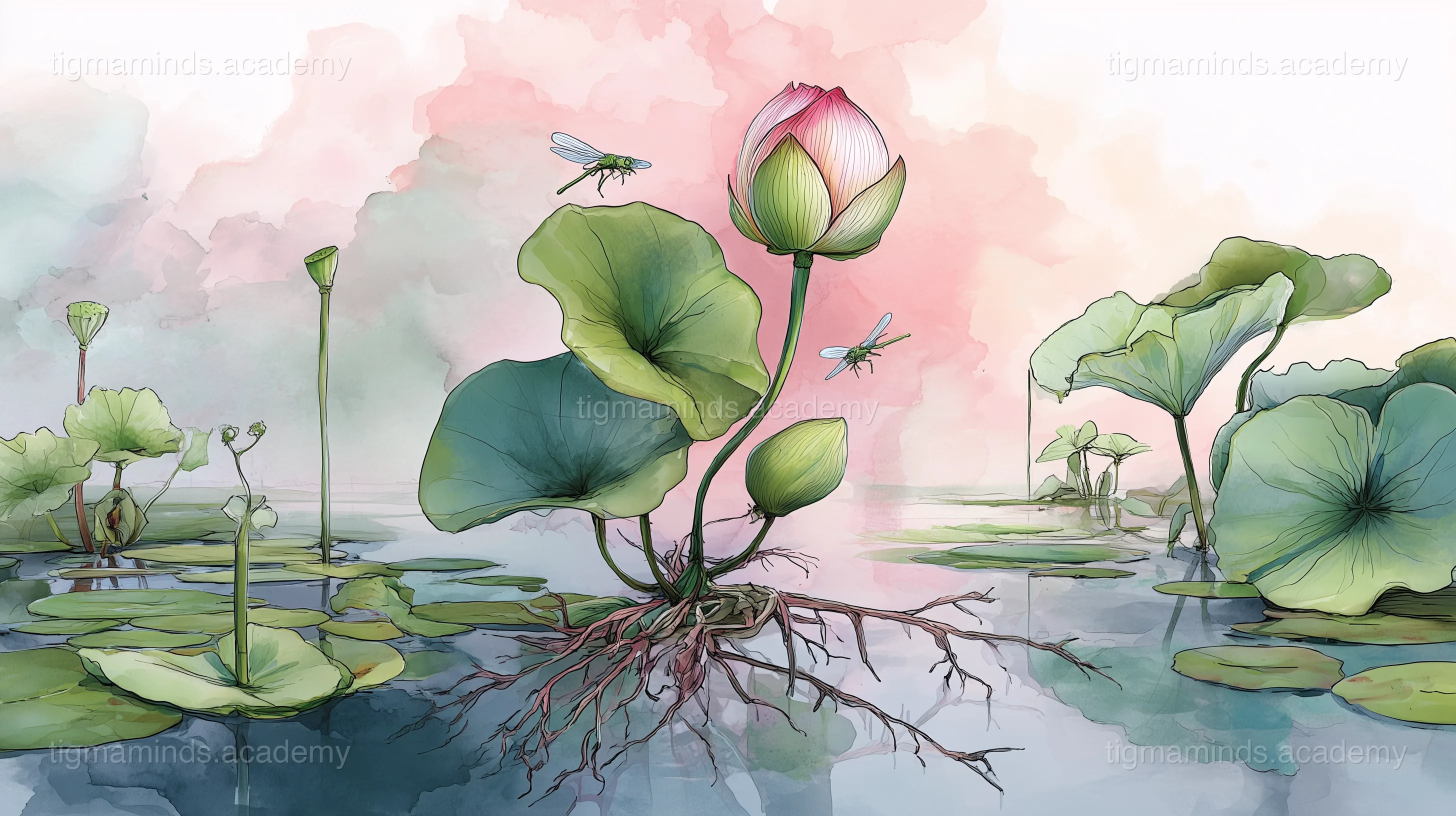
Buoyancy and the lotus effect.
The Seed at the Bottom
Deep beneath the still water of a beel — one of those wide, quiet wetlands that dot the Brahmaputra floodplain like scattered mirrors — lay a tiny lotus seed named Poddo. She had been sleeping in the mud for a long time, curled tight inside her hard shell, afraid to grow.
All around her, other seeds were sprouting. They sent pale green shoots upward through the dark water, reaching for the light. But Poddo stayed put.
“Aren’t you going to grow?” asked a friendly snail who lived on the muddy bottom.
“I can’t,” whispered Poddo. “I’m afraid of the water.”
“But you’re in the water,” said the snail, puzzled.
“That’s exactly the problem,” said Poddo.
The Fear
Poddo’s fear was simple and enormous: she was afraid she would sink. Every other plant she could see had roots that held it to the bottom. But Poddo had heard stories about lotuses — how they had to rise all the way to the surface and open their petals to the sun. No roots to hold them down. Just water on every side.
“What if I’m too heavy?” she worried. “What if I float for a day and then sink? What if the water swallows me?”
A wise old catfish who had lived in the beel for thirty years overheard her and drifted close. “Little seed,” he said, “do you know why lotuses float?”
“Because they’re light?” guessed Poddo.
“No. Lotuses are heavy. Their leaves are broad and their stems are thick. They float because their leaves are waxy — the water cannot grip them. The very thing that makes you afraid of the water is what keeps you above it.”
The First Shoot
Poddo thought about the catfish’s words for three days. On the fourth morning, when the first light filtered down through the green water, she uncurled — just a little. A tiny white shoot poked out of her shell and reached upward.
The water pressed against it. Cold. Heavy. Dark. Poddo wanted to curl back up.
But the shoot kept growing, and something remarkable happened. The water didn’t pull her down. It pushed her up. Every centimetre of stem she grew was more buoyant than the last, as if the water wanted her to reach the surface.
Days passed. The shoot became a stem. The stem grew a leaf, still curled like a fist. And one bright morning, the leaf broke the surface of the beel and unfurled into the warm air.
The Floating Leaf
Poddo’s leaf lay flat on the water, round and green and perfect. A dragonfly landed on it and rested its wings. A tiny frog hopped aboard and croaked happily. The morning dew sat on the leaf in silver beads that rolled around like tiny marbles, never soaking in.
“The water can’t touch me,” Poddo whispered, amazed. “I’m sitting right on top of it, and it can’t pull me under.”
The old catfish surfaced beside her, his whiskers breaking the water. “You see? Your waxy coat — the thing you thought was strange, the thing that made you different from every other plant — is your greatest gift. The water rolls right off you.”
The Bloom
A week later, Poddo bloomed. Her petals opened one by one — white and pink, soft as silk, glowing in the morning light. She was the most beautiful thing on the beel, and she was floating, effortlessly, on the very water she had feared.
The other plants watched from below with admiration. The reeds, anchored to the mud, could never reach the sunlight the way Poddo could. The water hyacinths drifted aimlessly, but Poddo’s stem kept her in place, rooted and free at the same time.
A fisherman rowing past in his bhela saw Poddo and smiled. “The lotus,” he told his daughter, “is proof that you don’t have to fight the water. You just have to be yourself, and you’ll float.”
And Poddo, petals open to the sun, thought: He’s right. My fear wasn’t a warning. It was a compass. It pointed me exactly where I needed to go.
The end.
Choose your level. Everyone starts with the story — the code gets deeper as you go.
Here is a taste of what Level 1 looks like for this lesson:
import matplotlib.pyplot as plt
# Contact angle determines droplet shape
surfaces = ["Glass", "Plastic", "Wax", "Lotus leaf"]
contact_angles = [30, 75, 110, 155] # degrees
colors = ["#ef4444", "#f59e0b", "#22c55e", "#3b82f6"]
plt.figure(figsize=(10, 5))
plt.bar(surfaces, contact_angles, color=colors, alpha=0.6,
edgecolor=colors, linewidth=2)
plt.axhline(y=150, color="blue", linestyle="--",
label="Superhydrophobic threshold (150°)")
plt.ylabel("Contact Angle (degrees)")
plt.title("Water Droplet Contact Angles on Different Surfaces")
plt.legend()
plt.show() # Why is the lotus bar so much higher?This is just the first of 6 coding exercises in Level 1. By Level 4, you will build: Test the Lotus Effect on Different Surfaces.
Free
Level 0: Listener
Stories, science concepts, diagrams, quizzes. No coding.
You are here
Level 0 is always free. Coding levels (1-4) are part of our 12-Month Curriculum.
Buoyancy and the lotus effect.
The big idea: "How the Lotus Learned to Float" teaches us about Buoyancy & Plant Adaptations — and you don't need to write a single line of code to understand it.
Drop water on a lotus leaf: the droplet beads into a near-perfect sphere and rolls off, collecting dirt. This is the lotus effect — self-cleaning through superhydrophobicity.
The secret: dual-scale roughness. Microscopic bumps (papillae, 10–20 µm tall) are coated with waxy nanotubes (~100 nm). Water sits on the tips of bumps, touching less than 3% of the surface. Air fills the valleys below.
Prediction: rub the wax off a lotus leaf — would it still repel water? No. You need both microscale bumps AND nanoscale wax. This dual design creates a contact angle >150° (flat surface: ~70°).
Key idea: The lotus effect: microscale bumps + nanoscale wax = water contacts less than 3% of the surface. Self-cleaning through superhydrophobicity.
Water molecules pull on neighbors through hydrogen bonds. Inside the liquid, forces balance. At the surface, molecules are only pulled sideways and down — creating an elastic-like surface tension.
Water’s surface tension (72.8 mN/m at 25°C) is unusually high due to strong hydrogen bonding. This lets insects walk on water, causes capillary action, and helps lotus leaves trap air underneath for buoyancy.
On a superhydrophobic surface, high tension causes water to bead up. Combined with waxy nano-bumps, drops barely touch and roll off carrying dirt — nature’s self-cleaning system.
Key idea: Water’s high surface tension (from hydrogen bonding) creates an elastic surface film that causes droplets to bead up on superhydrophobic surfaces.
Access all 130+ lessons, quizzes, interactive tools, and offline activities
Scientists copy the lotus leaf’s dual-scale design: microscale bumps + hydrophobic nano-coating = self-cleaning surface....
Lotus roots sit in waterlogged mud where oxygen is scarce. Solution: **aerenchyma** — air-channel tissue that pipes atmospheric oxygen from leaves dow...