The Lost Temple of Madan Kamdev
Archaeology & Dating Methods

The Lost Temple of Madan Kamdev

Ancient carved stones — archaeology and time.
Archaeology & Dating Methods12-Month Curriculum 12h

The Story

The Hill Trail

Rishav and Diya were hiking in the hills north of Guwahati with their uncle, an archaeology professor who talked about old stones the way other people talked about cricket — with intense, breathless excitement.

"We're going to Madan Kamdev," said Uncle, striding up the path in his dusty boots. "One of the most extraordinary ruins in Northeast India, and hardly anyone knows about it."

"What's there?" asked Rishav.

"Stones that are a thousand years old. Stones that tell stories."

The Ruins

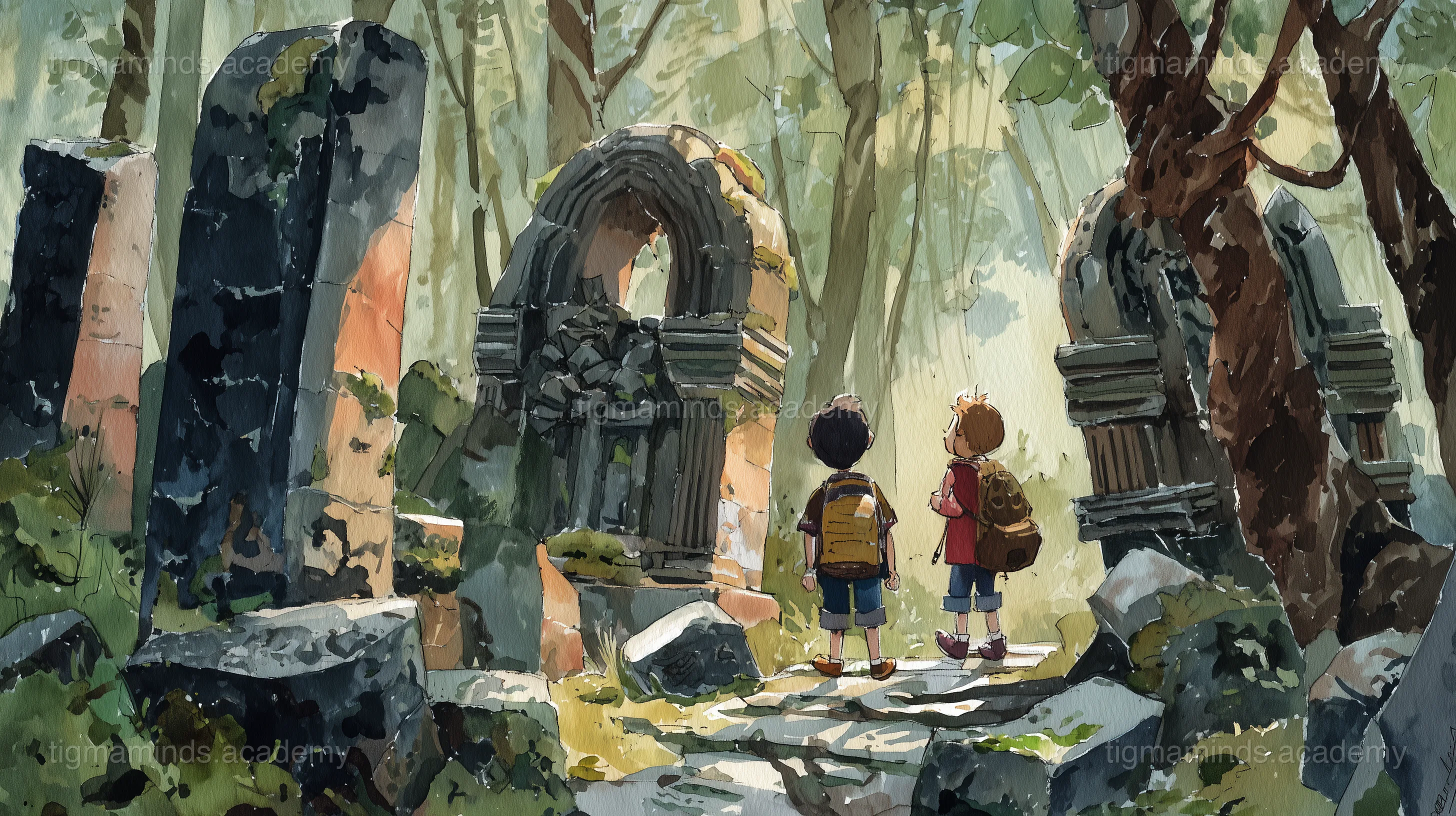
The trail opened into a clearing, and suddenly the forest floor was covered with carved stones — broken pillars, sculpted panels, fragments of temple walls, all scattered among the trees like pieces of a giant jigsaw puzzle.

Diya knelt beside a stone panel. Carved into it was a woman dancing, her arms raised, her sari flowing. The carving was so detailed that Diya could see individual bangles on the dancer's wrists.

"Who made this?" she whispered.

"The Pala dynasty," said Uncle. "About a thousand years ago, they built temples here — beautiful ones, covered in carvings. Then the temples fell. The forest grew over them. For centuries, nobody knew they were here."

"A whole city, just forgotten?" said Rishav.

"Not a city. A place of worship. And not forgotten — just waiting to be found again."

The Stories in Stone

The children wandered among the ruins, reading the stones like a picture book. Here was an elephant carrying a king. There was a lion guarding a doorway. On one fallen pillar, two children — carved a thousand years ago — were playing with a ball.

"They were like us!" said Rishav, pointing at the stone children.

"They were exactly like you," said Uncle. "They played games. They went to school — well, something like school. They loved their parents and fought with their siblings and wondered what the future would look like."

"And they built this," said Diya, running her fingers over the dancer's bangles. "By hand. Without machines. A thousand years ago."

The Imagining

Diya closed her eyes and tried to imagine the hill as it was — not ruined and overgrown, but alive. Temples with tall spires. Stone pathways swept clean every morning. The sound of bells and chanting. Dancers practising in the courtyard. Stonemasons tapping their chisels, carving elephants and lions and children playing ball.

"It must have been beautiful," she said.

"It still is," said Uncle. "Ruins aren't sad. They're proof that people were here — that they lived and built and created something that lasted longer than they did. Every carved stone is a message from the past saying: we were here, and we made something worth remembering."

The Message Back

Before they left, Rishav found a flat stone and, with Uncle's permission, placed a small smooth pebble on top of it — the way hikers mark a trail.

"What's that for?" asked Diya.

"It's a message back," said Rishav. "The old people left us their carvings. I'm leaving them a pebble. So they know someone came. Someone saw. Someone remembered."

Uncle smiled. "That," he said, "is exactly what archaeology is."

They walked back down the hill as the sun set behind Guwahati, leaving the old stones to their forest, their silence, and their thousand-year patience.

The end.

Try It Yourself

Choose your level. Everyone starts with the story — the code gets deeper as you go.

Story Progress

0%

Ready to Start Coding?

Here is a taste of what Level 1 looks like for this lesson:

Level 1: Explorer — Python
import numpy as np
import matplotlib.pyplot as plt

# Carbon-14 decay simulator
half_life = 5730  # years
time = np.linspace(0, 30000, 200)
remaining = 100 * (0.5 ** (time / half_life))

plt.figure(figsize=(10, 5))
plt.fill_between(time, remaining, alpha=0.2)
plt.plot(time, remaining, linewidth=2, color="royalblue")
plt.axhline(y=50, color="orange", linestyle="--", label="50% = 1 half-life")
plt.axhline(y=25, color="red", linestyle="--", label="25% = 2 half-lives")
plt.xlabel("Years before present")
plt.ylabel("% of original ¹⁴C remaining")
plt.title("How Carbon-14 Decays Over Time")
plt.legend()
plt.show()  # Where does Madan Kamdev fall on this curve?

This is just the first of 6 coding exercises in Level 1. By Level 4, you will build: Date an Archaeological Site Using Multiple Methods.

By Level 4, enrolled students build: Date an Archaeological Site Using Multiple Methods

Free

Level 0: Listener

Stories, science concepts, diagrams, quizzes. No coding.

You are here

Enrolled

Levels 1-4

Python, NumPy, Matplotlib, real projects, mentorship.

Sign Up Free

Stay Updated

Join Waitlist

Get notified when enrollment opens for your area.

Notify Me

Level 0 is always free. Coding levels (1-4) are part of our 12-Month Curriculum.