The Little Train of the Hills
Mechanical Engineering & Railways

The Little Train of the Hills

Narrow gauge railways — engineering on steep gradients.
Mechanical Engineering & Railways12-Month Curriculum 12h

The Story

The Smallest Engine

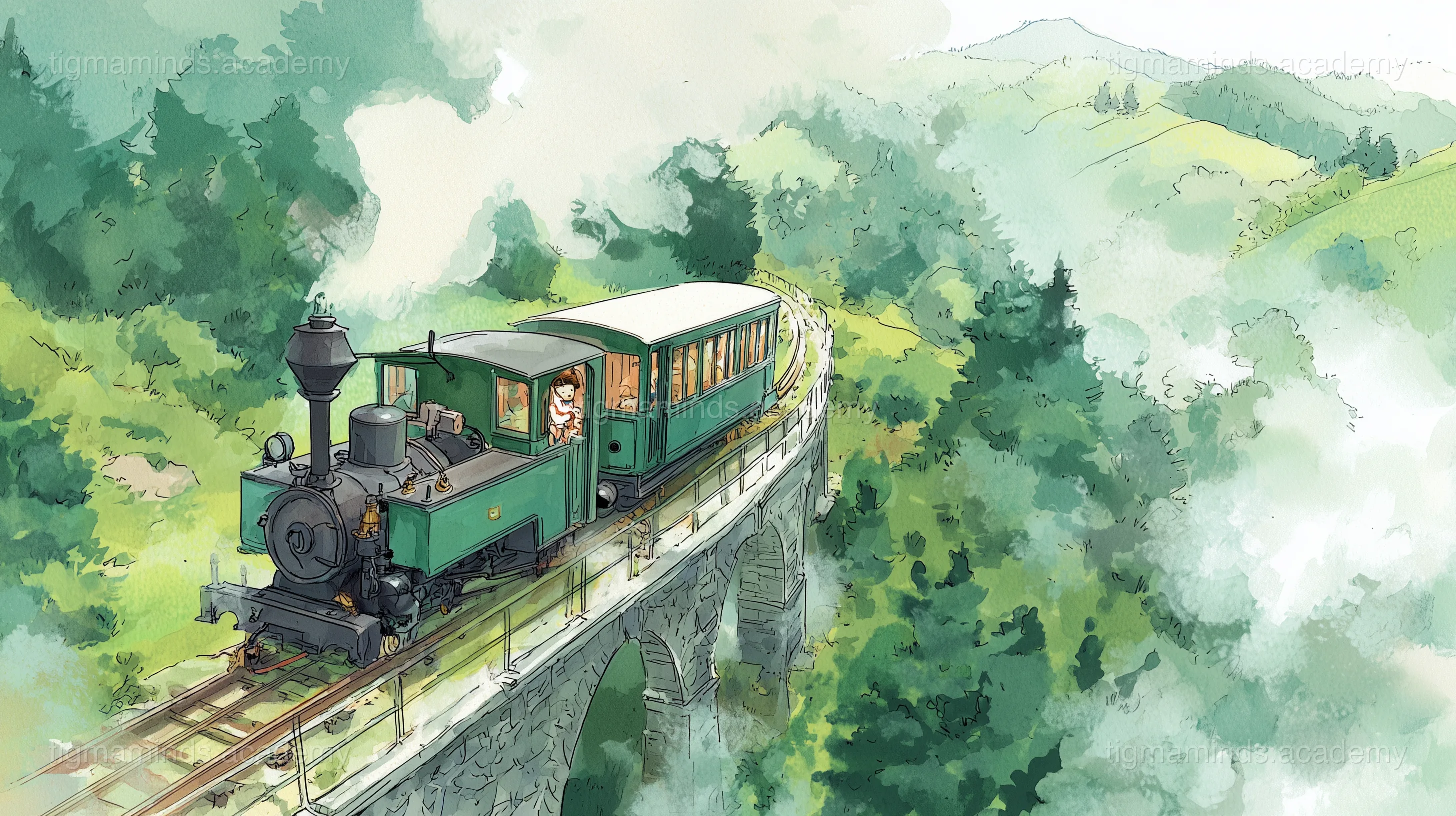
On a narrow-gauge track that wound through the hills of Northeast India like a ribbon dropped by a careless cloud, there ran a little train named Bogi. Bogi was old. Her boiler was patched in fourteen places. Her whistle had a crack in it that made her sound like a teakettle with a cold. Her wheels were so small that children on bicycles could keep up with her on the straight bits.

But Bogi didn't care about any of that. She had a job — to carry people and mail and chickens and sometimes a goat from the town at the bottom of the hills to the village at the top — and she did it every single day, rain or shine, monsoon or winter.

"I am the hill train," Bogi would say to herself as she puffed up the steep gradient. "I go where the big trains can't."

The New Express

One day, a gleaming new express train arrived at the junction station. She was enormous — twenty coaches long, sleek as a silver fish, powered by a diesel engine that hummed instead of coughed. Her name was painted in bright letters on her side: NORTHEAST EXPRESS.

"Who is that?" puffed Bogi, staring from her siding.

"That," said the stationmaster, not looking up from his ledger, "is your replacement. The government says narrow-gauge is too slow. They're building a broad-gauge line through the hills. The Express will do your route in two hours instead of eight."

Bogi felt her boiler go cold. "But... the hills are my route. I've been running it for fifty years."

"Progress," said the stationmaster, and shrugged.

The Route Nobody Wanted

The broad-gauge line was built. It punched through the hills with tunnels and viaducts, cutting straight where Bogi had always curved. The Northeast Express roared through in two hours flat, carrying hundreds of passengers in air-conditioned comfort.

Bogi was parked on a rusty siding. Her fire was let out. Weeds grew between her wheels. Birds nested in her funnel. For a year, she sat there, forgotten.

But something strange happened. The new Express didn't stop at the small villages — the tiny hamlets clinging to the hillsides where a dozen families lived, where children needed to get to school and grandmothers needed to get to the market. The Express was too big, too fast, too important. It flew past those places as if they didn't exist.

The villagers wrote letters. They complained. They walked for hours to reach the Express stations on the main line. And slowly, the word spread: We need the little train back.

The Return

A young railway engineer named Dipali was sent to inspect the old narrow-gauge line. She walked every kilometre, checking the rails, the bridges, the tunnels barely wider than a bullock cart. She found Bogi on her siding, rusted but intact.

"Can you still run?" Dipali asked, knocking on Bogi's boiler.

Bogi's firebox was cold. Her pistons were stiff. Her brake shoes were nearly worn through. But somewhere deep inside her iron bones, a spark of warmth remained.

"Light my fire," said Bogi, "and find out."

Dipali and her team spent two weeks repairing Bogi. They patched her boiler, oiled her valves, replaced her brake shoes, and polished her whistle until it sang clear and true. On a bright February morning, with the hills glowing gold in the winter sun, Bogi's fire was lit again.

She coughed. She sputtered. Then she roared — a sound so joyful that the stationmaster dropped his ledger and the birds in the signal box flew out in surprise.

The Hill Train's Purpose

Bogi runs again today. Not on the main line — that belongs to the Express. Bogi runs the old route, the winding, climbing, impossible route that hugs the hillsides and stops at every tiny village. She carries schoolchildren and market women and postal bags and, occasionally, a goat.

She is slower than the Express. She is smaller, older, and louder. But she goes where the Express cannot — into the folds and creases of the hills, to the places that big trains think are too small to matter.

"The big train carries the most people," Dipali said at the re-opening ceremony. "But the little train carries the people who need it most."

And Bogi, puffing proudly at the platform, blew her whistle and agreed.

In the hills of Northeast India, they say that every train has a soul, and the soul of a hill train is the stubbornest soul of all. It doesn't care about speed or size or shiny paint. It cares about one thing only: getting there.

The end.

Try It Yourself

Choose your level. Everyone starts with the story — the code gets deeper as you go.

Story Progress

0%

Ready to Start Coding?

Here is a taste of what Level 1 looks like for this lesson:

Level 1: Explorer — Python
import numpy as np
import matplotlib.pyplot as plt

# How much force does a hill train need?
mass = 50000       # kg (50 tonnes)
g = 9.81           # gravity
gradients = np.array([0, 1, 2, 3, 5, 8])  # percent

# Grade resistance = mass * g * sin(angle)
# For small angles, sin(angle) ≈ gradient/100
force_kN = mass * g * (gradients / 100) / 1000

plt.bar(gradients, force_kN, color='steelblue')
plt.xlabel("Gradient (%)")
plt.ylabel("Force needed (kN)")
plt.title("Why Hill Trains Need So Much Power")
plt.show()  # What happens at 8%?

This is just the first of 6 coding exercises in Level 1. By Level 4, you will build: Calculate the Physics of a Mountain Railway.

By Level 4, enrolled students build: Calculate the Physics of a Mountain Railway

Free

Level 0: Listener

Stories, science concepts, diagrams, quizzes. No coding.

You are here

Enrolled

Levels 1-4

Python, NumPy, Matplotlib, real projects, mentorship.

Sign Up Free

Stay Updated

Join Waitlist

Get notified when enrollment opens for your area.

Notify Me

Level 0 is always free. Coding levels (1-4) are part of our 12-Month Curriculum.