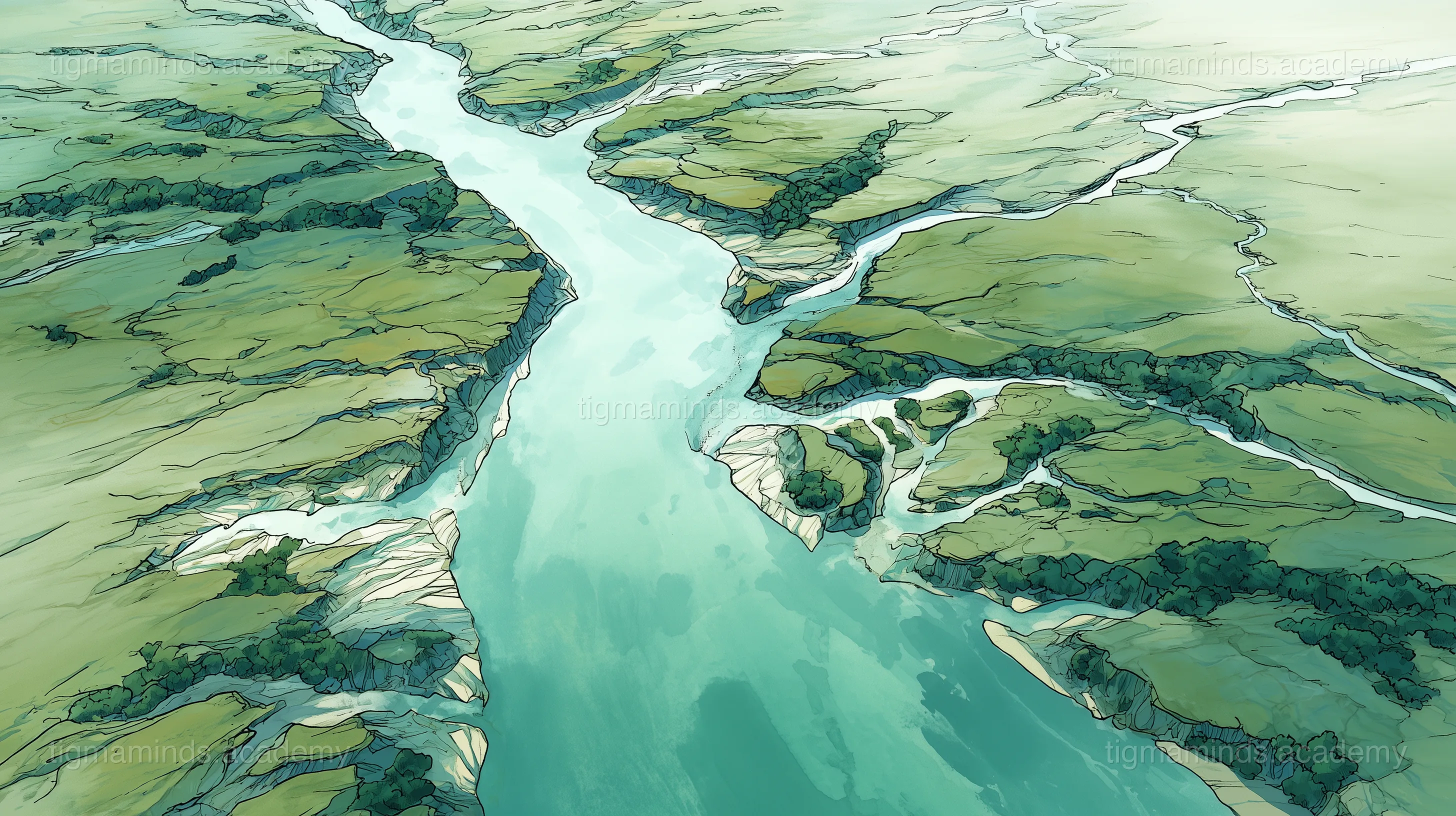
Joining something bigger doesn't mean disappearing — it means becoming part of something extraordinary.
The Little River That Joined the Big One
The Smallest River
In the green hills of Arunachal Pradesh, where the snow melts and the first trickles of water begin their long journey south, there was a tiny river called Nini. She was so small that a child could jump across her. She was so clear that you could count every pebble on her bed. She was so quiet that the only sound she made was a soft, musical gurgle.
Nini loved being small. She loved her mossy banks and her little waterfall and the three spotted trout who lived in her deepest pool. She loved that the village children dangled their feet in her water on hot afternoons and that the deer came to drink at dawn.
"I am perfect just as I am," Nini said to herself. And she was right.
The Rumour
But rivers flow downhill, and Nini was no exception. Every day she flowed a little farther from her mountain spring, through meadows and forests, past villages and rice terraces. And as she flowed, she heard a rumour from the other streams.
"Have you heard?" whispered a brook. "We're all going to the Brahmaputra."
"The Brahmaputra!" gasped a creek. "The great river! The mighty one! The one that is so wide you can't see the other side!"
Nini felt a chill run through her water. The Brahmaputra was the biggest river she had ever heard of — a river so vast that it carried whole islands on its back, so powerful that it changed course whenever it pleased, so ancient that it had been flowing since before the mountains were young.
"What happens when we join it?" Nini asked.
The brook shrugged — as much as a brook can shrug. "We become part of it, I suppose. We stop being us and start being it."
Nini was terrified. She didn't want to stop being Nini. She didn't want to lose her mossy banks and her spotted trout and her musical gurgle. She didn't want to disappear into something enormous.
The Attempt to Stop
Nini tried to stop flowing. She tried to hold herself back, to pool behind a boulder, to seep into the ground. But water cannot stop being water. Gravity pulled her forward, and the slope carried her down, and no matter how hard she tried, she kept moving toward the great river.
Along the way, she met other small rivers — a stream named Diju, a rivulet called Pari, a brook called Moni. They were all afraid too.
"I don't want to lose my waterfall," said Diju.
"I don't want to lose my singing rocks," said Pari.
"I don't want to lose my firefly pool," said Moni.
They flowed together, a band of small, frightened rivers, toward the thing they feared most.
The Meeting
And then they saw it. The Brahmaputra. It stretched across the plains like a silver sea, so wide that the far bank was just a dark line on the horizon. Birds wheeled above it. Boats dotted its surface. Islands of sand and grass rose from its middle like the backs of sleeping whales.
Nini stopped at the edge, where her clear water met the Brahmaputra's brown current. She could feel the big river's pull — gentle but irresistible.
"I'm scared," she whispered.
And then something astonishing happened. The Brahmaputra spoke. Its voice was deep and slow, like thunder heard from far away.
"Little river," said the Brahmaputra, "do you think I am just one river?"
"Yes," said Nini.
"I am ten thousand rivers," said the Brahmaputra. "Every stream, every brook, every rivulet that joins me is still itself. Your water doesn't stop being your water when it enters mine. It just travels farther than it ever could alone. Your trout will swim in waters they never dreamed of. Your song will join a chorus that reaches the sea."
The Joining
Nini let go. She let her water flow into the great river, and as it did, she felt something she hadn't expected: not loss, but expansion. She could feel the Brahmaputra's warmth, its strength, the memories of a thousand mountains carried in its current. And she could feel all the other small rivers — Diju and Pari and Moni — flowing beside her, each one still distinct, each one still themselves.
Joining something bigger didn't mean disappearing. It meant becoming part of something extraordinary while remaining exactly who you are.
And somewhere in the great Brahmaputra, if you dip your hand in just the right spot where a small tributary enters, you can still feel it — a thread of cold, clear mountain water, gurgling its own quiet song inside the mighty river.
That is Nini. Still small. Still clear. Still perfectly herself.
The end.
Choose your level. Everyone starts with the story — the code gets deeper as you go.
Here is a taste of what Level 1 looks like for this lesson:
import numpy as np
import matplotlib.pyplot as plt
# Your first data analysis with Python
data = [45, 52, 38, 67, 41, 55, 48] # measurements
mean = np.mean(data)
plt.bar(range(len(data)), data)
plt.axhline(mean, color='red', linestyle='--', label=f'Mean: {mean:.1f}')
plt.xlabel("Sample")
plt.ylabel("Value")
plt.title("River Hydrology & Confluences — Sample Data")
plt.legend()
plt.show()This is just the first of 6 coding exercises in Level 1. By Level 4, you will build: Map a Watershed and Calculate Total Discharge.
Free
Level 0: Listener
Stories, science concepts, diagrams, quizzes. No coding.
You are here
Level 0 is always free. Coding levels (1-4) are part of our 12-Month Curriculum.
How tributaries merge with main rivers — the science of confluences, mixing, and watershed systems.
The big idea: "The Little River That Joined the Big One" teaches us about River Hydrology & Confluences — and you don't need to write a single line of code to understand it.
Every river, no matter how mighty, begins as something small — a trickle of snowmelt, a spring bubbling from rock, or rainwater flowing downhill. A watershed (also called a drainage basin or catchment) is the entire area of land that drains water into a particular river. Every drop of rain that falls within a watershed eventually finds its way to the same river, flowing downhill through a branching network of streams and tributaries.
The Brahmaputra's watershed is enormous — approximately 580,000 square kilometers, spanning parts of Tibet, India (Arunachal Pradesh, Assam, Meghalaya, Nagaland, Sikkim, and West Bengal), Bhutan, and Bangladesh. This vast area funnels water from thousands of tributaries into the main channel. The watershed boundary (called the divide) is defined by ridge lines: on one side of a ridge, rain flows toward the Brahmaputra; on the other side, it flows toward a different river system.
Watersheds have a fractal-like structure — they branch like trees. The smallest branches are called first-order streams (with no tributaries of their own). When two first-order streams join, they form a second-order stream. When two second-order streams join, they form a third-order stream, and so on. The Brahmaputra is a very high-order river, the product of thousands of smaller streams merging in a hierarchical network. Nini, the tiny river in the story, would be a first-order stream — the smallest unit of a vast watershed tree.
Key idea: A watershed is the total land area that drains into a river. It has a branching tree structure where tiny first-order streams merge into progressively larger rivers, ultimately feeding a main channel like the Brahmaputra.
A confluence is the point where two rivers or streams meet and merge. Nini's meeting with the Brahmaputra is a confluence. These junctions are some of the most dynamic and scientifically interesting locations in a river system, because the two waters often have very different properties — temperature, sediment load, chemistry, speed, and even color.
When a clear mountain tributary like Nini meets a sediment-laden river like the Brahmaputra, the waters do not instantly mix. Instead, they flow side by side for some distance, with a visible boundary between the clear and turbid water. This phenomenon is spectacularly visible at the "Meeting of the Waters" in Manaus, Brazil, where the dark Rio Negro flows alongside the sandy-brown Amazon for 6 kilometers before fully mixing. Similar visible boundaries occur throughout the Brahmaputra system where clear hill streams enter the main channel.
The physics of mixing at a confluence depends on the velocity difference between the two flows and the turbulence generated where they meet. Fast, turbulent flow promotes rapid mixing; slow, laminar flow allows the waters to stay separated longer. Temperature differences also affect mixing — cold mountain water is denser than warm lowland water, so a cold tributary may initially sink beneath the warmer main river before gradually mixing. The "thread of cold, clear mountain water" that Nini retains in the story is not just poetic — it reflects real physics. Tributary water can maintain distinct identity for kilometers downstream of a confluence.
Key idea: At a confluence, two rivers with different temperatures, sediment loads, and speeds do not mix instantly — they can flow side by side for kilometers, with the colder, clearer water retaining its identity beneath or beside the main flow.
Access all 130+ lessons, quizzes, interactive tools, and offline activities
The most fundamental measurement in hydrology is **discharge** — the volume of water passing a point per unit time, measured in cubic meters per secon...