
Clay pots — where art meets material science.
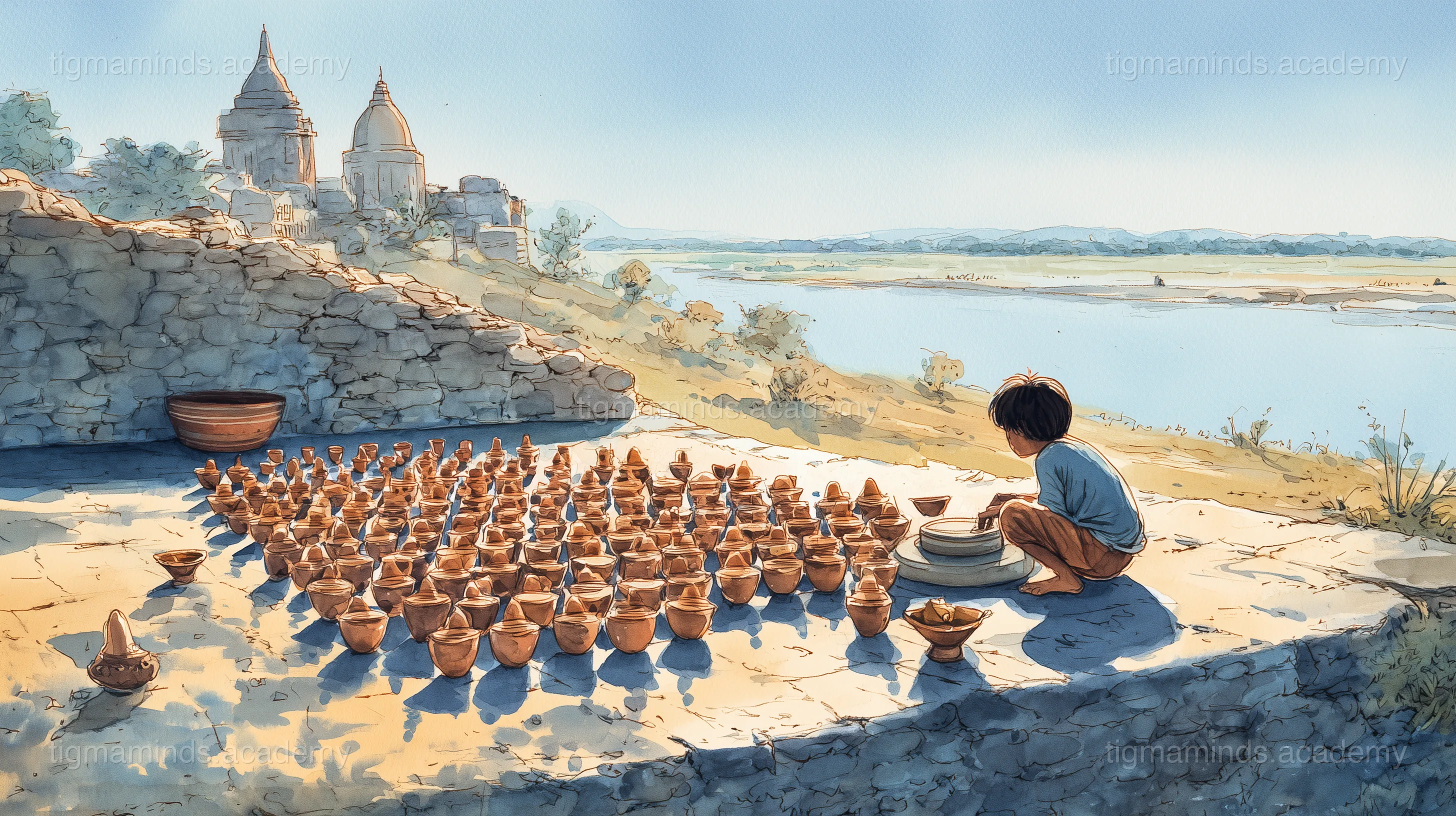
The Potter's Daughter
In Dhubri, where the Brahmaputra is so wide it looks like an ocean, there lived a girl named Juri who wanted to be a potter like her mother.
Juri's mother, Kamala, was the best potter in the district. Her clay lamps — diyas — were famous. Every Diwali, families came from villages across the river to buy Kamala's lamps. They were smooth, symmetrical, perfectly round, and held their flame without flickering.
Juri wanted to make lamps just like her mother's. There was only one problem: Juri's lamps were terrible.
The Crooked Lamps
Every afternoon, Juri sat at the wheel and tried. She wedged the clay, centred it, and pulled. But her lamps always came out wrong. One side would be higher than the other. The rim would wobble. The base would be too thick or too thin. Sometimes the whole thing would collapse into a sad lump while the wheel was still spinning.
"Don't worry," said her mother. "It takes years to learn."
"But Diwali is in two weeks!" said Juri. "I want to sell lamps at the market. My lamps."
Her mother looked at the row of crooked, lopsided diyas drying on the shelf and said, gently, "Perhaps you could help me with mine instead?"
Juri shook her head. She was stubborn — the good kind of stubborn, the kind that doesn't give up. She went back to the wheel.
Two Hundred Lamps
Over the next twelve days, Juri made two hundred lamps. She made them before school, after school, and by lantern light. Her hands were raw with clay. Her back ached from bending over the wheel.
Not one lamp was perfect. Every single one had a wobble, a dent, a thumbprint, or a crack. But Juri noticed something as she lined them up to dry: they were all different. No two were alike. Each one had its own personality — a tilt here, a dimple there, a slightly wider lip that made the flame dance in a unique way.
Her mother's lamps were perfect and identical. Juri's lamps were imperfect and individual.
The Diwali Market
On the morning of the market, Juri loaded her lamps into a basket and carried them to the riverfront. She set up a small mat next to her mother's stall — Kamala's smooth, perfect lamps on one side, Juri's crooked, characterful ones on the other.
At first, nobody looked at Juri's lamps. Everyone went straight to Kamala's stall, because everyone knew Kamala's lamps were the best.
Then a little boy stopped. He picked up one of Juri's diyas — a small one with a thumbprint pressed into the side and a rim that dipped on one end like a smile.
"This one looks happy," he said.
His mother looked at it and smiled. "It does, doesn't it?"
They bought it. Then an old man bought a tall, tilted one because "it leans like me." A young woman bought three because "each one is different — like people." A teacher bought ten for her classroom because "they'll teach the children that handmade means human-made."
By sunset, Juri had sold every lamp.
What the Clay Taught Her
That night, as Diwali lamps flickered across Dhubri — on windowsills, on ghats, on the edges of boats — Juri saw something wonderful. She could tell which lamps were hers. They were the ones whose flames danced a little differently, whose light tilted and swayed because the diya beneath it was beautifully, honestly imperfect.
Her mother sat beside her on the riverbank, watching the lights.
"Ma," said Juri, "your lamps are perfect. Mine aren't. But people liked mine anyway."
Kamala put her arm around her daughter. "Perfect means the same. Imperfect means only one. People don't want lamps that look like every other lamp. They want lamps that look like someone real made them — someone whose thumbprint is still in the clay."
Juri looked at her hands — small, clay-stained, calloused from the wheel — and understood. The cracks and wobbles weren't mistakes. They were signatures. Every dent said, A real person made me, and she did her best.
The next year, and every year after, Juri made Diwali lamps. They were never perfect. They were always beautiful.
The end.
Choose your level. Everyone starts with the story — the code gets deeper as you go.
Here is a taste of what Level 1 looks like for this lesson:
import numpy as np
import matplotlib.pyplot as plt
# How does firing temperature affect porosity?
temps = np.array([25, 200, 500, 800, 1000, 1200]) # °C
porosity = np.array([38, 32, 25, 15, 5, 1]) # %
plt.figure(figsize=(10, 5))
plt.plot(temps, porosity, "o-", color="sienna", linewidth=2)
plt.axvline(573, color="red", linestyle="--", label="Quartz inversion (573°C)")
plt.fill_between(temps, porosity, alpha=0.15, color="sienna")
plt.xlabel("Firing Temperature (°C)")
plt.ylabel("Water Absorption (%)")
plt.title("How Heat Changes Clay: Porosity vs Temperature")
plt.legend()
plt.grid(alpha=0.3)
plt.show() # What happens at the quartz inversion line?This is just the first of 6 coding exercises in Level 1. By Level 4, you will build: Test How Firing Temperature Changes Clay Properties.
By Level 4, enrolled students build: Test How Firing Temperature Changes Clay Properties
Free
Level 0: Listener
Stories, science concepts, diagrams, quizzes. No coding.
You are here
Level 0 is always free. Coding levels (1-4) are part of our 12-Month Curriculum.
Clay pots — where art meets material science.
The big idea: "The Little Potter of Dhubri" teaches us about Ceramics & Material Science — and you don't need to write a single line of code to understand it.
Pick up a handful of mud and squeeze it. It squishes. Now pick up a handful of sand and squeeze. It crumbles. What makes clay different from sand? The answer is particle size and shape. Clay particles are incredibly tiny — less than 2 micrometres across, about 50 times thinner than a human hair. And they are flat, like microscopic playing cards, not round like sand grains.
Imagine a deck of cards with a thin film of water between each card. You can slide the cards past each other easily, right? That is exactly what happens in wet clay. The flat mineral particles slide over each other on a lubricating layer of water, which is why you can shape it. Add too much water and the cards float apart (clay becomes soup). Too little and they lock together (clay cracks when you bend it). The potter's first skill is getting the water content just right.
Prediction check: if clay's plasticity comes from water between layers, what should happen if you leave a shaped clay pot in the sun for two days? The water evaporates, the layers lock in place, and the shape becomes rigid. Try it! A sun-dried pot holds its shape but is still fragile — you need heat to make it truly hard.
Key idea: Clay is made of flat mineral particles with water between them. The water lets the layers slide, making clay shapeable. The potter controls water content to balance plasticity and strength.
Sun-dried clay is hard-ish, but crumble it between your fingers and it falls apart. Drop it in water and it dissolves back to mud. To make clay permanently hard, you need serious heat — 900°C or more, the temperature of glowing red-hot metal. This is what happens inside a potter's kiln.
At high temperatures, something remarkable occurs at the contact points between clay particles: atoms start migrating from one particle to the next, building tiny bridges between them. This is called sintering. The particles are not melting — the temperature is too low for that — but atoms at the surface have enough energy to drift across the gap. Slowly, these bridges thicken and the particles fuse into a solid mass. It is like welding, but at the atomic scale.
As sintering progresses, the air gaps (pores) between particles shrink and the pot becomes denser, harder, and smaller — typical shrinkage is 8–15%. Earthenware fired at 1,000°C is partially sintered and still porous (which is why clay water pots "sweat" and keep water cool). Porcelain fired at 1,400°C is almost fully sintered — dense, glassy, and waterproof. The transformation is irreversible: once fired, the clay can never become soft again.
Key idea: Sintering uses heat to build atomic bridges between clay particles, fusing them into a permanent solid. Higher temperatures mean denser, harder ceramic with less porosity.
Access all 130+ lessons, quizzes, interactive tools, and offline activities
Unglazed pottery is porous — water can seep through the walls. To make a pot waterproof (and beautiful), potters apply **glaze**: a thin layer of powd...
Every potter knows the heartbreak of opening a kiln to find cracked pots. The culprit is **thermal shock** — stress caused by different parts of the p...