Cooking as chemistry.
Majoni's Kitchen
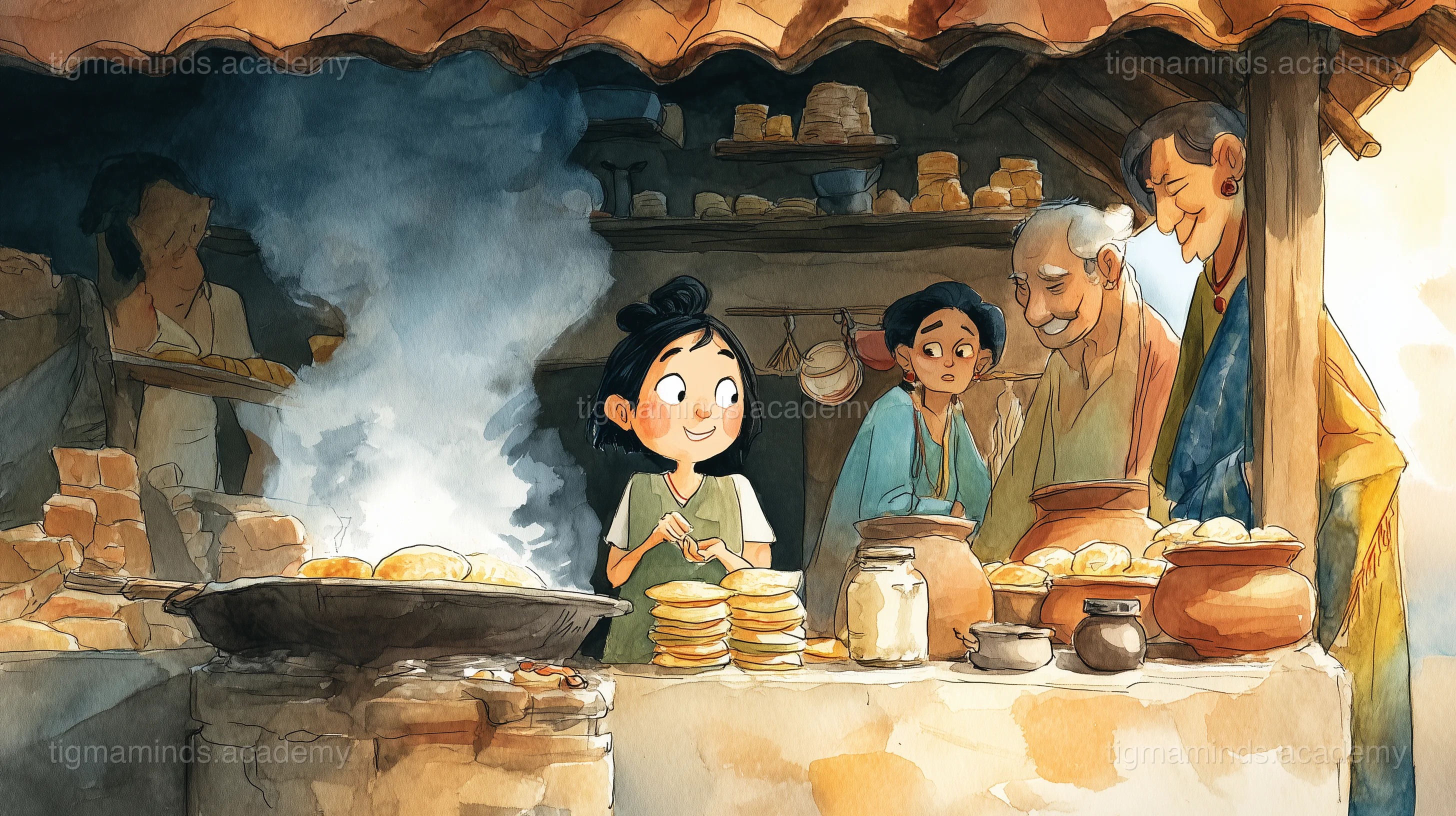
In the town of Jorhat, where the air smells of tea leaves and wood smoke, there lived a ten-year-old girl named Majoni whose pithas were famous. Not famous-famous — not on television or in newspapers — but famous in the way that matters most: everyone in her neighbourhood knew, and everyone wanted more.
Majoni made til pitha with sesame filling so sweet it made your eyes close. She made ghila pitha fried so crisp the edges shattered like thin ice. She made sunga pitha steamed inside bamboo tubes until the rice cake absorbed the smoky green flavour of the cane. Every Bihu, her mother's kitchen became the most popular room in the street.
"Where did she learn this?" visitors asked her mother.
"From watching," said her mother. "And from tasting. She has been tasting since she could walk."
The Contest
That year, the Jorhat District Pitha Competition was announced — a contest held every Magh Bihu, open to anyone, with a prize of a brass trophy and a hundred kilos of rice. The entrants were always adults — experienced home cooks, restaurant owners, grandmothers who had been making pithas for fifty years.
Majoni wanted to enter. Her mother hesitated. "You are ten, Majoni. The judges might not take you seriously."
"They will take my pitha seriously," said Majoni. "The pitha doesn't know how old I am."
Her mother laughed and signed the entry form.
The Competition Day
The contest was held in the Jorhat Gymnasium Field under a shamiana tent. Twenty-three contestants sat at wooden tables, each with a portable stove, a set of pans, and a basket of ingredients. The judges — three retired schoolteachers known for their strict palates — sat at the front with scorecards.
Majoni was the youngest contestant by thirty years. The woman next to her, Bina-baideo, had won the contest twice and looked at Majoni with a kind but sceptical smile. "First time, dear?"
"First and last, if I win," said Majoni, arranging her ingredients.
The whistle blew. Two hours to make three varieties of pitha.
The Secret
Majoni worked calmly. She had practised this a hundred times in her mother's kitchen, where the stakes were only whether her neighbours smiled or grinned. She ground the sesame seeds by hand — not in a mixer, by hand, because her grandmother had told her that the stone mortar releases oils that a machine cannot. She roasted the rice flour slowly, stirring with a bamboo spatula, listening to the sound it made — when the whisper became a crackle, the flour was ready.
Halfway through, she paused and tasted every component. The sesame — a little more jaggery. The rice batter — a pinch more salt. The bamboo tubes — she sniffed them and chose the greenest ones, the ones that still smelled like living forest.
Bina-baideo glanced over and noticed something. "You taste everything," she said.
"My mother says cooking without tasting is like singing with your ears plugged," said Majoni.
The Verdict
When the whistle blew again, twenty-three plates of pithas were carried to the judges' table. The judges tasted in silence, writing notes, conferring in whispers.
Majoni sat with her hands in her lap, heart thumping. Around her, adults paced and fidgeted.
The head judge stood. "The winner of this year's Jorhat District Pitha Competition," she said, "is contestant number seventeen."
That was Majoni.
The tent erupted. Some laughed — a child had beaten them. Some clapped — because the pithas were genuinely the best. Bina-baideo, who came second, walked over and hugged Majoni. "You deserved it, little one. Your pithas have something mine don't."
"What?" asked Majoni.
"Attention," said Bina-baideo. "I have been making pithas for so long that I stopped tasting them. You taste every bite as if it's the first time. That's the secret, isn't it?"
Majoni thought about it and nodded. The secret wasn't a special ingredient or a magic recipe. The secret was paying attention — tasting, adjusting, caring about every grain of rice and every drop of jaggery as if it mattered. Because it did.
The end.
Choose your level. Everyone starts with the story — the code gets deeper as you go.
Here is a taste of what Level 1 looks like for this lesson:
import numpy as np
import matplotlib.pyplot as plt
# Your first data analysis with Python
data = [45, 52, 38, 67, 41, 55, 48] # measurements
mean = np.mean(data)
plt.bar(range(len(data)), data)
plt.axhline(mean, color='red', linestyle='--', label=f'Mean: {mean:.1f}')
plt.xlabel("Sample")
plt.ylabel("Value")
plt.title("Food Chemistry & Cooking Science — Sample Data")
plt.legend()
plt.show()This is just the first of 6 coding exercises in Level 1. By Level 4, you will build: Investigate the Chemistry of Cooking.
Free
Level 0: Listener
Stories, science concepts, diagrams, quizzes. No coding.
You are here
Level 0 is always free. Coding levels (1-4) are part of our 12-Month Curriculum.
Cooking as chemistry.
The big idea: "The Little Chef of Jorhat" teaches us about Food Chemistry & Cooking Science — and you don't need to write a single line of code to understand it.
When Majoni roasts rice flour until it crackles and turns golden, she is triggering the Maillard reaction — one of the most important chemical reactions in cooking. It is not the same as caramelization, although they look similar. The Maillard reaction happens when amino acids (from proteins) react with reducing sugars at temperatures above roughly 140 °C.
The reaction produces hundreds of new molecules, each contributing a different flavor or aroma compound. The specific products depend on which amino acid and which sugar are involved, which is why toasted bread smells different from seared meat, even though both are undergoing Maillard reactions. Temperature, moisture, and pH all affect the speed and outcome.
Food scientists use the Maillard reaction deliberately. When you see "natural flavors" on a label, many were created by carefully controlled Maillard reactions between specific amino acids and sugars. Understanding this single reaction explains why we roast coffee beans, toast spices, bake bread crusts, and sear steaks — all are the same chemistry, tuned to different starting ingredients.
Key idea: The Maillard reaction between amino acids and sugars creates the complex flavors and brown color in cooked food — it is the single most important flavor-generating reaction in the kitchen.
Oil and water do not mix because water molecules are polar (they have a slight electric charge) and oil molecules are nonpolar (they do not). Polar molecules attract each other, squeezing out nonpolar ones. This is why oil floats on top of dal in a separate layer.
An emulsifier is a molecule with one polar end and one nonpolar end — it acts as a bridge. Lecithin in egg yolks is a classic emulsifier: its polar head bonds with water while its nonpolar tail bonds with oil, holding tiny oil droplets suspended throughout the water. This is how mayonnaise works — it is roughly 80% oil, yet it behaves like a thick cream because each oil droplet is coated in lecithin.
In traditional Assamese cooking, mustard paste serves as a natural emulsifier. When ground mustard seeds are mixed into a fish curry, the mucilage and proteins in mustard help fat droplets stay suspended in the gravy, creating a smooth, unified sauce rather than a greasy layer on top. The science of emulsification is central to food manufacturing — from milk homogenization to salad dressings to chocolate.
Key idea: Emulsifiers bridge oil and water by having one end that loves water and one that loves oil, allowing stable mixtures of ingredients that would otherwise separate.
Access all 130+ lessons, quizzes, interactive tools, and offline activities
Fermentation is a **metabolic process** in which microorganisms — bacteria, yeast, or molds — break down sugars in the absence of oxygen. The byproduc...