
Kites over the river — flight in your hands.
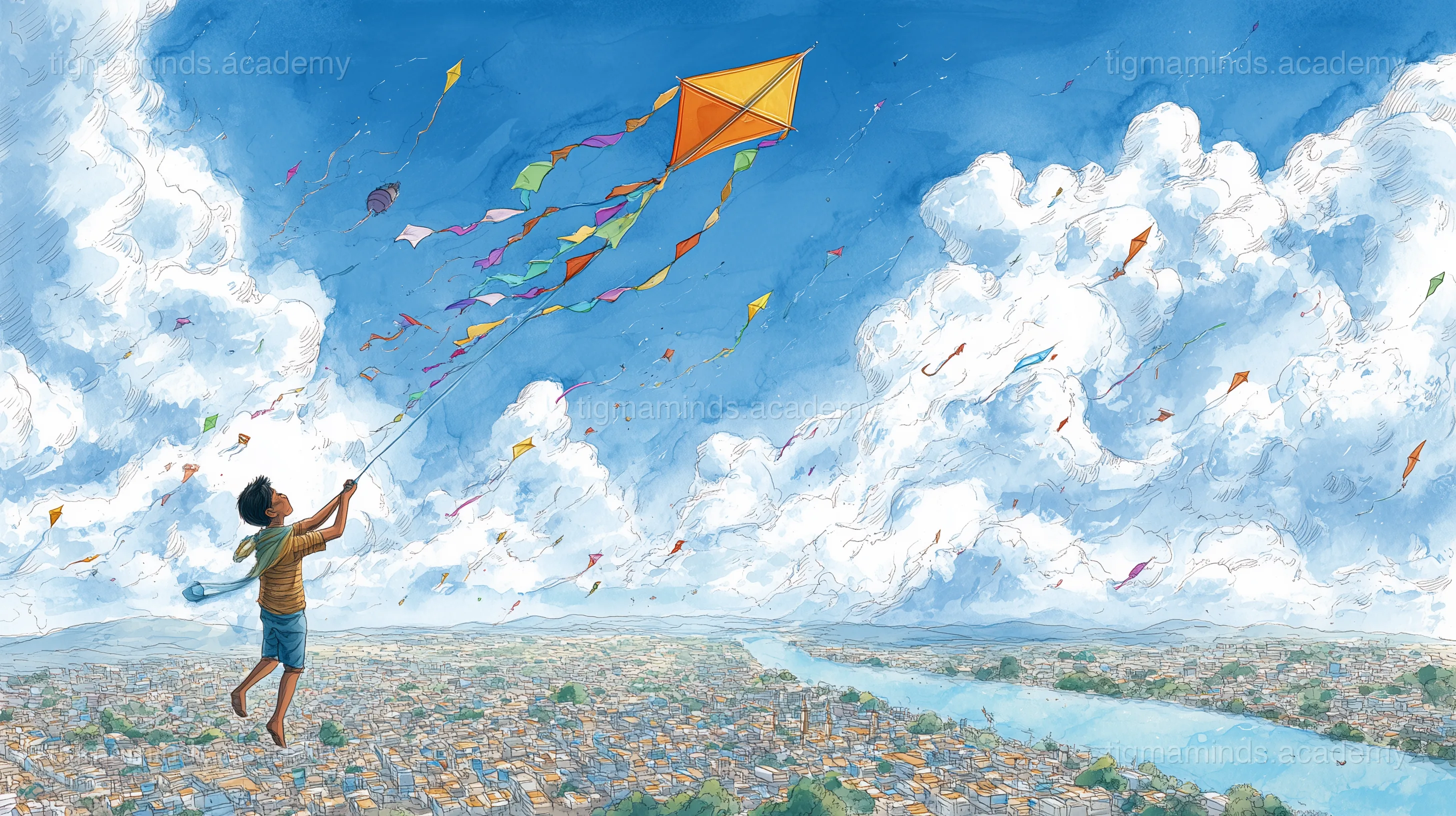
The Contest
Every January, when the winter sun hangs low and golden over Guwahati, the children of the city hold an unofficial kite festival along the banks of the Brahmaputra. There are no trophies, no judges, no registration fees. The rule is simple: whoever flies the highest, longest, wins.
This year, the favourite was Ronit, a boy whose father owned a toy shop. Ronit's kite was imported — a sleek red delta kite with a fibreglass frame and nylon skin, bought for eight hundred rupees. It came in a box with instructions in English.
Nobody expected anything from Biren.
Biren was eleven, the son of a rickshaw puller who lived in the narrow lanes behind Fancy Bazaar. Biren couldn't afford a store-bought kite. But Biren could build.
The Homemade Kite
For three weeks before the festival, Biren worked on his kite every evening. His materials cost almost nothing.
The frame was made from bamboo slivers — thin strips split from an old bamboo pole his neighbour was throwing away. Biren shaved them with a knife until they were light and springy, then tied them together with thread into a diamond shape.
The skin was old newspaper — the Assamese daily his father brought home each evening. Biren glued the paper over the frame with rice paste, smoothing out every wrinkle. He reinforced the edges with strips of cloth from a torn lungi.
The tail was made from plastic bags cut into ribbons and knotted together. The bridle — the string that connects the kite to the flying line — was adjusted a hundred times until the angle was perfect.
Total cost: four rupees for the ball of thread.
His father watched him work and said, "That's a fine kite, Biren."
"It needs to be more than fine," said Biren. "It needs to fly higher than anything in Guwahati."
The Festival Morning
The morning of the festival was perfect — clear sky, steady breeze from the river, the kind of wind that makes kite flyers grin. Thirty children gathered on the sandy bank near Uzan Bazaar, their kites spread out like a field of colourful birds.
Ronit's red delta kite drew admiration. So did Priya's butterfly kite and Javed's box kite. Nobody looked twice at Biren's newspaper diamond.
"Is that a kite or a homework assignment?" Ronit laughed.
Biren said nothing. He checked his bridle angle one last time and waited for the signal.
The Flight
At noon, someone shouted "Go!" and thirty kites launched into the sky. Ronit's delta shot up fast, its nylon skin catching the wind efficiently. Priya's butterfly climbed steadily. Javed's box kite wobbled but held.
Biren's newspaper kite rose slowly at first. The newspaper was heavier than nylon. But Biren had accounted for that. He had shaped the bamboo frame with a slight curve — a dihedral angle, though he didn't know the fancy word for it — that made the kite naturally stable. He had positioned the bridle point so the kite tilted into the wind at exactly the right angle.
As the wind grew stronger in the afternoon, the expensive kites began to struggle. Ronit's delta kite, designed for gentle breezes, pulled and jerked in the gusts. Priya's butterfly kite ripped at one seam. Three other kites tangled and crashed.
Biren's newspaper kite climbed. And climbed. And climbed.
The bamboo frame flexed in the gusts instead of fighting them. The newspaper skin, slightly porous, let just enough air through to reduce drag. The plastic-bag tail stabilised every wobble. It wasn't fast, but it was relentless.
By three o'clock, only five kites were still flying. By four, only two — Ronit's delta and Biren's newspaper diamond. By sunset, Ronit's line snapped in a sudden gust.
Biren's kite flew on, a tiny diamond of newsprint and bamboo, higher than anything in the Guwahati sky.
What the Wind Knows
The other children crowded around Biren as he reeled his kite in. "How did you do it?" they asked. "It's just newspaper!"
Biren held up his kite. The newspaper was tattered, the bamboo bent, the tail frayed. It looked like it had been through a war. But it had won.
"My father can't buy me an expensive kite," said Biren. "So I had to understand the wind instead. I watched the wind for three weeks — which direction it comes from, how strong it gets in the afternoon, where the gusts are worst. Then I built a kite that works with the wind instead of fighting it."
Ronit looked at his broken delta kite, then at Biren's battered newspaper diamond, and said something nobody expected: "Will you teach me to build one like that?"
Biren smiled. "Bring bamboo and newspaper tomorrow. I'll show you everything."
And the next January, at the kite festival, there were fewer store-bought kites and more homemade ones. Because the children of Guwahati had learned what every kite maker knows: the best kite isn't the most expensive — it's the one built by someone who bothered to understand the wind.
The end.
Choose your level. Everyone starts with the story — the code gets deeper as you go.
Here is a taste of what Level 1 looks like for this lesson:
import numpy as np
import matplotlib.pyplot as plt
# Kite force balance — how string angle reveals efficiency
wind_speed = np.linspace(5, 40, 100) # km/h
# Lift and drag both grow with v^2, but at different rates
lift = 0.5 * 1.2 * (wind_speed / 3.6)**2 * 0.8 * 0.3 # simplified
drag = 0.5 * 1.2 * (wind_speed / 3.6)**2 * 1.0 * 0.3
# String angle from vertical: arctan(drag / lift)
angle = np.degrees(np.arctan2(drag, lift))
plt.figure(figsize=(10, 5))
plt.plot(wind_speed, angle, linewidth=2, color='#f59e0b')
plt.axhline(45, color='#ef4444', linestyle='--', label='45° = equal lift and drag')
plt.xlabel("Wind speed (km/h)")
plt.ylabel("String angle from vertical (°)")
plt.title("How Wind Speed Affects Kite String Angle")
plt.legend()
plt.grid(True, alpha=0.3)
plt.show() # What happens at high wind speeds?This is just the first of 6 coding exercises in Level 1. By Level 4, you will build: Design and Test Kites for Maximum Lift.
By Level 4, enrolled students build: Design and Test Kites for Maximum Lift
Free
Level 0: Listener
Stories, science concepts, diagrams, quizzes. No coding.
You are here
Level 0 is always free. Coding levels (1-4) are part of our 12-Month Curriculum.
Kites over the river — flight in your hands.
The big idea: "The Kite Festival of Guwahati" teaches us about Aerodynamics & Flight — and you don't need to write a single line of code to understand it.
Hold a piece of stiff paper flat in front of a fan. Nothing happens — the air slides past on both sides equally. Now tilt the paper slightly, so the front edge is higher than the back. The paper pushes air downward. And by Newton’s third law (every action has an equal and opposite reaction), the air pushes the paper upward. That upward push is called lift.
The tilt angle matters enormously. It has a name: the angle of attack. At 0° (flat), there is no lift. Tilt a little (around 10–15°), and lift increases steadily. But tilt too far (past about 20° for a flat surface), and the smooth airflow over the top breaks apart into chaotic swirls — the paper suddenly drops. This sudden loss of lift is called a stall. Every kite, every airplane wing, every bird has a stall angle.
There is a second way to think about the same physics. When air flows over the tilted top surface, it speeds up (it has further to travel). The physicist Daniel Bernoulli showed that faster-moving air has lower pressure. So the pressure above the kite is lower than the pressure below. This pressure difference pushes the kite up. Newton and Bernoulli are not competing explanations — they are two descriptions of the same thing: air being deflected downward creates an upward force.
Check yourself: If you hold a kite flat (0° angle of attack) in a strong wind, will it fly? Why or why not? (Answer below — think first!)
Answer: No. At 0° the air flows equally over both sides. No air is deflected downward, so there is no upward push. The kite needs to be tilted into the wind. That is exactly what the bridle (the string that connects the kite to the flying line) does — it holds the kite at the right angle.
Key idea: A kite flies because it is tilted into the wind (angle of attack). This deflects air downward, and the air pushes the kite upward — that upward push is called lift. Too much tilt causes a stall.
You have felt drag a thousand times without knowing the word. Stick your hand out of a moving car window, palm facing forward. The wind pushes your hand backward. That backward push is drag — the force that resists motion through air.
Now here is the key insight: a kite in flight is caught in a tug of war between two forces. Lift pulls it upward. Drag pushes it backward (in the direction the wind blows). The kite string anchors the kite so it cannot blow away, and the angle the string makes with the ground tells you who is winning the tug of war.
Drag has a nasty property: it grows with the square of wind speed. Double the wind speed and drag does not double — it quadruples. This is why a kite that flies beautifully in a gentle breeze can be ripped apart in a strong gust. Biren’s bamboo frame flexed in gusts instead of fighting them, and his newspaper skin let some air through, reducing the force. Ronit’s rigid fibreglass delta had no such flexibility.
A tail is not decoration. It creates drag behind the kite’s body, pulling the bottom downwind. This keeps the kite face-on to the wind. Without a tail, most flat kites spin wildly — any tiny wobble gets amplified because the forces become uneven. The tail acts like a damper, absorbing wobble energy as drag. The same principle puts the tail at the back of an airplane.
Prediction you can test: Next time you fly a kite, try shortening the tail. It should become less stable. Try removing it entirely — many kites will spin out and crash.
Key idea: Drag opposes lift and grows with the square of wind speed. The string angle reveals the lift-to-drag balance. A tail creates drag behind the kite to keep it stable — it is a physics tool, not decoration.
Access all 130+ lessons, quizzes, interactive tools, and offline activities
Not all kites are the same shape, and the shape is not just for looks. Each design makes a different trade-off between lift, drag, stability, and the ...
A kite without wind is just decorated paper. Wind is the energy source. But wind is not a simple, steady flow — it varies in speed, direction, and eve...