
A paper kite and a real eagle share the sky — the wind treats them the same.
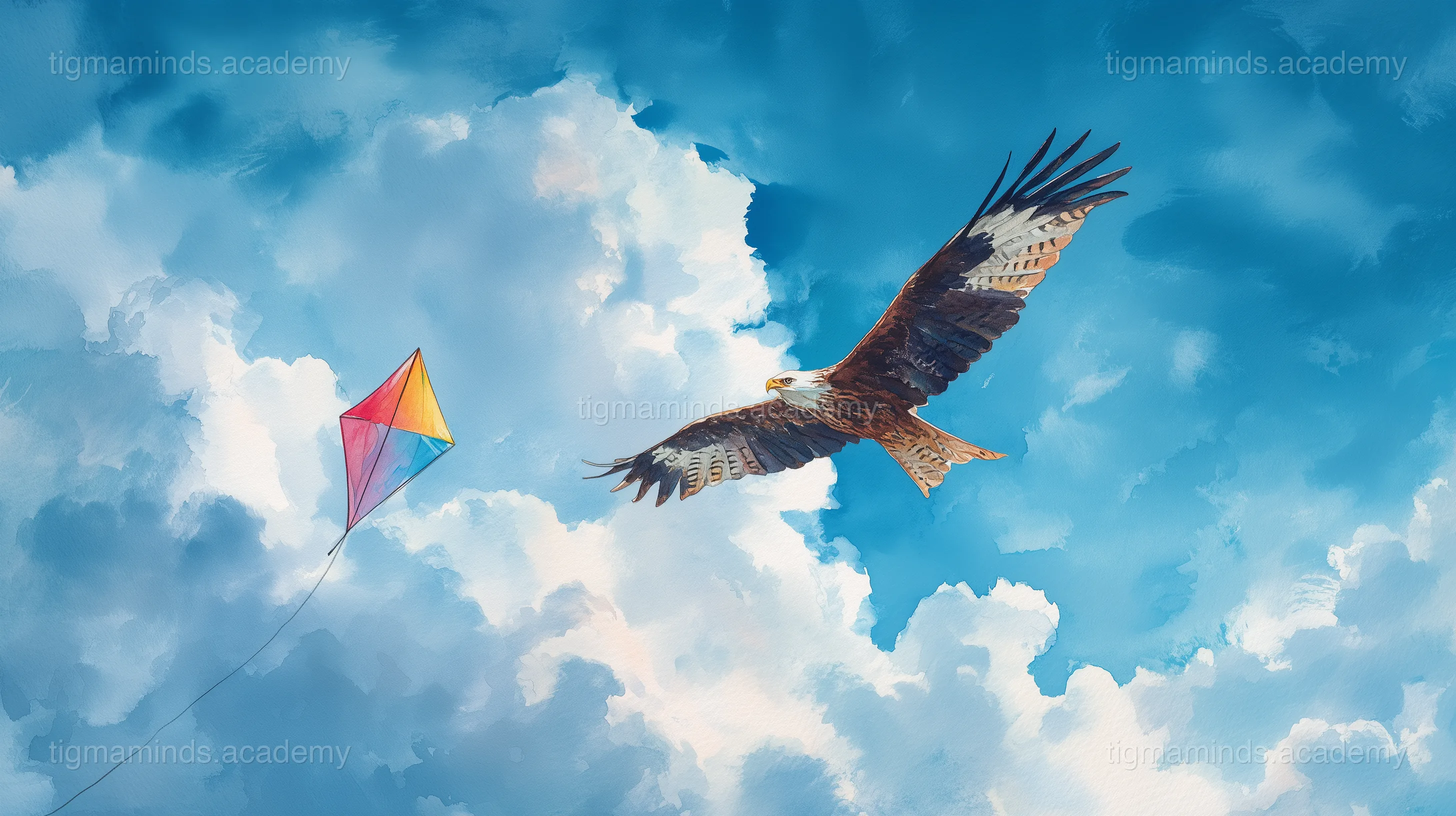
The Kite and the Eagle Over Dimapur
The Paper Kite
On a windy Sunday in Dimapur, the gateway city of Nagaland, a boy named Kevi launched a kite from the rooftop of his house. It was a simple kite — bamboo frame, newspaper skin, a tail made from strips of his mother's old mekhela — but it flew beautifully.
The kite rose fast, caught the March wind, and climbed above the rooftops. Past the church steeples. Past the mobile towers. Past the treetops where crows sat and watched. Higher and higher, until Kevi's spool was nearly empty and the kite was a tiny diamond in the enormous blue sky.
"Fly!" Kevi whispered, feeding out the last of his string. "Fly as high as you can."
The Eagle
A mountain hawk-eagle was hunting that morning. She had risen on a thermal above the Dhansiri River valley and was circling slowly, her golden eyes scanning the ground far below for movement — a rat, a lizard, a careless pigeon.
Then she saw the kite.
It was strange — flat and angular, nothing like any bird she had ever seen. It didn't flap. It didn't turn its head. It just hung in the wind, trembling, held by an invisible thread.
The eagle circled closer. The kite trembled but held its position. The eagle tilted her head, curious. What kind of creature flies without wings?
The Shared Sky
From the rooftop, Kevi saw the eagle circling his kite. His heart pounded. Would the eagle attack it? Tear it to shreds with those talons?
But the eagle didn't attack. She flew alongside the kite for a long, extraordinary minute — the paper diamond and the feathered hunter, side by side, riding the same wind at the same height. From the ground, they looked almost the same size. Two shapes in the sky, both dancing.
Kevi held his breath. He felt the string vibrate with the wind, and he imagined the eagle feeling the same wind in her feathers. Different bodies, different purposes — but the same sky, the same air, the same invisible force holding them both up.
The Lesson of the Wind
The eagle eventually lost interest and banked away toward the hills, her wings catching a rising current that carried her out of sight. The kite stayed, trembling, loyal to its string.
Kevi reeled the kite in slowly, thinking. The eagle was magnificent — alive, powerful, free. His kite was just paper and bamboo and string. But for one minute, they had been equals in the sky.
"The wind doesn't care what you're made of," Kevi told his younger sister that evening, mending a tear in the kite's newspaper skin. "It lifts everything the same way — eagles, kites, leaves, dust. The wind doesn't judge."
His sister, who was five and still learning the world, asked, "Did the eagle like your kite?"
Kevi smiled. "I think she was confused by it. But she didn't attack it. Maybe that's how respect starts — you see something you don't understand, and instead of destroying it, you fly beside it for a while."
The Sky Above Dimapur
Every March, when the winds pick up over Dimapur, children launch kites from rooftops and fields. And if you look carefully, you'll see eagles and kites sharing the sky — the real and the handmade, the hunter and the toy, each one riding the wind in its own way.
The people of Assam and the Northeast have a saying: the sky is big enough for everyone. On a windy day in Dimapur, watching a paper kite dance with a mountain eagle, you understand exactly what that means.
The end.
Choose your level. Everyone starts with the story — the code gets deeper as you go.
Here is a taste of what Level 1 looks like for this lesson:
import numpy as np
import matplotlib.pyplot as plt
# Your first data analysis with Python
data = [45, 52, 38, 67, 41, 55, 48] # measurements
mean = np.mean(data)
plt.bar(range(len(data)), data)
plt.axhline(mean, color='red', linestyle='--', label=f'Mean: {mean:.1f}')
plt.xlabel("Sample")
plt.ylabel("Value")
plt.title("Aerodynamics & Flight — Sample Data")
plt.legend()
plt.show()This is just the first of 6 coding exercises in Level 1. By Level 4, you will build: Design and Test Kites with Different Shapes.
Free
Level 0: Listener
Stories, science concepts, diagrams, quizzes. No coding.
You are here
Level 0 is always free. Coding levels (1-4) are part of our 12-Month Curriculum.
The physics of flight — how wings, kites, and air currents create lift.
The big idea: "The Kite and the Eagle Over Dimapur" teaches us about Aerodynamics & Flight — and you don't need to write a single line of code to understand it.
Whether it is Kevi's paper kite or the mountain hawk-eagle, every object in flight is subject to the same four forces: lift (upward, perpendicular to the airflow), weight (downward, due to gravity), thrust (forward force — from flapping wings, an engine, or wind pulling a kite string), and drag (backward force — air resistance opposing motion). For stable flight, these forces must be in balance: lift equals weight, and thrust equals drag.
For the eagle, lift is generated by her wings — their curved shape (called an airfoil) forces air to travel faster over the top surface than the bottom, creating lower pressure above and higher pressure below. This pressure difference pushes the wing upward. The eagle generates thrust by flapping her wings on the downstroke, or — when soaring — by exploiting rising air currents (thermals) that push her upward without any flapping effort.
For the kite, the physics is slightly different but the same four forces apply. The kite's flat surface is tilted at an angle to the wind (called the angle of attack). Wind hitting the tilted surface is deflected downward, and by Newton's third law, the kite experiences an equal and opposite upward force — lift. The string provides the backward force that keeps the kite tilted into the wind; without the string, the kite would tumble. Weight pulls the kite down, and the wind provides the energy to overcome it. Despite the differences in mechanism, both the eagle and the kite achieve the same result: balanced forces that sustain flight.
Key idea: All flight involves four forces: lift, weight, thrust, and drag. Both eagles and kites achieve flight by balancing these forces, though eagles use wing-shaped airfoils while kites use a tilted flat surface deflecting wind downward.
The eagle in the story "had risen on a thermal above the Dhansiri River valley." A thermal is a column of rising warm air created when the sun heats the ground unevenly. Dark surfaces (roads, rocky outcrops, plowed fields) absorb more solar energy than light surfaces (water, forests) and heat the air above them. This warm air is less dense than the surrounding cooler air, so it rises — sometimes reaching altitudes of 2,000-3,000 meters.
Thermals are not smooth, uniform columns — they are turbulent, bubble-like structures that form, rise, and dissipate continuously. They typically start forming mid-morning as the sun heats the ground, reach peak strength in the early afternoon, and weaken toward evening as the ground cools. The strongest thermals can produce updrafts of 3-5 meters per second — fast enough to carry a large eagle upward without a single wingbeat.
Birds of prey like the mountain hawk-eagle are masters of thermal soaring. They locate thermals by feel (detecting the upward push on their wings) and by sight (watching other birds or dust being carried upward). Once inside a thermal, the bird circles tightly to stay within the rising column, gaining altitude effortlessly. When it reaches the top, it glides toward the next thermal, losing altitude slowly. By "thermal hopping," a soaring bird can travel hundreds of kilometers while barely flapping — an extraordinarily energy-efficient form of travel. Paraglider and hang glider pilots use exactly the same technique, reading the same atmospheric cues that eagles do.
Key idea: Thermals are columns of rising warm air that allow eagles and gliders to soar without expending energy. They form when the sun heats the ground unevenly, creating updrafts of 3-5 m/s that can carry birds to altitudes of 2,000-3,000 meters.
Access all 130+ lessons, quizzes, interactive tools, and offline activities
The eagle's wing has a curved cross-section called an **airfoil** — the top surface is more curved than the bottom. When air flows over this shape, it...