
Color without pigment — nanostructures.
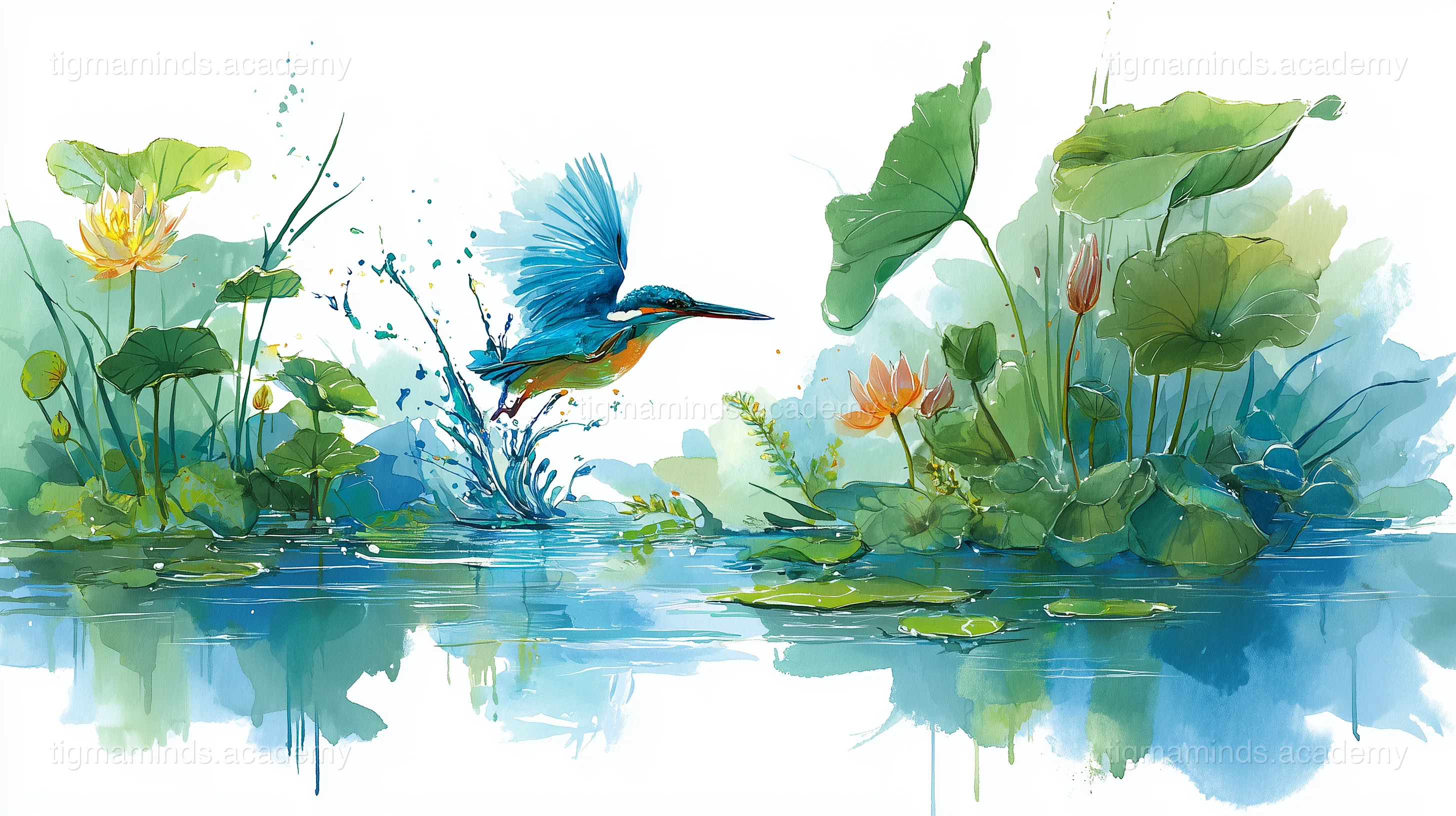
The Plain Brown Bird
Long ago, when the rivers of Assam were young and the forests were still learning to grow, there lived a small brown bird near the banks of the Brahmaputra. She had no name yet — names came later, when the people of the land began to notice things — but she was quick, sharp-eyed, and hungry.
She was also, she felt, terribly plain.
The paradise flycatcher had a tail like a white ribbon. The scarlet minivet burned like a coal in the treetops. The golden oriole wore the colour of ripe mangoes. Even the common mynah had a smart yellow eye-patch. But the little brown bird by the river had nothing — just brown feathers the colour of mud, the colour of bark, the colour of forgetting.
"Nobody sees me," she said to the river one morning. "I sit on this branch every day, and nobody looks up."
The Brahmaputra, who was old and wise even then, rippled gently. "I see you," the river said. "I see you every morning when you dive for fish. You are the fastest diver on my banks."
"Fast isn't beautiful," said the bird.
"Isn't it?" said the river. "Watch the sky at noon and tell me what you see."
The Mirror Hour
At noon, when the sun was directly overhead, the brown bird looked down at the Brahmaputra. The river had become a perfect mirror. The sky — the whole enormous Assam sky, blue from horizon to horizon — was reflected so clearly in the water that it looked like a second sky had been laid flat upon the earth.
"The sky is in the water," the bird whispered.
"Yes," said the river. "Every day at noon, the sky comes down to visit me. For one hour, I carry the sky's colour. If you dive now — at the exact moment when the sky and the water are one — you will pass through the sky itself."
The brown bird hesitated. She had dived a thousand times for fish. She knew the water — its cold, its current, its darkness below the surface. But diving through the sky? That was something else entirely.
"What will happen?" she asked.
"I don't know," said the river honestly. "But nothing beautiful ever came from staying on the branch."
The Dive
The brown bird took a breath. She fixed her eyes on the blue mirror below — the place where sky and water merged — and she dove.
She hit the surface like an arrow. The water closed over her, and for one brilliant instant, she was not in the river at all. She was in the sky — swimming through blue, surrounded by blue, swallowed by blue. It was warm and cold at the same time. It tasted of rain and sunlight and the high, thin air above the clouds.
She grabbed a small silver fish in her beak — because she was, after all, a practical bird — and burst back through the surface into the air.
She landed on her branch, shook herself dry, and looked down at her reflection.
Her feathers were blue.
Not just any blue — the deep, electric, heart-stopping blue of the Assam sky at noon. Her back blazed like a sapphire. Her wings shone like lapis lazuli. Even her beak had turned from grey to bright coral-orange, as if the sunset had kissed it on her way back up.
The River's Gift
"River!" she cried. "What happened?"
"You dove through the sky," said the Brahmaputra. "And the sky stuck. You are wearing it now — the colour of the deepest blue I carry every noon. It will never wash off, because it is not paint. It is light itself, woven into your feathers."
The paradise flycatcher flew past and stopped mid-air. "Who are you?" she asked.
"The same brown bird who was here yesterday," said the blue bird. "Only now the sky is my coat."
From that day, every bird on the river knew her. They called her the kingfisher — the king of fishers — because no one who wears the sky can be called plain. And every kingfisher born after her carried the same blazing blue, passed down from that one perfect dive through the mirror of the Brahmaputra.
What the Kingfisher Teaches
The people of Assam say that the kingfisher is proof of a simple truth: beauty comes to those who are brave enough to dive. The sky does not come to you — you must go through the water to reach it. The colour does not land on your feathers while you sit on a branch — you must plunge into the unknown and trust that you will come up changed.
So the next time you see a kingfisher flash across the Brahmaputra — a streak of impossible blue against the green — remember: she was once the plainest bird on the river. And all it took was one brave dive to become the most beautiful.
The end.
Choose your level. Everyone starts with the story — the code gets deeper as you go.
Here is a taste of what Level 1 looks like for this lesson:
import matplotlib.pyplot as plt
import numpy as np
# Thin-film interference: which wavelength is reinforced?
film_thickness_nm = np.arange(50, 400, 1) # nanometers
n_keratin = 1.56 # refractive index of keratin
# Constructive interference when 2*n*d = m*wavelength
# For first order (m=1):
wavelength = 2 * n_keratin * film_thickness_nm
colors = plt.cm.rainbow(np.linspace(0, 1, len(wavelength)))
plt.figure(figsize=(10, 5))
plt.scatter(film_thickness_nm, wavelength, c=colors, s=5)
plt.axhspan(400, 500, alpha=0.15, color="blue", label="Blue light")
plt.axhspan(500, 570, alpha=0.15, color="green", label="Green light")
plt.xlabel("Film Thickness (nm)")
plt.ylabel("Reinforced Wavelength (nm)")
plt.title("What Color Does the Feather Reflect?")
plt.legend()
plt.show() # At what thickness do you get blue?This is just the first of 6 coding exercises in Level 1. By Level 4, you will build: Explore Structural Color in Nature and Technology.
By Level 4, enrolled students build: Explore Structural Color in Nature and Technology
Free
Level 0: Listener
Stories, science concepts, diagrams, quizzes. No coding.
You are here
Level 0 is always free. Coding levels (1-4) are part of our 12-Month Curriculum.
Color without pigment — nanostructures.
The big idea: "Why the Kingfisher Has a Blue Coat" teaches us about Structural Color & Nanostructures — and you don't need to write a single line of code to understand it.
The brilliant blue of a kingfisher's feathers is not produced by blue pigment. If you ground a kingfisher feather to powder, the powder would be brown. The blue is produced by structural color — the interaction of light with nanostructures in the feather. Specifically, the feather barbs contain a spongy layer of keratin and air pockets with dimensions close to the wavelength of blue light (around 450 nanometers).
Thin-film interference occurs when light reflects off two surfaces separated by a distance comparable to the wavelength of light. Some wavelengths constructively interfere (their reflected waves add up) while others destructively interfere (their waves cancel out). The spongy nanostructure in kingfisher feathers selectively reinforces blue wavelengths and cancels others, producing an intense blue that changes slightly with viewing angle.
Structural colors are fundamentally different from pigment colors. Pigments absorb certain wavelengths and reflect others — they fade as the pigment molecules degrade. Structural colors result from physical geometry, not chemistry — they never fade as long as the structure is intact. Museum specimens of kingfisher feathers remain brilliantly blue after centuries, while pigment-based colors in adjacent specimens have faded completely.
Key idea: Kingfisher blue is not a pigment but a structural color produced by light interference in nanoscale keratin-air structures. Structural colors never fade because they depend on geometry, not chemistry.
Structural color appears throughout the animal kingdom, produced by a variety of nanostructures. Morpho butterflies have wing scales with rows of microscopic ridges spaced at exactly the right distance to reflect blue light. Peacock feathers use layers of melanin rods in a photonic crystal arrangement. Beetle shells use helically stacked chitin layers that selectively reflect circularly polarized light.
These biological nanostructures are self-assembled — they form through developmental processes encoded in DNA, not through nanoscale manufacturing. A kingfisher embryo's feathers develop their light-manipulating spongy structure through a process called spinodal decomposition, where a uniform protein mixture spontaneously separates into two phases with the right dimensions to interact with visible light.
The precision is remarkable. The spongy keratin structures in kingfisher feathers have a periodicity of 100-200 nanometers (billionths of a meter) — smaller than the wavelength of visible light. For comparison, the best semiconductor fabrication plants produce features of about 3-7 nanometers. Nature achieves comparable nanoscale precision using protein self-assembly at room temperature in an egg, while engineers require billion-dollar clean rooms, toxic chemicals, and extreme conditions.
Key idea: Nature produces nanostructures with 100-200 nm precision through protein self-assembly — no clean rooms or toxic chemicals required. These biological photonic structures rival or exceed the precision of human nanofabrication.
Access all 130+ lessons, quizzes, interactive tools, and offline activities
**Biomimicry** is the practice of solving engineering problems by studying and imitating nature's designs. The kingfisher has inspired two famous exam...