How the Kaziranga Grass Grows Tall
Grassland Ecology & Fire Cycles

How the Kaziranga Grass Grows Tall

Elephant grass — fire ecology and grassland management.
Grassland Ecology & Fire Cycles12-Month Curriculum 12h

The Story

The Naked Park

Long ago — long before Kaziranga became a national park, before the forest rangers and the jeep safaris and the tourists with their cameras — the land that would become Kaziranga was flat and bare. The Brahmaputra flooded it every monsoon and left behind a plain of mud and low scrub. There were no tall trees and no tall grass. Everything was exposed.

This was a problem for the one-horned rhinoceros.

A young rhino named Gorh stood in the middle of the open plain, feeling extremely visible. His grey skin was thick as armour, his horn was sharp, and he weighed more than a bullock cart. But even the bravest animal doesn't like to be stared at all day.

"I need somewhere to hide," said Gorh.

"You're a rhinoceros," said a kingfisher from a nearby bush. "You weigh a thousand kilos. Where exactly do you plan to hide?"

The Small Grass

Near the riverbank, a small, thin grass was trying very hard to grow. Her name was Kaahi, and she was an elephant grass — though at this point in history, she was more of a mouse grass, barely knee-high and floppy.

"I want to grow tall," Kaahi sighed. "I want to be the tallest grass in the world. But the soil here is waterlogged, and every monsoon the flood washes me flat."

"You're a grass," said the kingfisher, who had opinions about everyone. "Grass is supposed to be short. That's the whole point of being grass."

The Pact

Gorh the rhino and Kaahi the grass looked at each other across the muddy plain. One was enormous and wanted to be hidden. The other was tiny and wanted to be tall. Neither could solve their problem alone.

"What if we help each other?" said Gorh.

"How?" said Kaahi.

"I walk through the mud every day. My hooves churn the soil and mix in nutrients from the river silt. If I walk through your patch every morning, the soil will be richer, and you can grow taller."

"And in return?"

"In return, when you grow tall enough, you hide me. Grow as high as my back, and I can disappear into you like a grey stone into a grey field."

Kaahi thought about this. "But how will I spread? Right now, I'm just one small patch."

Gorh smiled — which, on a rhino, is a sight to see. "I'll eat your seeds and carry them in my belly. Wherever I walk, wherever I drop my dung, your seeds will sprout. I will plant you across the entire plain."

"Deal," said Kaahi.

The Growing Years

And so the great partnership began. Every morning, Gorh walked through Kaahi's patch, his massive feet churning the mud, pressing seeds deep into the soil, mixing silt and nutrients. Every evening, he grazed on her leaves — not too much, just enough to carry seeds in his belly — and wandered the plain, planting new patches wherever he went.

Season by season, Kaahi grew taller. First knee-high. Then waist-high. Then shoulder-high. By the fifth year, she was taller than a man — six feet, seven feet, eight feet tall. Her leaves were broad and sharp-edged, her stems as thick as bamboo. She was no longer mouse grass. She was elephant grass, and she had earned the name.

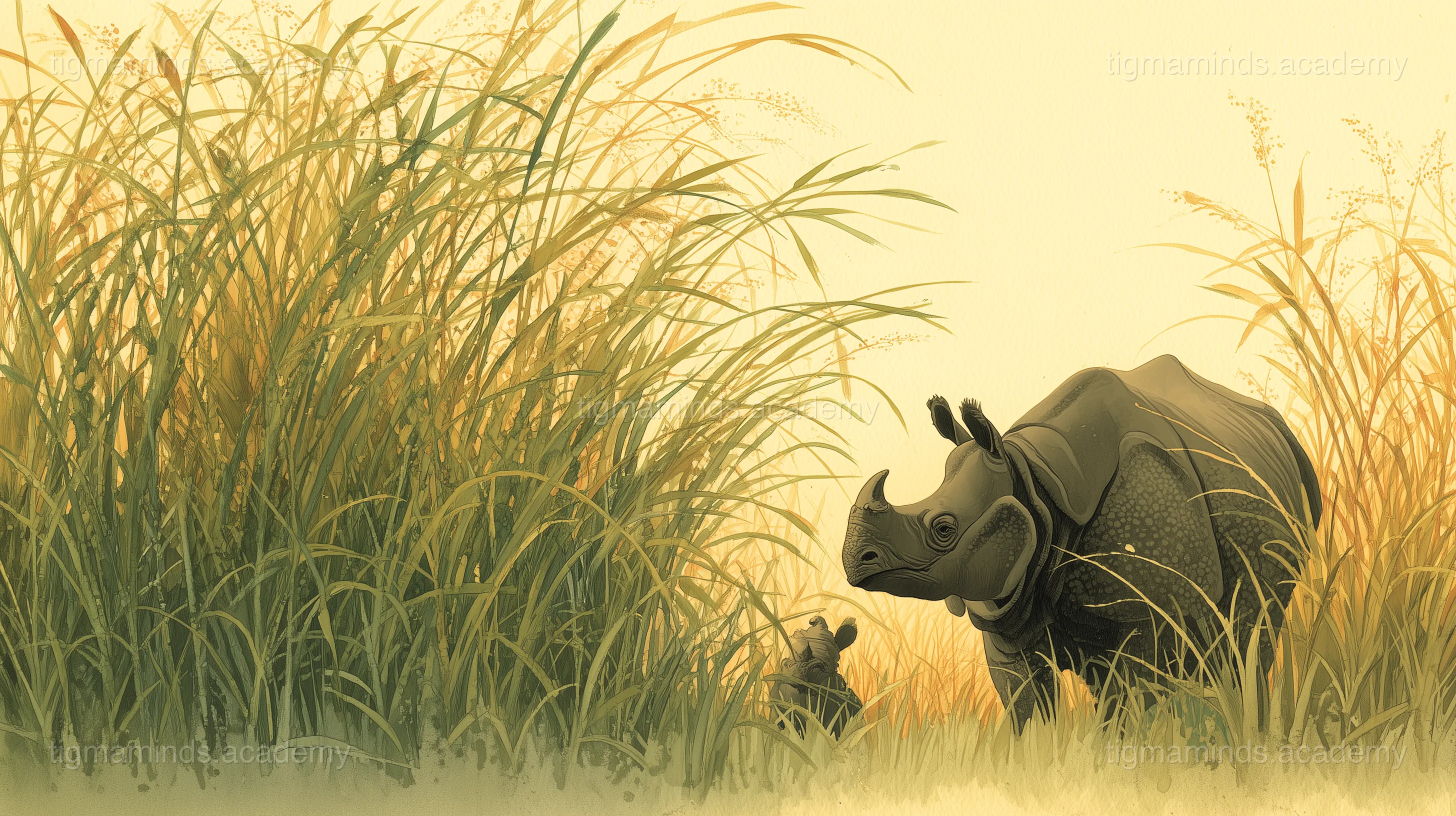
And Gorh? Gorh disappeared. He walked into the grass and vanished — a one-thousand-kilo animal, invisible, hidden by the very grass he had helped to grow. Only his ears twitched above the leaf tips, and only if you knew where to look.

The Living Partnership

Today, Kaziranga National Park is covered in elephant grass so tall that even elephants can vanish inside it. And hidden in that grass are more than two thousand one-horned rhinoceroses — the largest population in the world.

The partnership that Gorh and Kaahi started has never ended. The rhinos still churn the soil with their hooves. They still eat the grass and spread its seeds in their dung. The grass still grows tall enough to hide them from hunters and from the harsh sun. Neither could thrive without the other.

Rangers at Kaziranga call it an ecosystem. Scientists call it a symbiotic relationship. But the kingfisher — whose descendants still perch on the same bushes — calls it something simpler: "Two friends who figured out that the best way to get what you need is to give someone else what they need."

And if you visit Kaziranga and stand at the edge of the elephant grass, listening to the wind rustle through the tall stems, you might hear a low rumble deep inside the green wall. That's Gorh's great-great-great-grandchildren, hidden and happy, exactly where they want to be.

The end.

Try It Yourself

Choose your level. Everyone starts with the story — the code gets deeper as you go.

Story Progress

0%

Ready to Start Coding?

Here is a taste of what Level 1 looks like for this lesson:

Level 1: Explorer — Python
import matplotlib.pyplot as plt

# Kaziranga NDVI recovery after controlled burn
days = list(range(0, 60))
ndvi = [0.05 + 0.75 * (1 - 2.718 ** (-d / 15)) for d in days]

plt.figure(figsize=(10, 5))
plt.plot(days, ndvi, linewidth=2, color="green")
plt.axhline(y=0.6, color="gray", linestyle="--", label="Healthy grass threshold")
plt.fill_between(days, ndvi, alpha=0.2, color="green")
plt.xlabel("Days after controlled burn")
plt.ylabel("NDVI (greenness index)")
plt.title("Grassland Recovery in Kaziranga")
plt.legend()
plt.show()  # How many days until the grass recovers?

This is just the first of 6 coding exercises in Level 1. By Level 4, you will build: Analyze Vegetation Change in Kaziranga Using Satellite Data.

Free

Level 0: Listener

Stories, science concepts, diagrams, quizzes. No coding.

You are here

Enrolled

Levels 1-4

Python, NumPy, Matplotlib, real projects, mentorship.

Sign Up Free

Stay Updated

Join Waitlist

Get notified when enrollment opens for your area.

Notify Me

Level 0 is always free. Coding levels (1-4) are part of our 12-Month Curriculum.