
Sustainable honey — the science of bees and pollination.
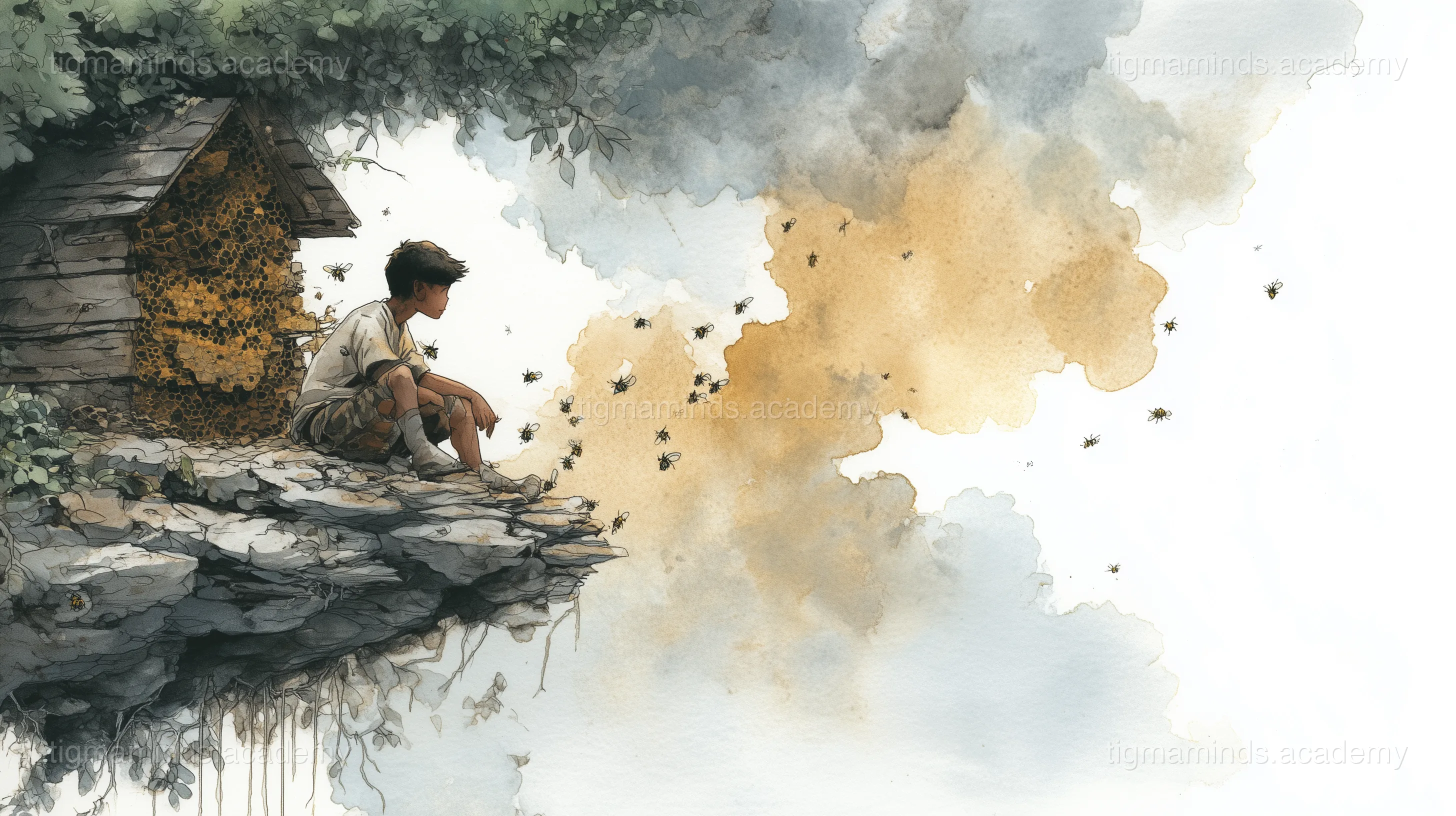
The Boy Who Wanted Honey
In a village perched on the misty hills of Meghalaya, where rain fell more days than it didn't and the forests were so green they seemed to glow, there lived a boy named Bah Rit. He was twelve years old, quick on his feet, and impatient about almost everything.
"Why does rice take so long to cook?" he would ask. "Why does the rain take so long to stop? Why does morning take so long to come?"
His grandmother, Kong Shailynti, would shake her head and say, "The world moves at its own speed, Rit. You cannot hurry the rain or rush the rice."
But Rit didn't listen. He was a boy in a hurry.
The Wild Bees of the Cliff
One morning, Rit's uncle Bah Kynmaw announced he was going honey hunting on the great limestone cliff above the village. The rock bees of the Khasi Hills built their hives on sheer cliff faces — enormous golden combs hanging like curtains from the rock, guarded by thousands of fierce bees.
"Can I come?" asked Rit.
"You can come," said his uncle. "But you must promise one thing: when I tell you to be still, you must be still. Not mostly still. Not almost still. Completely still."
Rit promised, though standing still was the thing he was worst at in the entire world.
They climbed for two hours through dripping forest, past living root bridges and waterfalls that appeared from nowhere. The air smelled of moss and wild orchids. At last they reached the cliff — a wall of pale grey stone rising straight up, and there, halfway up, hung three enormous hives, each one bigger than a buffalo.
The First Attempt
Bah Kynmaw lit a bundle of green leaves and damp grass. Thick white smoke curled upward toward the hives. "The smoke calms the bees," he explained. "We wait until they are peaceful. Then we climb."
They waited. And waited. Rit fidgeted. He shifted from foot to foot. He swatted at gnats. He picked up pebbles and tossed them.
"How long do we have to wait?" he whispered.
"Until the bees say it's time," said his uncle.
Rit couldn't bear it. While his uncle tended the smoke, Rit crept toward the cliff and began to climb. He was fast and agile, and within minutes he was halfway up, reaching toward the nearest hive. Golden honey dripped from its edge. He could smell it — warm and sweet and wild.
He reached out his hand.
The bees hit him like a storm. Hundreds of them, buzzing with fury, stinging his arms, his neck, his face. Rit screamed and lost his grip, sliding down the cliff in a shower of pebbles. He landed in a bush at the bottom, covered in welts, crying with pain and shame.
The Uncle's Way
Bah Kynmaw didn't scold him. He simply treated the stings with crushed wild basil leaves and said, "Now watch."
The uncle sat perfectly still for another hour, feeding the smoke, humming a low song that the people of Assam and the Khasi Hills had hummed to bees for generations. Slowly, the buzzing changed. The angry roar softened to a gentle murmur. The bees settled back onto their comb.
Then Bah Kynmaw climbed. He moved like water flowing uphill — slow, smooth, never jerky. When a bee landed on his hand, he didn't flinch. When a cluster of bees covered his arm, he kept climbing. He reached the hive, sliced away a section of golden comb with a bamboo knife, placed it in his basket, and climbed back down.
Not a single sting.
"How?" Rit asked, astonished.
"The bees can feel your mood," said his uncle. "If you come with impatience and greed, they feel a threat. If you come with patience and respect, they feel a friend. Rush the hive and you get stung. Wait calmly and you get honey."
The Lesson That Stuck
Rit carried those words home along with the basket of honeycomb. That evening, as his grandmother heated the comb to strain the honey into clay jars, Rit sat beside her — and for the first time in his life, he didn't ask how long it would take.
He watched the honey drip, golden and slow, each drop catching the firelight. It was the most beautiful thing he had ever seen, and it moved at exactly the speed it needed to.
In the years that followed, Rit became one of the finest honey hunters in the Khasi Hills. He was known not for his speed or his daring, but for his patience. He could sit beside a cliff for half a day without moving, humming the old bee song, waiting for the moment when the bees said yes.
And whenever a young child in the village complained that something was taking too long, Rit would smile and say, "Let me tell you about the bees."
The end.
Choose your level. Everyone starts with the story — the code gets deeper as you go.
Here is a taste of what Level 1 looks like for this lesson:
# Simulating a bee's waggle dance
# Encode direction and distance in movement
import math
# Flower is 800m away, 45° east of the sun
sun_direction = 0 # degrees (straight ahead)
flower_direction = 45 # degrees east of sun
flower_distance = 800 # metres
# The waggle angle encodes direction
waggle_angle = flower_direction - sun_direction
# The waggle duration encodes distance
waggle_seconds = flower_distance / 1000 # ~1 sec per km
print(f"Waggle angle: {waggle_angle}° from vertical")
print(f"Waggle duration: {waggle_seconds:.1f} seconds")
print(f"Message: fly {waggle_angle}° from the sun,")
print(f" for about {flower_distance}m")
# Try changing flower_direction to 90 or 180!This is just the first of 6 coding exercises in Level 1. By Level 4, you will build: Simulate a Bee Colony Foraging Network.
By Level 4, enrolled students build: Simulate a Bee Colony Foraging Network
Free
Level 0: Listener
Stories, science concepts, diagrams, quizzes. No coding.
You are here
Level 0 is always free. Coding levels (1-4) are part of our 12-Month Curriculum.
Sustainable honey — the science of bees and pollination.
The big idea: "The Honey Hunter's Lesson" teaches us about Entomology & Bee Biology — and you don't need to write a single line of code to understand it.
Imagine a city with 50,000 residents. Everyone has a job. There are nurses, builders, guards, cleaners, and food collectors. The city runs perfectly — no traffic jams, no shortages, no chaos. Now here is the twist: there is no mayor, no manager, no boss telling anyone what to do. Every resident just knows their job and does it. Welcome to a beehive.
A honeybee colony has three types of bee. The queen — there is only one — lays eggs. Up to 2,000 a day. That is her entire job. She does not give orders, despite her royal name. The drones (males) exist only to mate — they do not work, do not forage, do not even feed themselves. And then there are the workers — all female, making up 95% of the colony — who do everything else.
Here is the part that baffled scientists for years: a worker bee changes jobs as she ages. In her first 3 days of adult life, she cleans cells. From days 3 to 10, she feeds baby bees. From 10 to 20, she builds wax comb and guards the entrance. After day 20, she becomes a forager — flying out to collect nectar and pollen. No one assigns these roles. Each bee's body chemistry changes with age, and the new chemistry drives her toward the next job automatically.
Check yourself: If the queen is not the boss, why is she called 'queen'? (Answer: the name is misleading. Her role is egg-laying, not ruling. The colony's decisions — where to forage, when to swarm, how warm to keep the hive — are made collectively by thousands of workers, not by one leader.)
Key idea: A bee colony runs without a boss. The queen lays eggs, drones mate, and workers do everything else — changing jobs automatically as they age, driven by body chemistry rather than orders.
A forager bee has found a patch of mustard flowers 800 metres north of the hive. The flowers are loaded with nectar. She flies back to tell the others. But bees cannot talk. They cannot draw maps. They cannot point. So how does she tell 50,000 sisters exactly where the food is?
She dances. On the vertical surface of the honeycomb, in the dark hive, the forager performs a figure-eight dance called the waggle dance. The crucial part is the straight-line run in the middle, where she waggles her body side to side. Two pieces of information are encoded in this waggle:
Try this: Stand up and face a window (pretend the window is the sun). Now point toward your kitchen. Notice the angle between 'toward the window' and 'toward the kitchen.' A bee would encode that exact angle in her dance. If your kitchen is far away, she would waggle longer. If it is close, a quick waggle.
This dance language was decoded by scientist Karl von Frisch, who spent 20 years watching bees before he cracked the code. He won the Nobel Prize for it in 1973. Think about that — a bee has a brain smaller than a sesame seed, yet she can encode direction, distance, and quality of a food source in a dance, in the dark, on a vertical surface.
Key idea: The waggle dance encodes direction (angle relative to the sun) and distance (duration of waggle) — a GPS system built from body movement, decoded by a Nobel Prize-winning scientist.
Access all 130+ lessons, quizzes, interactive tools, and offline activities
Why do flowers exist? Not for us to admire — flowers evolved for a single purpose: to **attract pollinators**. A flower is an advertisement. Its brigh...
Nectar is mostly water — about 70% water with some sugar dissolved in it. If you left a cup of sugar water on the table for a week, it would grow moul...