The Colors of Holi in the Tea Gardens
Chemistry of Colors & Dyes

The Colors of Holi in the Tea Gardens

Natural vs synthetic — the chemistry of dyes.
Chemistry of Colors & Dyes12-Month Curriculum 12h

The Story

The Morning Before

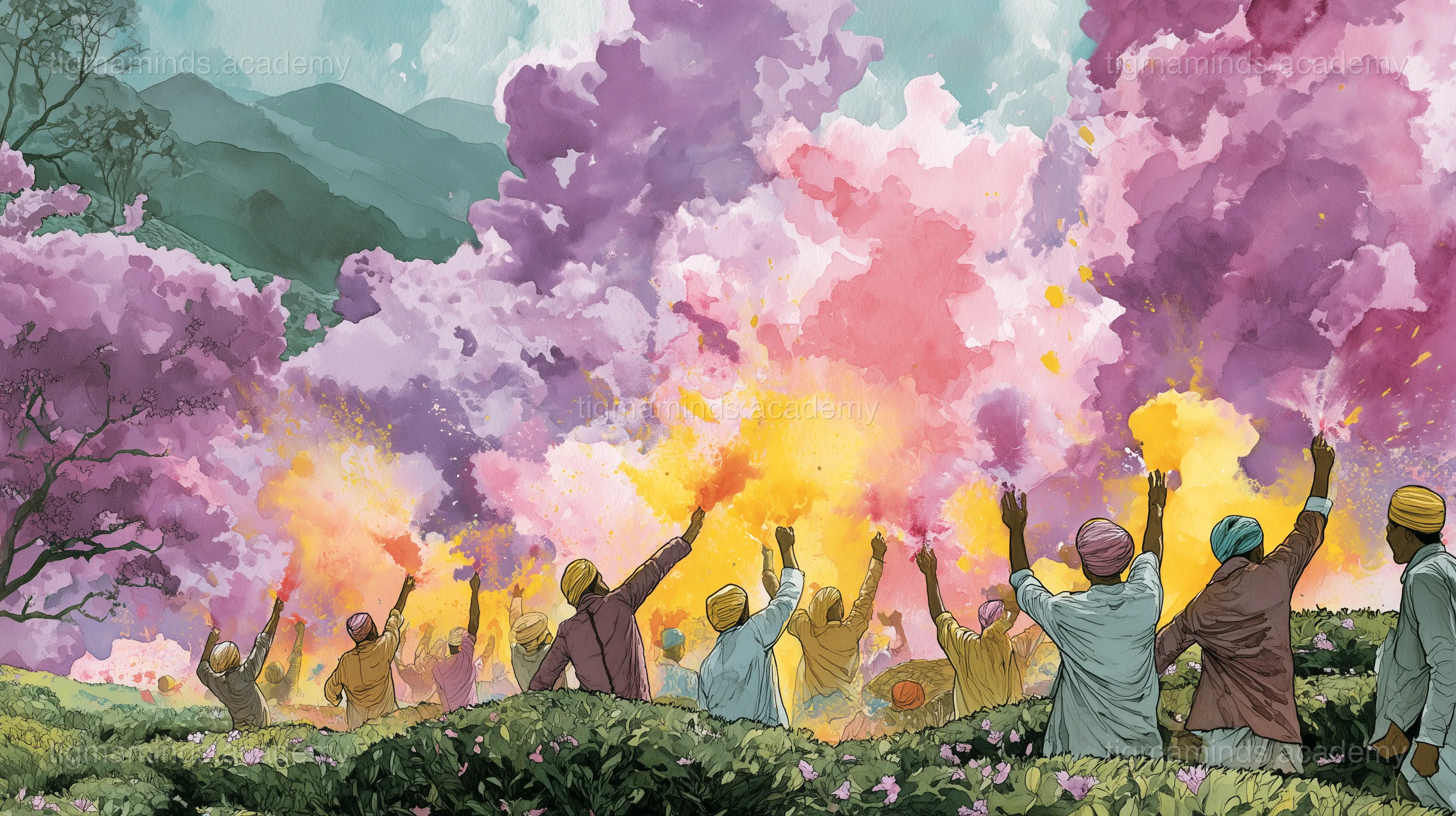
The morning before Holi in the tea gardens of Assam is quieter than you'd expect. The tea bushes stand in neat rows, dark green and glistening with dew, stretching across the flat land toward the blue hills. Workers move between the rows with their baskets, plucking the last leaves before the holiday begins.

In Line Number 7 — that's what the workers' quarters are called, numbered lines of small brick houses — a girl named Sunita was preparing. She had three steel bowls in front of her: one filled with red powder made from dried hibiscus flowers, one with yellow from turmeric, and one with green from crushed neem leaves.

"Natural colours only," said her grandmother, who was mixing the turmeric. "None of that chemical powder from the market. Our colours come from the earth, and they go back to the earth."

Sunita's family had been tea garden workers for four generations. They had come originally from Jharkhand, brought to Assam by the British a hundred years ago to work the gardens. Other families in the line had come from Bihar, Odisha, Bengal, and Chhattisgarh. They spoke different languages, ate different foods, worshipped different gods.

But on Holi, none of that mattered.

The First Colour

At exactly ten o'clock, the dhol drum started. Old Mangal Bhaiya, who had been the garden's drummer for thirty years, set up outside the community hall and began to play. The rhythm was fast and wild, and within minutes, children poured out of every line — Line 3, Line 5, Line 7, Line 12 — running toward the sound.

Sunita ran with them, her three bowls balanced on a tray. She found her best friend Jonali — an Assamese girl from the manager's quarters — and smeared a streak of yellow across her cheek.

"Happy Holi!" Sunita shouted.

Jonali laughed and retaliated with a handful of pink gulal that turned Sunita's black hair into a sunset. Within seconds, the air was thick with colour — clouds of red, yellow, green, and pink drifting across the garden like a rainbow that had exploded.

The Garden Becomes a Rainbow

What made Holi in the tea gardens special wasn't just the colours — it was who was throwing them. The Adivasi families from Jharkhand danced alongside the Bengali families from Line 3. The Nepali watchman joined the Bihari cook in a water fight near the tube well. The Assamese garden manager, still in his white shirt, got doused by a bucket of pink water thrown by his own daughter.

Languages mixed in the air like the colours: "Holi hai!" in Hindi, "Rangote!" in Assamese, "Phagua!" in Bhojpuri. The women sang songs that had travelled a thousand kilometres from their ancestral villages. The children understood none of the words and all of the joy.

By noon, nobody could tell who was from which community. Everyone was the same colour: a wild, glorious, impossible rainbow of every shade mixed together. The tea garden, usually so orderly with its neat rows and numbered lines, had become the most colourful place on Earth.

The Feast

In the afternoon, the colours dried to a dusty glow on everyone's skin, and the feast began. Every family brought their speciality. Sunita's grandmother brought pua — sweet fried bread soaked in sugar syrup. Jonali's mother brought pithas — rice cakes filled with coconut and jaggery. The Bengali families brought sandesh. The Nepali families brought sel roti.

They spread everything on a long cloth under the rain tree, and two hundred people sat down together — the whole garden, from the manager to the newest worker — and ate from each other's plates.

"This is my favourite day," Sunita told Jonali, turmeric still streaked across her nose.

"Mine too," said Jonali. "Because today, Line Number doesn't matter."

What the Colours Mean

That evening, as the sun set behind the tea bushes and turned the sky the colour of the gulal that covered everyone's clothes, Sunita sat on her doorstep and thought about what Holi meant in the tea gardens.

It wasn't just about colours. It was about the one day when all the invisible lines disappeared — the lines between communities, between languages, between the manager's bungalow and the workers' quarters. On Holi, a splash of colour was an invitation that said: Today, we are the same. Today, we are family.

Sunita's grandmother came and sat beside her. "You know," she said, "when my grandmother first came to Assam, she cried every Holi because she missed home. But then she started celebrating with the people here — people from everywhere — and she said, 'This Holi is even better. Because back home, we celebrated with people who were just like us. Here, we celebrate with people who are different. And that makes the colours brighter.'"

Sunita smiled. The colours on her skin were fading in the evening light, but the feeling — warm, bright, connected — would last until next Holi. And the one after that. And the one after that.

The end.

Try It Yourself

Choose your level. Everyone starts with the story — the code gets deeper as you go.

Story Progress

0%

Ready to Start Coding?

Here is a taste of what Level 1 looks like for this lesson:

Level 1: Explorer — Python
import numpy as np
import matplotlib.pyplot as plt

# Red cabbage pH indicator: color vs pH
ph_values = np.array([2, 4, 6, 7, 8, 10, 12, 14])
colors = ["#ef4444", "#f472b6", "#a855f7", "#8b5cf6",
          "#3b82f6", "#06b6d4", "#22c55e", "#eab308"]

fig, ax = plt.subplots(figsize=(10, 3))
for i, (ph, color) in enumerate(zip(ph_values, colors)):
    ax.bar(ph, 1, width=1.5, color=color, edgecolor="white")
    ax.text(ph, 0.5, f"pH {ph}", ha="center", fontsize=9)

ax.set_xlim(0.5, 15.5)
ax.set_title("Red Cabbage Juice: 8 Colors from 1 Plant!")
ax.set_xlabel("pH")
ax.set_yticks([])
plt.tight_layout()
plt.show()  # Which pH range is neutral?

This is just the first of 6 coding exercises in Level 1. By Level 4, you will build: Extract and Test Natural Dyes.

Free

Level 0: Listener

Stories, science concepts, diagrams, quizzes. No coding.

You are here

Enrolled

Levels 1-4

Python, NumPy, Matplotlib, real projects, mentorship.

Sign Up Free

Stay Updated

Join Waitlist

Get notified when enrollment opens for your area.

Notify Me

Level 0 is always free. Coding levels (1-4) are part of our 12-Month Curriculum.