Why Hanuman Lifted a Mountain
Geology & Botany

Why Hanuman Lifted a Mountain

A divine quest for a healing herb — and the geology and botany hidden inside the Himalayas.
Geology & Botany12-Month Curriculum 12h

The Story

The Battle of Lanka

The war had been raging for days. Rama, the exiled prince of Ayodhya, and his army of vanaras (forest beings) had crossed the ocean on a bridge of stones to reach Lanka, the golden city of the demon king Ravana. Ravana had abducted Rama's wife Sita, and Rama had come to bring her home.

The battles were fierce. Ravana's warriors wielded weapons of dark power — arrows tipped with venom, spears that burned like fire, and war elephants armoured in bronze. Rama's army fought with courage, stones, and trees uprooted from the earth.

But Ravana had a weapon no one expected.

The Fall of Lakshmana

On the bloodiest day of the war, Ravana's son Indrajit — a warrior so skilled he had once defeated Indra, king of the gods — rose into the sky and became invisible. From the clouds, he unleashed the Shakti, a divine weapon given to him by Brahma himself.

The Shakti struck Lakshmana, Rama's younger brother and closest companion. Lakshmana collapsed on the battlefield. His body went cold. His breathing faded to nothing. The vanaras gathered around him in horror.

Rama fell to his knees. "Without Lakshmana," he whispered, "I cannot go on."

The physician Sushena examined Lakshmana and shook his head. "There is one remedy. A herb called Sanjeevani — the one that restores life. It grows on Dronagiri, a peak in the Himalayas, far to the north. But it must be brought before sunrise, or Lakshmana will die."

The Himalayas were thousands of yojanas away. No army could march there in time. No chariot could fly that distance before dawn.

But there was Hanuman.

The Flight to the Himalayas

Hanuman was no ordinary vanara. He was the son of Vayu, the wind god, and he carried within him a strength that most of the time he himself forgot. When the need was greatest, that strength awakened.

He grew to an immense size. His body expanded until his shadow covered the battlefield. He crouched, and then he leaped — not running, not flying, but launching himself northward like a living comet, tearing through clouds, racing the rotation of the Earth itself.

Below him, the forests of the Deccan became a green blur. Rivers shrank to silver threads. The plains of northern India spread like a brown quilt. And ahead, rising from the edge of the world like a wall of white teeth, stood the Himalayas.

Hanuman had never seen anything like them. Peak after peak, climbing into altitudes where the air itself thinned to almost nothing. Snow and ice covered everything above a certain line. Below that line, the slopes were dense with forests — dark pines, ancient oaks, meadows of wildflowers that no human had ever catalogued.

He landed on Dronagiri.

The Mountain of Herbs

The peak was covered in plants. Thousands of species — mosses clinging to rocks, ferns in sheltered crevices, shrubs with thick waxy leaves, tiny flowers of every colour pushing through thin soil. The Sanjeevani was here, somewhere, glowing faintly in the pre-dawn darkness.

But Hanuman did not know botany.

He searched. He ran his hands over leaves, smelled roots, examined flowers. Every plant looked different, but none announced itself as the Sanjeevani. The sky was beginning to lighten in the east. Dawn was coming. Lakshmana was dying.

Hanuman made a decision that only Hanuman could make.

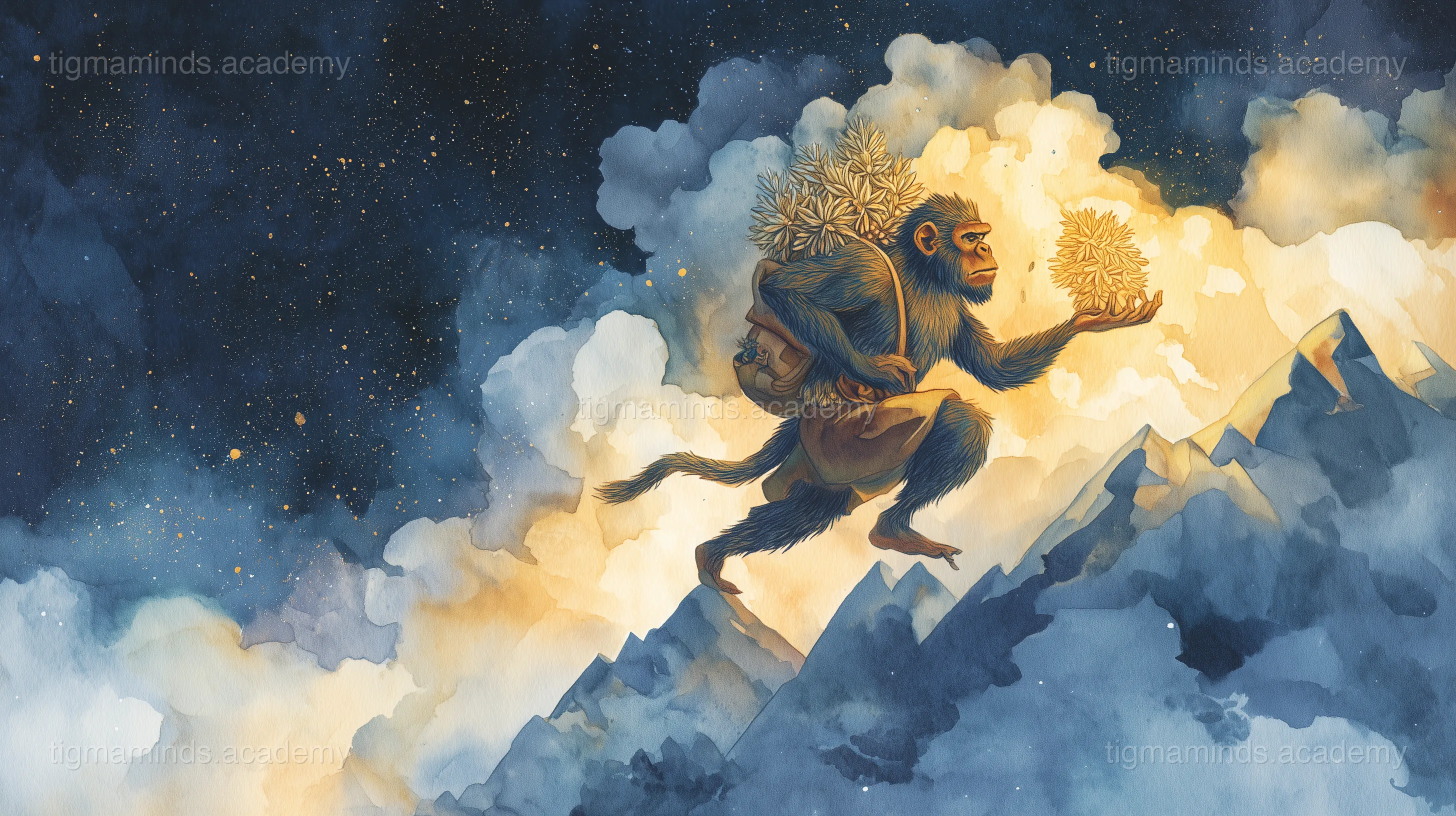
He crouched, dug his fingers into the rock at the base of the mountain, and lifted the entire peak. Rock cracked. Roots tore. The earth groaned as Dronagiri separated from the Himalayan range. Hanuman raised it above his head — a mountain balanced on one palm — and leaped back into the sky.

He flew south, carrying a mountain, racing the sunrise.

The Healing

He arrived in Lanka as the first rays touched the horizon. Sushena found the Sanjeevani among the thousands of plants on the uprooted peak — its leaves shimmering with a faint golden light. He crushed the herb, mixed it with water, and placed it on Lakshmana's chest.

Lakshmana's eyes opened. Colour returned to his face. He sat up, reached for his bow, and said, "What happened? Why is everyone staring at me?"

The army erupted in joy. Rama embraced his brother. And Hanuman, quietly, flew the mountain back to the Himalayas and set it down where it belonged.

What the Story Teaches

The story of Hanuman and the Sanjeevani is about devotion, urgency, and the limits of knowledge. Hanuman had the strength to fly to the Himalayas and back, but he lacked the botanical knowledge to identify one herb among thousands. His solution — lifting the entire mountain — is magnificent but also a confession: when you do not know what you are looking for, you must take everything.

Science is the opposite approach. A geologist knows WHY the Himalayas exist (tectonic plates). A botanist knows WHERE specific plants grow (altitude zones). A pharmacologist knows HOW plant compounds heal (molecular targets). With knowledge, you do not need to lift a mountain. You walk to the right altitude, identify the right species, extract the right compound, and save a life.

Hanuman's strength was divine. But the real miracle is knowledge — and that is available to everyone.

The end.

Try It Yourself

Choose your level. Everyone starts with the story — the code gets deeper as you go.

Story Progress

0%

Ready to Start Coding?

Here is a taste of what Level 1 looks like for this lesson:

Level 1: Explorer — Python
# Himalayan Plant Altitude Filter
plants = [
    {"name": "Tulsi", "alt_range": (0, 1800), "use": "anti-inflammatory"},
    {"name": "Himalayan Yew", "alt_range": (2400, 3800), "use": "anti-cancer"},
    {"name": "Aconite", "alt_range": (3000, 5000), "use": "pain (toxic!)"},
    {"name": "Alpine Poppy", "alt_range": (4000, 5500), "use": "unknown"},
]

search_altitude = 4200  # metres
print(f"Searching at {search_altitude} m...\n")
for p in plants:
    lo, hi = p["alt_range"]
    if lo <= search_altitude <= hi:
        print(f"  FOUND: {p['name']} ({lo}-{hi} m)")
        print(f"  Use: {p['use']}")
# What altitude range has the most medicinal species?

This is just the first of 6 coding exercises in Level 1. By Level 4, you will build: Build a Himalayan Plant Identification System.

By Level 4, enrolled students build: Build a Himalayan Plant Identification System

Free

Level 0: Listener

Stories, science concepts, diagrams, quizzes. No coding.

You are here

Enrolled

Levels 1-4

Python, NumPy, Matplotlib, real projects, mentorship.

Sign Up Free

Stay Updated

Join Waitlist

Get notified when enrollment opens for your area.

Notify Me

Level 0 is always free. Coding levels (1-4) are part of our 12-Month Curriculum.